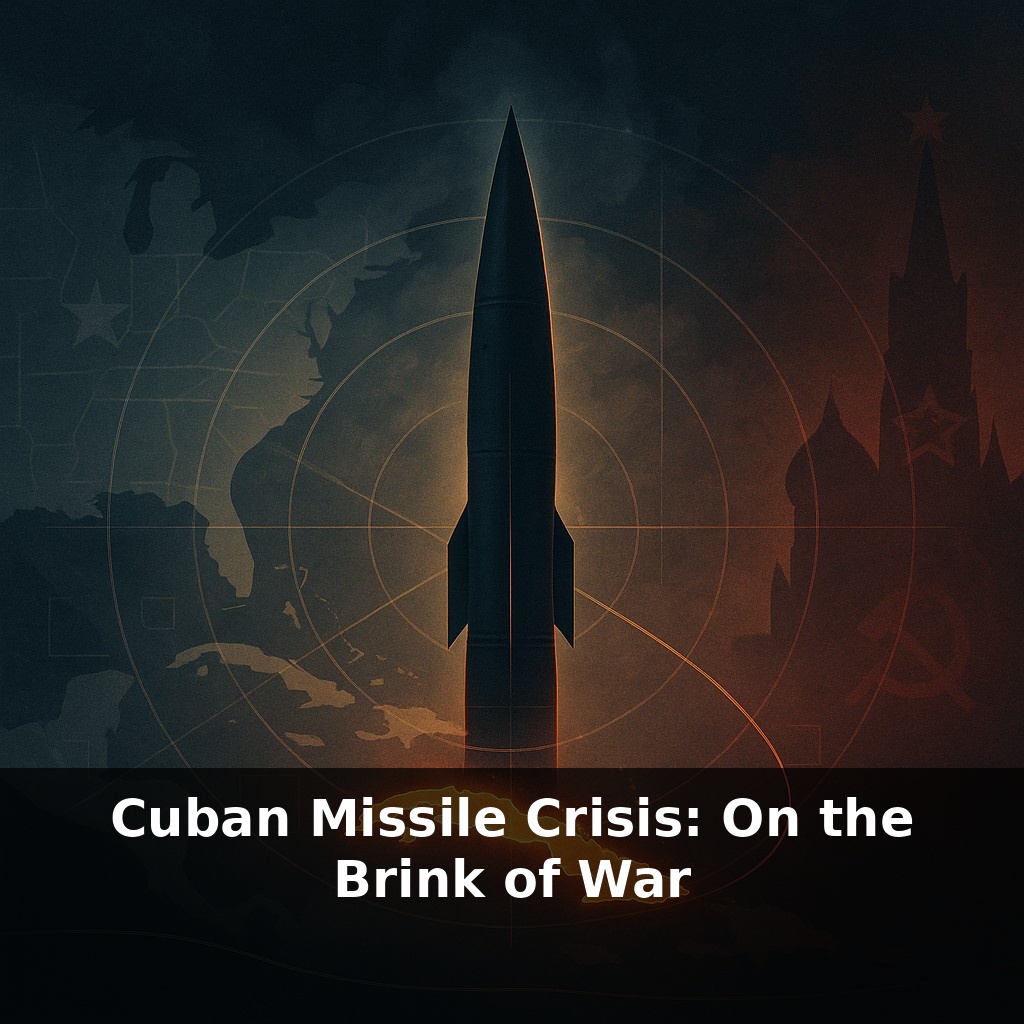
Cuban Missile Crisis: On the Brink of War
📝 Transcript
Sixteen nuclear missiles. That’s all it took to push two superpowers to the edge of ending the world. In this episode, we drop into a tense October morning in 1962, where one misread message, or one nervous officer, could have turned a quiet sky into blinding fire.
At first, the crisis didn’t even have a name. For Kennedy’s inner circle, it was simply “the problem of Cuba,” a knot of grainy photos, half-finished launch sites, and urgent voices on secure phone lines. The real story wasn’t just the weapons; it was how fast the rules of the Cold War were being rewritten. A small Caribbean island, long treated as a sideshow, had abruptly become the main stage on which global survival was being negotiated.
Inside the White House, lawyers, generals, and diplomats argued not only about what the U.S. could do, but what it *should* do—legally, morally, and politically. Like engineers stress-testing a bridge they were already driving across, they probed every option: airstrikes, invasion, diplomacy, or something in between. Meanwhile, Khrushchev’s own advisors were running their parallel calculations, staring at the same clock, hearing it tick just as loudly.
Kennedy’s advisors knew the world was watching, but not what, exactly, it would see. Publicly, life in American suburbs went on—kids at baseball practice, new cars in driveways—while a hidden clock in Washington counted down briefing by briefing. The Soviets, too, balanced outward calm with frantic internal debates, like a company projecting confidence while its servers quietly overheat in the back room. Every move now had two audiences: the other side’s leadership, parsing signals for intent, and millions of citizens, who might panic if they grasped how narrow the margin for error had become.
Kennedy’s team quickly realized that doing nothing was not an option—but striking first could unleash what they were trying to prevent. The compromise was the “quarantine,” a naval ring around Cuba to intercept Soviet ships carrying offensive weapons. It wasn’t called a blockade because that word implied an act of war under international law. Words, suddenly, were as carefully aimed as warheads.
The Joint Chiefs leaned hard toward airstrikes. General Curtis LeMay argued that anything less looked weak, telling Kennedy that future generations would blame him for missing the chance to remove a threat. Others worried that a surprise attack would make the U.S. look like the aggressor, undercutting its claim to moral leadership. The quarantine offered a way to apply pressure in daylight, step by step, where the world could see who escalated first.
While American destroyers took up positions at sea, another contest ran in the shadows. Robert Kennedy met the Soviet ambassador, Anatoly Dobrynin, in quiet rooms away from cameras. Messages shuttled through intermediaries, with each sentence weighed for what it said—and what it implied. Khrushchev sent one emotional, conciliatory letter, then a tougher, more formal one. Kennedy deliberately answered only the first, treating it as the “real” offer, and letting the harsher terms hang in the air.
All the while, the military machine kept climbing the ladder. Bombers went on continuous alert, and missile crews dug in at their consoles. Soviet commanders in Cuba received tactical nuclear weapons, with rules of use that Washington barely suspected. Local misjudgment—an overzealous captain, a spooked radar operator—could have ignited consequences far beyond their rank.
As the quarantine line tightened, Soviet ships slowed, halted, or turned back. But the most dangerous pieces weren’t on the surface at all: Soviet submarines moved under the waves, cut off from reliable communication, harassed by U.S. Navy ships dropping practice depth charges to signal “surface.” In those cramped hulls, overheated and exhausted crews had to interpret thuds and explosions without knowing if war had already started above.
Here, crisis management resembled a high-stakes software patch being pushed to a live system: both sides tried to update their moves in real time without crashing the whole structure they depended on. Choices had to be reversible, signals had to stay just ambiguous enough to leave room for retreat, and each leader had to guess how much risk the other was truly prepared to run.
Khrushchev’s gamble in Cuba worked a bit like an overconfident software rollout: he pushed a major “update” to the strategic balance, assuming the other side would spot it late and have to live with the new reality. But once U‑2 photos exposed the sites, Kennedy treated the discovery as a rare debugging window—proof of what Moscow would do if left unchecked, and a chance to rewrite how crises were handled. Out of that terror came the Moscow–Washington “hotline,” a direct link meant to cut through delay and confusion. Later arms‑control talks, from the Limited Test Ban Treaty to SALT, grew from the shared memory of how close the system had come to crashing. Even smaller states took note: Cuba, non‑aligned countries, and future nuclear aspirants saw that proximity to a standoff could bring leverage—but also make them ground zero. The crisis didn’t end the Cold War; it hardened some instincts while forcing new rules about how far brinkmanship could safely go.
1962 left a scar on strategy: leaders learned that buying time can be as powerful as firepower. Future crises may move faster—hypersonic glide vehicles, automated early‑warning, cyber blinding of sensors—but the core task remains pacing decisions so they’re human, not reflex. Your challenge this week: each time a headline screams “red line” or “show of force,” trace the quiet offers, pauses, and face‑saving exits that might be shaping what you are not shown.
In the years after those 13 days, strategists treated 1962 like engineers revisiting blueprints after an earthquake, adding extra supports where the structure shook most. Crisis hotlines, war‑game simulations, even today’s nuclear doctrines still carry its fingerprints, reminding us that restraint—like a hidden safety net—often matters more than raw power.
Try this experiment: For the next 48 hours, run your own “ExComm” crisis simulation for a real, low-stakes conflict in your life (like a work disagreement or family tension). First, privately draft your gut-reaction “airstrike option” (the fast, forceful response you’re tempted to send in an email or text), then deliberately create a “quarantine option” (a slower, limited, reversible response—like a question, a delay, or a boundary). Before acting, imagine you’re Khrushchev reading your message on the other side: how might they misinterpret each option, and which one is more likely to lower the temperature instead of escalate? Then send only the “quarantine option” and watch over the next two days how the other person actually responds versus what you feared.
From this course
Cold War Epochs: Turning Points and Crises
8 episodesUnlock all episodes
Full access to 8 episodes and everything on OwlUp.
Subscribe — $1.99/monthLess than a coffee ☕ · Cancel anytime