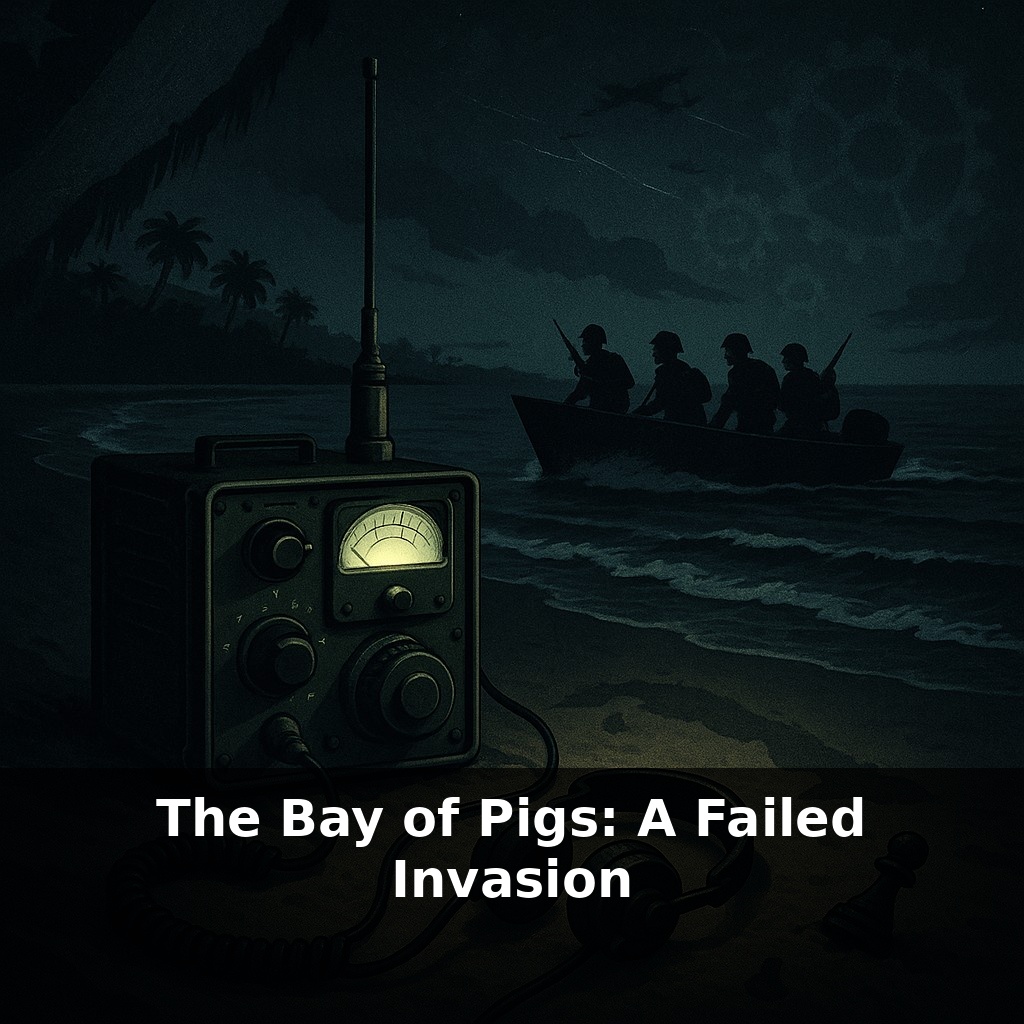
The United States spent tens of millions of dollars planning an invasion it then refused to fully support. On a dark Cuban beach, a small army of exiles landed, radios crackling, waiting for American air cover that… never really came. Why start something you won’t finish?
Kennedy inherited this covert plan from the Eisenhower administration and, at first, treated it like a political power tool he could dial up or down at will. In reality, by early 1961 the machine was already running: trainers in Guatemala, arms shipments, propaganda broadcasts, quiet promises to Cuban exiles that “this time” Washington would see it through. Inside the new administration, glamorous campaign advisers sat beside hardened CIA veterans, each group convinced it understood how far the U.S. could go without “really” going to war. Lines on briefing-room maps made the whole thing look clean and adjustable, like moving sliders on a control panel. But those lines mapped onto real beaches, real towns, and a Cuban leadership that had spent two years preparing for exactly this kind of foreign-backed strike.
The decision Kennedy now faced wasn’t just “yes or no” on an operation; it was how much risk he was willing to own in public. A new president obsessed with avoiding another “Pearl Harbor” headline was suddenly weighing flight paths, ship routes, and deniability clauses. Inside the White House, lawyers, diplomats, and generals tugged at the plan from different directions, like software engineers arguing over a release that’s already live in beta. Every tweak to reduce political exposure introduced new military fragility, and each compromise blurred who was actually in charge.
Kennedy’s advisers walked him through a menu of options, but the menu itself was dishonest. Briefers described a “spark” that would supposedly trigger mass defections in Castro’s ranks and uprisings in nearby towns. Intelligence reports soft-pedaled how deeply the revolution’s social programs and nationalism had sunk into Cuban society. In Washington slideshows, “Cuban forces” appeared as abstract numbers; on the island, they were real militias, rapidly mobilizing, many convinced they were defending sovereignty rather than a single leader.
Inside the CIA, planners had quietly shifted the goalposts. What began under Eisenhower as a smaller, more flexible guerrilla insertion had swelled into a conventional-style beach landing with supply ships, heavy equipment, and fixed landing zones. The more the plan grew, the less plausible “plausible deniability” became—but nobody wanted to be the one to admit that the operation now required either full-throated backing or cancellation. Instead, they sold Kennedy a third option that didn’t truly exist: a large invasion treated as if it were still a small, deniable raid.
The numbers alone told a harsher story. Roughly 1,400 men were expected to carve out and hold a foothold against roughly 20,000 defenders, many with armor and air assets. Pentagon professionals flagged the imbalance, but their concerns were filtered through layers of bureaucratic optimism. Those filters also distorted timing. The operation was scheduled during a period when Castro’s security forces were already on high alert, having cracked down on internal dissent and infiltrated exile networks. Surprise, the one big advantage the attackers might have had, was already compromised before the first boat left port.
Yet within the exile brigade, morale ran high. They had trained hard, believed they were the spearhead of a broader liberation, and understood that turning back was not an option. Washington, however, still treated the mission as adjustable. That mismatch—between men who knew they were betting their lives and policymakers who still thought in reversible steps—would define everything that happened once the first shots were fired on the Cuban shore.
Kennedy’s cabinet debates sometimes sounded less like war councils and more like clashing corporate boards. The State Department worried about Latin American opinion, the Pentagon fixated on logistics, the CIA guarded operational turf, and each piece of bureaucratic friction slowed reaction time once things began to unravel. Inside Cuba, by contrast, decision-making tightened. Castro personally toured defensive positions, appeared on radio and television in fatigues, and tied the fight to a broader anti-imperialist story that resonated beyond his own supporters. Radio Havana framed the attackers as hired proxies of a superpower, a message that played well in newly decolonized countries watching from afar. Soviet advisors, noting both the vulnerability and the propaganda value, pushed for deeper ties: more oil, more weapons, more intelligence cooperation. Washington’s failed gamble had done what years of quiet diplomacy had not—turned a wary revolutionary government into a committed client of Moscow.
Boards and war rooms studied the fiasco less as a moral tale than as a systems failure. Future planners began asking: Who challenges the rosy slide deck? Who tracks how fast a “limited move” can morph into crisis once cameras, alliances, and domestic politics lock in? Your challenge this week: any time you see a “small step” proposed—in office policy, campus rules, local politics—map out how, like code updates, it could cascade into something no one openly voted for.
In the end, the Bay of Pigs became a case study in how quickly a “manageable setback” can harden into history. Its echo shaped missile deployments, crisis hotlines, and the quiet rules of later interventions. Like a software patch that crashes the whole system, one misjudged covert move forced both superpowers to rewrite their operating manuals.
Try this experiment: Pick a decision you’re facing this week (at work, school, or in your community) and deliberately create a “Bay of Pigs prevention team” of 3–5 people whose job is only to poke holes in your plan. Before you meet, send them your idea and explicitly ask them to act like skeptical CIA analysts in 1961 who’ve just been told to challenge Kennedy’s invasion plan—no cheerleading allowed. In the meeting, you must only ask clarifying questions and are not allowed to defend your idea; just listen and take notes. Afterward, revise your original decision and compare the “before” and “after” versions to see exactly how much the structured dissent changed your plan.