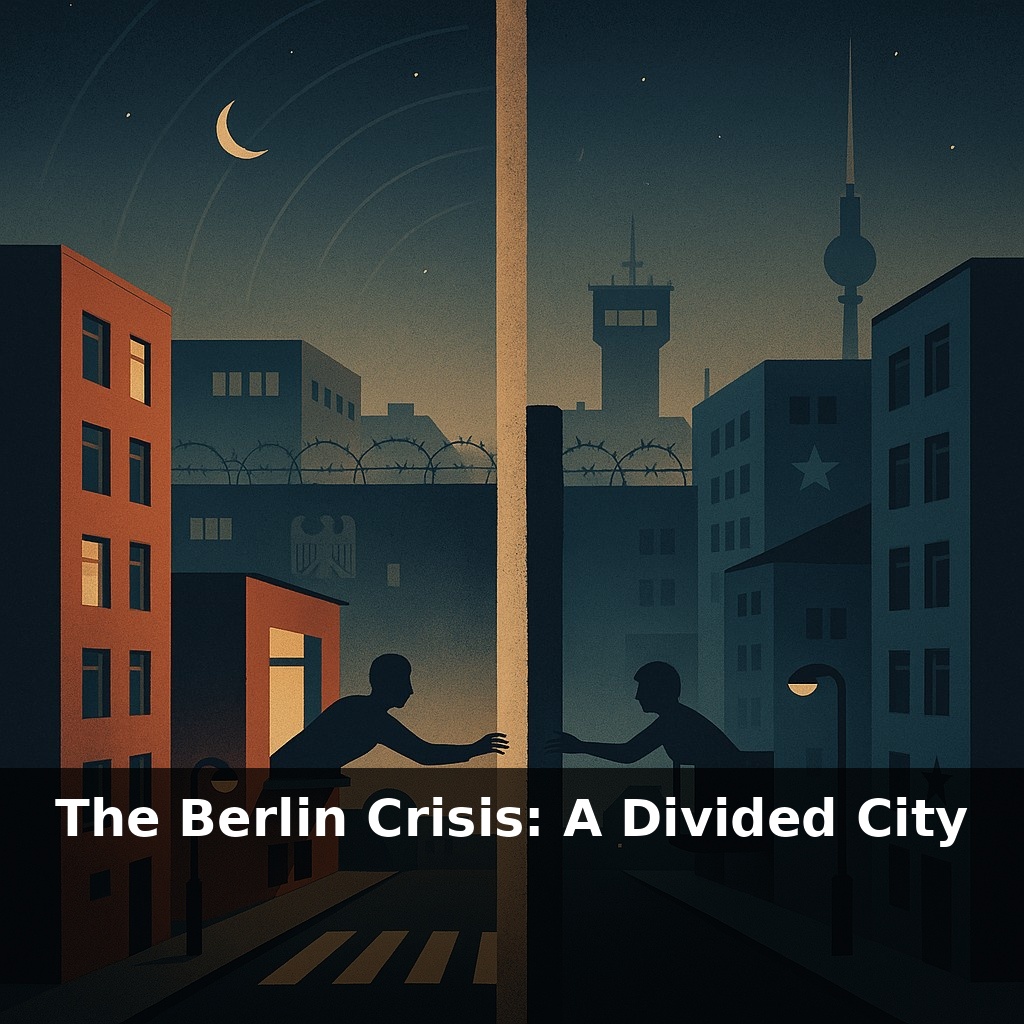
A city where neighbors could wave but not walk across the street. One night in 1961, families went to sleep in one country and woke up in another—without moving an inch. The border hadn’t shifted on a map. The city itself had been quietly, brutally rearranged.
By the late 1940s, Berlin had become less a city and more a pressure gauge for the entire Cold War. Four victorious powers—USA, UK, France, and the Soviet Union—were supposed to run it together, yet they pulled in opposite directions on almost everything: elections, currency, even food supplies. When the Western Allies introduced a new currency in their zones in 1948, Moscow answered by choking off road, rail, and canal access to West Berlin. Overnight, two million civilians at the Cold War’s front line depended on outside help to eat. The Western response was not tanks, but transport planes—thousands of flights tracing narrow air corridors, turning the sky above the city into a kind of three-dimensional supply chain that operated with the precision of a high-stakes assembly line. The message was clear: West Berlin would not be surrendered by neglect or by hunger.
The airlift did more than keep people alive; it hardened political lines. While cargo planes traced their routes overhead, leaders on the ground drew their own paths: West Berlin was tied tighter to a market-oriented, democratic camp, East Berlin to a socialist, Soviet-backed one. Everyday choices—what newspaper you read, which radio station you trusted, which shop shelves were full—became quiet votes for a system. The city turned into a live experiment in governance, like two operating systems running side by side on the same hardware, each trying to prove it could run a better version of daily life.
If the airlift drew the outline of division, the years that followed filled in the details. As West Berlin was woven more tightly into Western institutions, it became something East German leaders feared as much as any weapon: a daily, visible comparison. Streetlights, shop windows, and travel rights turned into data points in a contest about which system could claim the future.
By the mid‑1950s, that comparison was hurting the East. Skilled workers, doctors, and engineers realized that, unlike their compatriots elsewhere in Eastern Europe, they had a legal exit door: the city’s open sector border. You could board an S‑Bahn in East Berlin, step off in West Berlin, and from there fly to West Germany. No midnight river crossing, no forged papers—just a train ride. Between 1949 and 1961, roughly 2.7 million people left East Germany, most of them through Berlin. For a state planning its economy like a carefully balanced budget, this was a steady leak of its most valuable assets.
Moscow and East Berlin tried propaganda, new police powers, and tighter rules. None stopped the flow. The more the East clamped down—on churches, on dissent, on travel—the more Berlin’s open hinge stood out. It became a paradox at the heart of the Soviet bloc: a system that claimed superiority but had to rely on restriction to keep its citizens inside.
Crisis flared again in 1958. Soviet leader Nikita Khrushchev demanded Western troops leave the city and threatened to sign a separate peace treaty with East Germany, which would have given East German authorities control over access routes. For three tense years, negotiations stalled, ultimatums were issued, and each side probed the other’s resolve. Tanks rolled closer; planners war‑gamed scenarios where a clash on a single street could spiral into nuclear war.
The eventual “solution” chosen in August 1961 was brutally simple: freeze the problem in place. In one coordinated move, East German forces cut rail lines, rolled out barbed wire, and sealed the sector borders. Over time, that improvised barrier hardened into a 155‑kilometre system of walls, patrol roads, floodlights, and watchtowers, slicing through neighborhoods and memories alike. Where ideas and people had once flowed, concrete now enforced the division the superpowers had already accepted.
Think of Berlin after 1961 less as a static wall line and more as a constantly updated security “software patch.” Each escape attempt—through tunnels, in modified cars, even by hot‑air balloon—was like a hacker probing for vulnerabilities. West German engineers helped design ingenious “tools”: hidden compartments in vehicles, forged paperwork networks, even early surveillance of border guard routines. East German authorities responded with thicker barriers, trip‑wires, signal flares, and a growing database on citizens—files that could follow you from school to factory to retirement. The real struggle wasn’t only about territory; it was about controlling information: who knew what, who could go where, and who dared to talk about it. Western radio stations quietly amplified stories of successful escapes, turning individual acts into symbols. Eastern state media, by contrast, framed the barrier as an “antifascist” shield, trying to recode confinement as protection in the public mind.
Berlin hints that walls are less endpoints than temporary settings on a system. As controls tighten, workarounds adapt: fax machines, cassette tapes, and later satellite TV let ideas seep through like water finding hairline cracks in concrete. Today’s digital firewalls echo that logic. Your challenge this week: pick one modern divided space—online or offline—and trace a single “leak path” by which people bypass its limits. What does that reveal about where real power lies?
In the end, Berlin’s story is less about concrete than about timing. Systems that look permanent can, under the right pressure, fold like stage scenery between acts. The Wall fell not from one push, but from countless small misreads and improvisations—clerks, protesters, broadcasters. Like a jammed door suddenly swinging open, history moved faster than its guards.
Try this experiment: For one day, split your normal walking route into “East” and “West” zones, marked by a line you create (use chalk, tape, or a map on your phone) that you’re not allowed to cross except at 2–3 “checkpoints” you choose in advance, like specific intersections or doorways. In the “East” zone, restrict yourself to only the shops, cafés, and streets on that side, and in the “West” zone, do the same—no “cheating” by using places you usually rely on across the line. Notice how this artificial “wall” changes your choices: where you buy food, who you run into, how long errands take, and how it feels emotionally to be blocked from your usual spots. At the end of the day, stand at one of your “checkpoints” and imagine what it would mean if this line were permanent—then decide one concrete way you’ll use your freedom of movement more intentionally tomorrow.