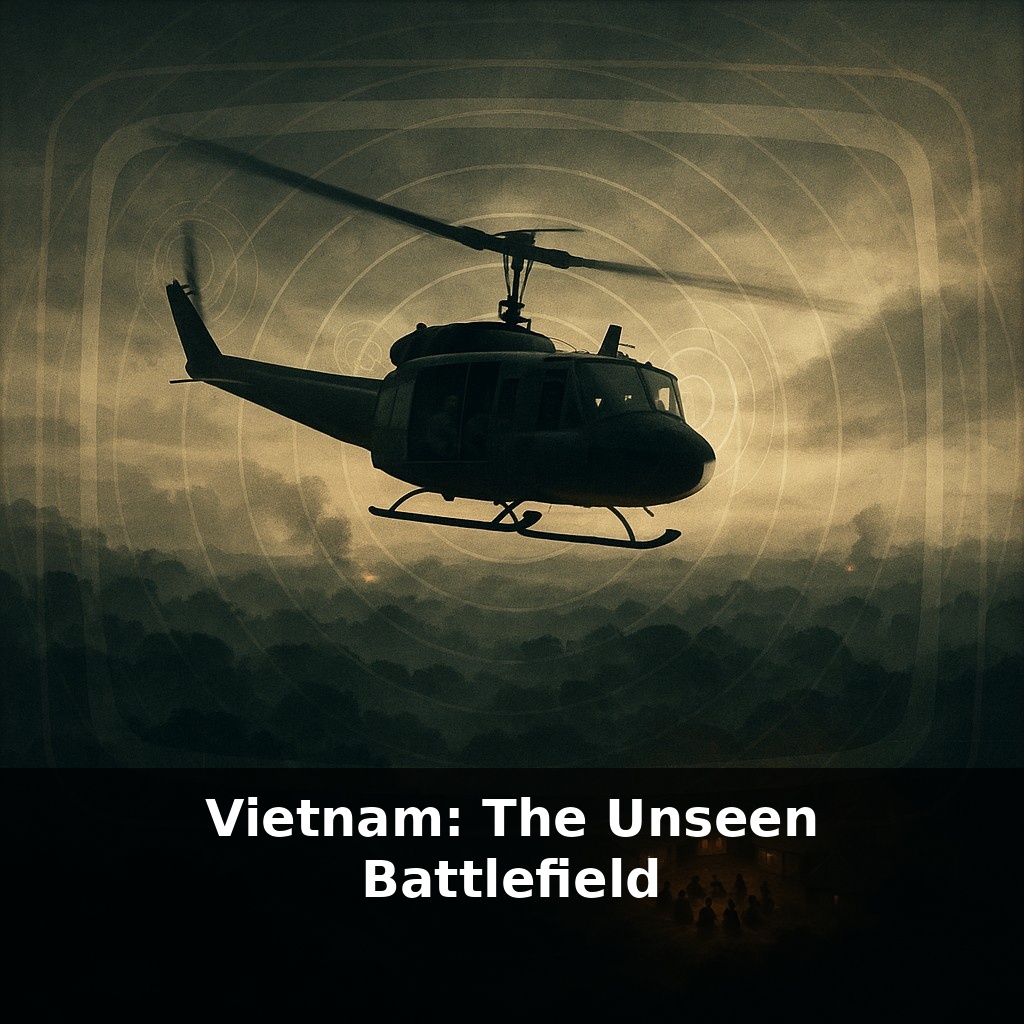
Helicopters roar overhead, jungle explodes below, and yet the real battle isn’t on that smoking hillside. It’s in ghostly radio broadcasts, whispered village meetings, and TV screens back in American living rooms. Vietnam’s most decisive front was the one almost nobody saw.
By 1968, Vietnam wasn’t just a warzone; it was a pressure cooker where village councils, jungle trails, and foreign embassies all fed the same boiling pot. While cameras chased burning hamlets and firefights, another contest unfolded in hushed negotiations, supply chains, and whispered promises of land, justice, or simply survival. A farmer in the Mekong Delta might see three different “governments” in a single week—Saigon officials by day, local militias at dusk, communist cadres after dark—all claiming authority, all demanding loyalty. Each side juggled more than bullets: they managed alliances, ration cards, and rumors. The unseen battlefield stretched from rice paddies to Paris peace talks, from secret supply routes in Laos to budgeting sessions in the U.S. Congress, where a single funding decision could hit harder than an airstrike.
In this maze, ideology wasn’t debated in classrooms but enforced in villages, prisons, and party cells. Washington spoke of “dominoes” and credibility; Hanoi fused anti-colonial struggle with socialist revolution; Saigon promised modernization and stability. Each vision came with its own calendars, holidays, slogans, and heroes, all competing for space in people’s heads. Add in Soviet and Chinese advisors, U.S. Green Berets, and regional players hedging their bets, and Vietnam began to resemble overlapping blueprints for different nations drawn on the same contested ground, lines crossing and clashing in everyday life.
Numbers on paper said one thing; the ground often said another. U.S. commanders logged body counts, villages “cleared,” and sorties flown. Hanoi tallied cadres recruited, hamlets “liberated,” and weapons moved down the Ho Chi Minh Trail. Both sides chased metrics that could be briefed in air-conditioned rooms, even as Vietnamese families measured the war in safer nights, fuller rice bowls, or which flag flew over the school.
Look at the fighting itself. Textbooks often split it into neat categories—guerrilla ambush here, conventional battle there—but in Vietnam those lines blurred. A patrol hit by mines and snipers in the morning might find itself facing uniformed North Vietnamese Army (PAVN) regulars by afternoon, backed by mortars and heavy machine guns. For U.S. and South Vietnamese officers, this meant every “small” engagement risked escalating without warning.
The Ho Chi Minh Trail turned that fluidity into a system. Officially, it was just “logistics,” a network through Laos and Cambodia feeding men and materiel south. In practice, it functioned like a constantly evolving software patch: when U.S. bombing “deleted” one section, engineers, porters, and local laborers rewrote the code—building bypasses, camouflage, and underground storage. Millions of craters later, traffic still flowed, slower at times, but rarely stopped.
In the South, overlapping hierarchies added more layers. The National Liberation Front (NLF) wrapped communist leadership in the language of local grievance—land reform, corruption, village autonomy. Many recruits weren’t quoting Marx; they were joining neighbors, settling scores, or choosing the side that seemed less likely to abandon them. Meanwhile, Saigon juggled regional warlords, religious sect militias, and an army whose loyalty could tilt with promotions, pay, or coups.
Foreign sponsors saw different maps entirely. For Washington, Vietnam sat on a global chessboard: losing Saigon looked less like one country changing hands than a signal to allies from Tokyo to Berlin. For Moscow and Beijing, aid flowed not just to bleed America but to shape which brand of communism—Soviet or Chinese—would claim credit for victory. Vietnamese leaders in Hanoi learned to navigate that rivalry, extracting weapons, fuel, and training without becoming mere clients.
All these layers collided in 1968’s Tet Offensive, when months of hidden movement, stockpiled weapons, and quiet organizing suddenly erupted into near-simultaneous attacks across South Vietnam. The shock didn’t just come from where communist forces struck, but from how deeply they had embedded themselves—inside cities, inside units thought reliable, inside assumptions about how “close” the war was to being won.
Think of the war’s layers like a stadium where three games run at once on the same field. On the surface, the “scoreboard” showed firefights and casualty numbers. Beneath that, a second contest decided who controlled bridges, crossroads, and fertile valleys week to week. Deeper still, a slower game unfolded over who would run schools, courts, and village committees when the guns went quiet.
Take a single province: a U.S. unit might secure a district town by day, while North Vietnamese regulars probed its outskirts at night. In nearby hamlets, local NLF organizers quietly arranged land disputes, weddings, even harvest schedules—functions a state would normally perform. Meanwhile, Saigon officials tried to expand roads, police posts, and markets to make their rule feel tangible.
Foreign aid amplified every layer. Soviet trucks and artillery made set-piece battles possible; Chinese engineering units improved trails and river crossings; American helicopters turned remote firebases into temporary strongpoints. Each shipment, training mission, or new airstrip nudged the long-term balance of who could actually govern the same patch of ground.
Power in Vietnam often shifted without a single shot: a cadre taking over a village school, a local chief switching loyalties, a road suddenly “safe” for one side’s trucks. Those micro-shifts echo today when cyber campaigns, drones, and proxy militias quietly reshape who actually controls space. Your challenge this week: look at one current conflict and map not the front lines, but who runs courts, clinics, and classrooms—and how that’s changing.
In the end, Vietnam’s “unseen battlefield” outlasted bullets: demographics, village networks, and dwindling U.S. budgets quietly tipped the scales. Herbicides scarred forests like erased lines on a map, yet new paths and loyalties kept reappearing. The war’s lesson lingers: who endures, adapts, and still holds a grip on daily life often decides the final outcome.
Try this experiment: Pick one Vietnam War battle or operation mentioned in the episode (like Khe Sanh or the Ho Chi Minh Trail) and, for 20 minutes, compare how it’s described in a mainstream history source (e.g., a textbook article or big-name website) versus a veteran’s oral history or diary you can find online. As you read, make two side‑by‑side columns on your screen labeled “Official View” and “Unseen View” and copy short phrases or details under each. Then ask yourself out loud: “If I only had the ‘official’ version, what human reality would I completely miss?” Notice how this changes your sense of what “counts” as true in war stories, and decide one concrete way you’ll question a single-source narrative in the news this week.