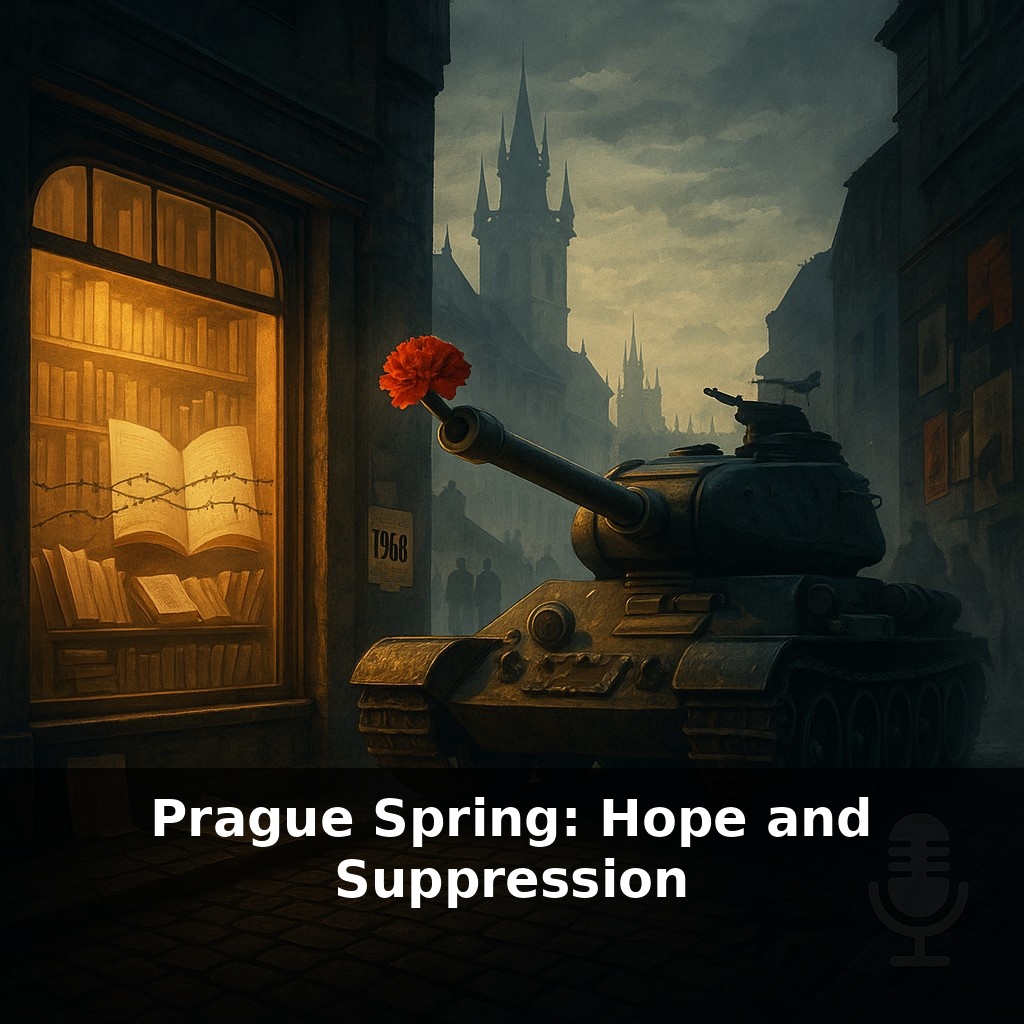
Gunfire echoes through a city that was cheering in the streets just weeks before. Newspapers that had suddenly grown bold now vanish overnight. How does a society move from open debate to tanks at dawn so quickly—and why did so many still believe change was possible?
Within months of Dubček’s reforms, Prague’s bookshops filled with previously banned authors, party meetings crackled with real argument, and student forums sounded less like scripted rituals and more like late-night campus debates. Reformers weren’t trying to ditch socialism; they were trying to repair it—testing whether a one‑party state could tolerate real criticism and still survive. Radio journalists pushed the line first, grilling officials live. Economists followed, proposing market‑style incentives inside a planned economy. Even some party insiders quietly welcomed the chance to govern by persuasion instead of fear. But each new experiment in openness was being logged—not just in Prague, but in Moscow. To Soviet leaders watching newsreels and reading reports, the question wasn’t whether hope was inspiring; it was whether hope was contagious.
Moscow’s concern wasn’t abstract ideology; it was geography and precedent. Czechoslovakia sat in the middle of the Warsaw Pact, bordering West Germany and Austria, its railways and airfields woven into Soviet defense plans. In Kremlin thinking, a wavering ally here could unravel the whole security belt. Leaders in East Berlin, Warsaw, and Sofia sent anxious reports: Czech newspapers were praising pluralism, students debated neutrality, and party hardliners elsewhere feared their own citizens might ask, “If Prague can talk openly, why can’t we?” Pressure on Dubček grew quieter, then sharper, like a warning light that never turned off.
Dubček’s team moved in stages, testing how far they could go without triggering a crackdown. The April 1968 Action Program was their blueprint: it promised lawful opposition inside the Communist framework, more power for Slovakia within the federation, and courts that would answer to written laws, not whispered orders. Crucially, it lifted prior censorship. Editors no longer had to clear every headline with party censors before printing; instead, they were told to uphold “socialist responsibility” after publication. Overnight, investigative pieces probed party abuses, historians revisited Stalinist show trials, and people saw their own recent past described without euphemism.
Workers’ councils began to appear in factories, debating production targets and wages with a frankness that would have been unthinkable a year earlier. University students staged teach‑ins that spilled out of lecture halls and into public squares. Writers’ and filmmakers’ unions seized the opening to push for legal protections, not just informal tolerance. Each of these arenas—media, workplaces, campuses, cultural institutions—became its own mini‑laboratory, asking the same question in different ways: how much autonomy could exist under a monopoly of political power?
Outside Czechoslovakia, this was read less as cautious experimentation and more as a spreading fault line. East German and Polish leaders warned Moscow that if Prague’s model held, their own tightly controlled systems would soon face demands for the same freedoms. Soviet officials began inviting (and then summoning) Dubček to increasingly tense meetings in Dresden, Moscow, and Čierna nad Tisou, pressing him to “restore order” and rein in the press. He answered with pledges and minor compromises, hoping time and negotiation could keep both reform and alliance commitments intact.
Inside the country, however, expectations kept outrunning his cautious reassurances. Opinion polls—rarely conducted so openly in the bloc—showed overwhelming support for continued liberalization. Party membership surged, paradoxically, as people who had kept their distance now thought they might influence policy from within. Reformers believed they had discovered a narrow corridor where they could move without setting off alarms. In Moscow, the same movement was charted as a widening breach, and contingency plans quietly shifted from political pressure to military intervention.
When prior censorship vanished, the most striking changes appeared in small, everyday corners of life. A village librarian could suddenly order books that had only circulated in samizdat. A regional theater director might schedule a play hinting at bureaucratic absurdity and trust that the audience would catch every subtext. In workplaces, people began pinning petitions, strike rumors, and satirical cartoons to bulletin boards that had once displayed only production quotas and party slogans. Student dorms set up discussion clubs that blended philosophy, rock music, and foreign news, turning late-night arguments into draft manifestos for “how things should work now.”
The shock in Moscow wasn’t just the content, but the speed: practices that had taken years to thaw in other contexts were changing in weeks. To Soviet planners, it recalled a software system where a small “update” in one module unexpectedly rewrites default settings across the entire network—suddenly, behavior everywhere looks less predictable, harder to roll back with a single command.
Prague Spring’s afterlife works less like a monument and more like open‑source code: activists, policymakers, and scholars keep forking it for new uses. EU debates on rule‑of‑law now quietly draw on 1968 as a warning about letting erosion go “just a bit further.” Protesters in places like Belarus borrow its slogans to frame their own pushes for dignity. Strategists, meanwhile, study the episode to ask how far great powers will go to freeze political “updates” they didn’t script.
Prague Spring’s quiet legacy is a checklist future movements now study: diversify voices early, expect friendly regimes to waver, archive everything before censors return. Like architects reusing blueprints from a demolished building, today’s reformers borrow its load‑bearing ideas—gradualism, pluralism, legal guarantees—while reinforcing them for harsher political weather.
Start with this tiny habit: When you open the news on your phone, pause for 10 seconds and whisper one sentence you remember about the Prague Spring (like “In 1968, Czechoslovaks tried ‘socialism with a human face’”). The next time you pass a library or bookstore, glance at the history shelf and mentally look for the name “Dubček” or “1968 Czechoslovakia,” even if you don’t go in. At dinner or over coffee, slip in just one line about how Soviet tanks rolled into Prague to crush reforms, and notice how the person reacts.