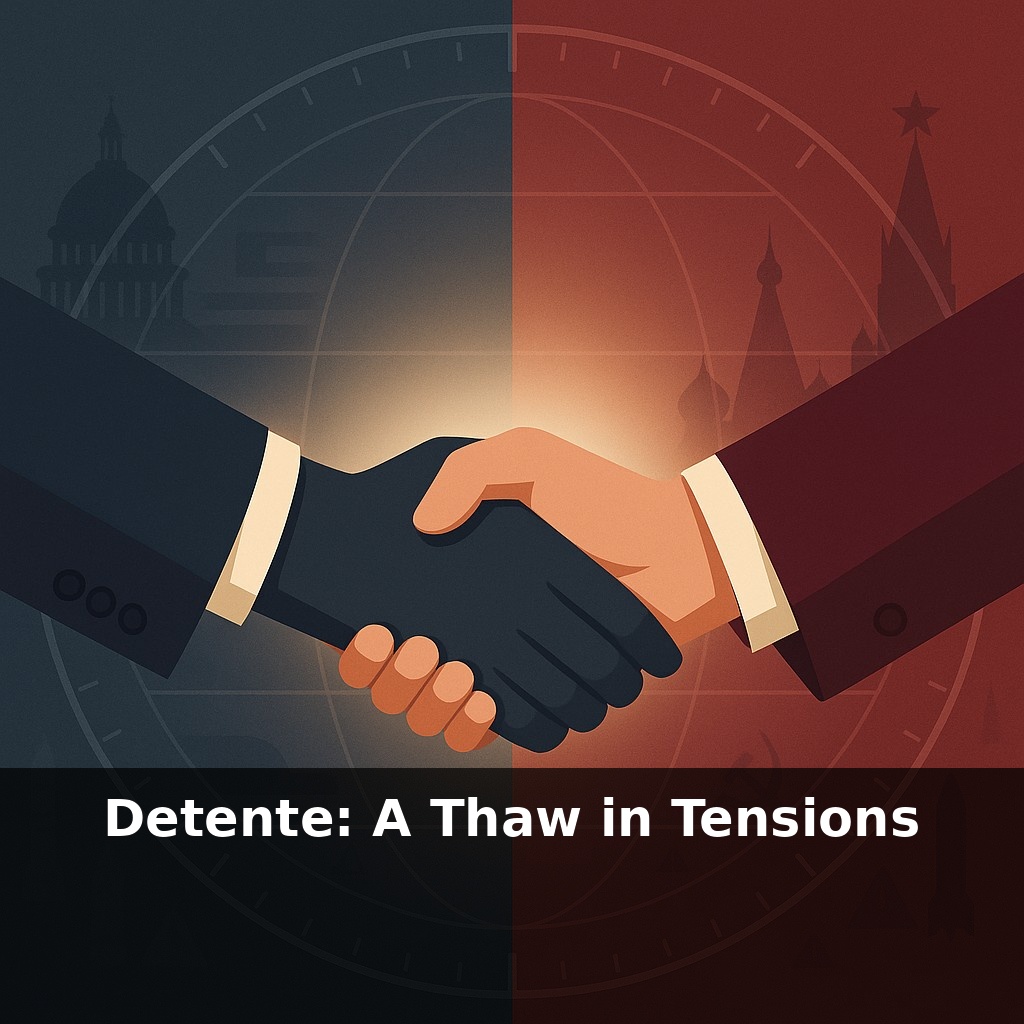
In 1972, a U.S. president walked into the heart of Moscow—for the first time ever—shaking hands with the leader of a rival armed with thousands of nuclear warheads. This episode, we’re stepping into that room to ask: how do enemies agree not to blow up the world?
Nixon’s Moscow visit wasn’t just a dramatic photo-op; it kicked off a risky experiment in Cold War risk‑management. From 1969 to 1979, Washington and Moscow tried something new: instead of simply threatening each other louder, they tried to write rules for their rivalry. Not rules to end the contest, but rules to keep it from spiraling out of control.
Think of it less like sudden friendship and more like two heavyweight fighters agreeing on the number of rounds and the weight of the gloves before the match starts. They were still trying to win—just not by collapsing the ring.
In this episode, we’ll trace how summit meetings, trade deals, and human-rights language ended up in the same story as missile numbers and interceptor limits, and why this “regulated hostility” both slowed the arms race and quietly planted the seeds of its own collapse.
Détente didn’t start with trust; it started with exhaustion and calculation. By the late 1960s, both superpowers were bleeding money into defense while facing problems at home—Vietnam and social unrest for the U.S., economic stagnation and food shortages for the USSR. Leaders realized that without some predictability, every crisis risked spiraling. So they tried something closer to a negotiated cease-fire in specific areas: weapons testing, trade, space launches. Like software companies agreeing on shared protocols, they hoped limited cooperation would reduce glitches that could crash the entire system.
The first big experiment was SALT I, signed in 1972. On paper, it looked modest: both sides accepted caps on long‑range launcher totals and promised not to build nationwide missile shields. In practice, it forced generals and scientists to map their arsenals in excruciating detail, because suddenly numbers had legal and political meaning, not just military value. Verification clauses dragged spies and satellites into the diplomatic spotlight: could you trust what your opponent declared if your own photos said something different?
Around these talks, a whole ecosystem of interaction grew. The 1972 Moscow summit produced not just military documents but deals on environmental cooperation, space, and science. That same year, the “Basic Principles of Relations” tried to set a tone: avoid armed conflict, respect sovereignty, consult during crises. Vague? Yes. But they gave diplomats a script to point to when hawks on either side wanted to slam the door.
Economic links were supposed to make restraint feel profitable. Grain sales helped feed Soviet cities; Western credits and technology offered shortcuts around Soviet inefficiency. In Washington, the pitch was blunt: sell wheat and equipment, and you gain leverage over Moscow’s choices. Congress, however, folded human rights into the bargain. The 1974 Jackson–Vanik Amendment tied trade benefits to freedom of emigration from the USSR, particularly for Jews. Now Soviet treatment of its own citizens directly affected access to Western markets.
That logic culminated in the 1975 Helsinki Final Act. Thirty‑five states—NATO, the Warsaw Pact, and neutrals—accepted a package deal: recognize Europe’s post‑1945 borders, expand cooperation, and affirm a basket of rights including freedom of thought, religion, and movement. For Western leaders, Helsinki looked like a pragmatic trade: accept the map of Europe in exchange for principles that could slowly erode its political realities. For dissidents in Prague, Warsaw, and Moscow, those signatures became a legal crowbar to pry open censorship and repression.
All the while, the shooting never stopped entirely. U.S. and Soviet advisers faced each other indirectly in the Middle East and Africa, stress‑testing whether new habits of communication could contain old habits of confrontation.
Think of the 1975 Helsinki Final Act less as a single treaty and more as a massive, shared “update” to Europe’s operating system. Once leaders installed it with their signatures, unexpected apps began to appear. In Czechoslovakia, Charter 77 activists cited Helsinki language line‑by‑line to demand that their own government follow rules it had proudly endorsed abroad. In Moscow, small monitoring groups quietly logged arrests, interrogations, and censorship, then smuggled reports to Western journalists, turning legal jargon into moral ammunition.
On the military side, verification habits seeped into other areas. Intelligence analysts who had learned to match satellite photos to SALT figures now applied similar scrutiny to naval deployments and bomber patrols, slowly normalizing the idea that both sides could “see” a lot without firing a shot. Meanwhile, cultural exchanges—Bolshoi tours in New York, American jazz in Leningrad, joint space missions—worked like tiny breach points in a firewall, letting in glimpses of alternate ways to live, spend, and speak that planners in neither capital could fully control.
Nixon’s Moscow visit and Helsinki’s signatures hint at a future where rivals haggle not just over borders, but over code, bandwidth, and algorithms. Your challenge this week: whenever you read about U.S.–China tech friction or NATO–Russia maneuvers, ask yourself: “What would a SALT‑style deal look like here?” Picture limits on autonomous drones, disclosure rules for cyber intrusions, or “no‑go” zones in orbit—and notice which ideas feel politically impossible, and why.
Detente’s quiet legacy is procedural: hotlines, verification teams, and summit choreography that later crises recycled like a well-tested playbook. Think of it as drafting blueprints for future negotiations—templates later reused for climate accords or cyber talks, where trust is thin, but the cost of miscalculation still feels like standing on thin ice.
To go deeper, here are 3 next steps:
1. Watch the full **Nixon–Brezhnev Moscow Summit (1972)** coverage via C-SPAN’s online archive and pause to compare what you see with the way the podcast described SALT I and the ABM Treaty—note where the public theater matches or diverges from the behind-the-scenes story you heard. 2. Read the chapters on détente in **John Lewis Gaddis’s “The Cold War”** or Raymond Garthoff’s **“Détente and Confrontation”**, and as you go, keep a browser tab open with the **Wilson Center Digital Archive** (search “détente” or “SALT”) so you can cross-check the historians’ interpretations with actual declassified memos. 3. Open **Arms Control Association’s** website and pull up a current factsheet on **New START or U.S.–Russia nuclear arms control**, then list 3 concrete parallels and 3 differences between modern arms control and the 1970s détente framework described in the episode—use that comparison to decide whether you think we’re in a “new détente” or something fundamentally different.