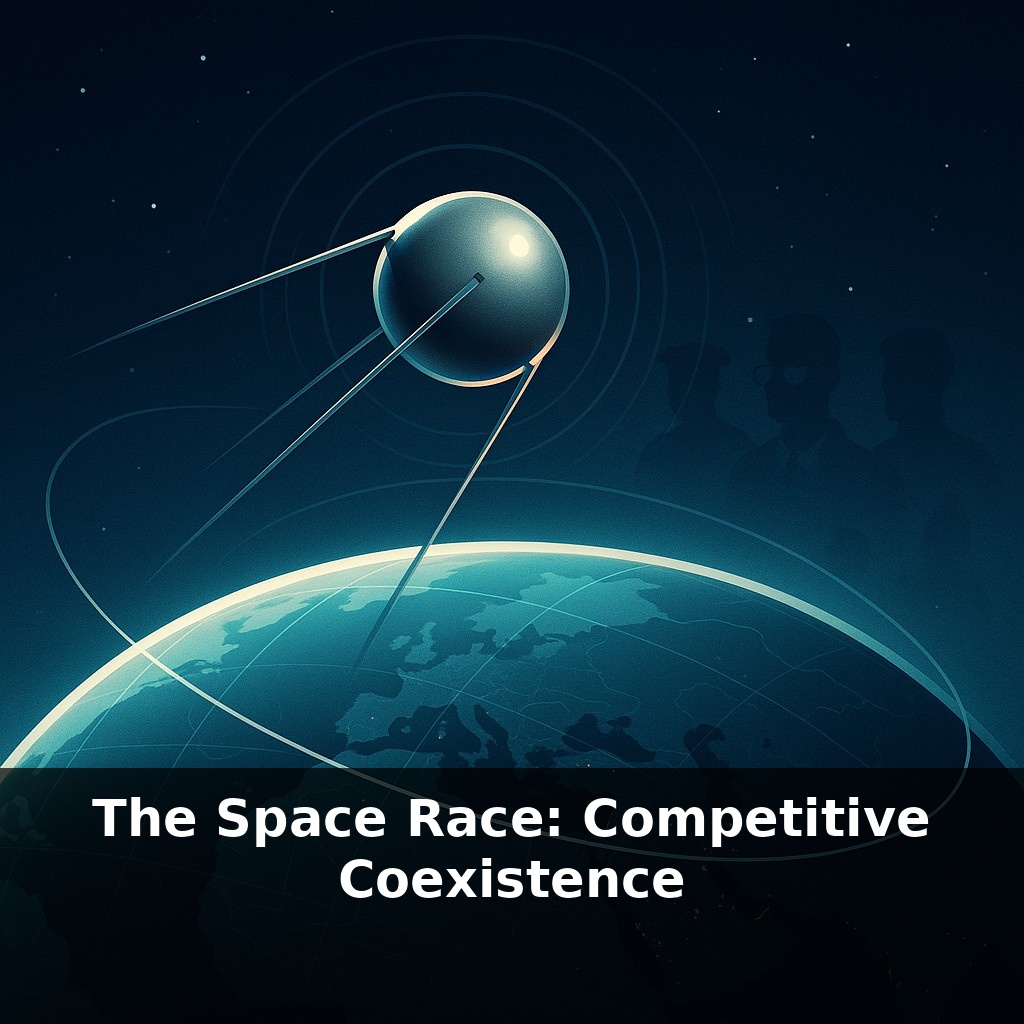
A metal sphere, smaller than a beach ball, circles Earth—and suddenly generals, scientists, and politicians all hear the same beeping. Is it a threat, a scientific miracle, or both? Stay with this episode as we unravel how fear and curiosity shared the same orbit.
In the time it takes you to listen to this paragraph, that first satellite has already crossed entire countries, slipping over borders that armies and diplomats treat as immovable. For military planners, this wasn’t just about altitude—it was about helplessness. No interceptor, no radar curtain, no fortified line could reach that high. At the same moment, scientists saw a moving laboratory: a way to weigh Earth, probe its atmosphere, and test radio signals across vast distances. Those two reactions—strategic anxiety and scientific excitement—shaped everything that followed. Budgets ballooned, new agencies formed overnight, and classrooms from Kansas to Kazakhstan quietly changed, steering students toward physics, math, and engineering, as if the next launch might begin in their notebook.
Within months, that orbiting experiment had rewritten domestic priorities on the ground. Legislators reallocated money away from familiar projects toward launchpads, tracking stations, and hurried math textbooks. Space became a budget line, a campaign slogan, and a late‑night worry. Children saw rockets on classroom posters; parents saw them in tax debates and nightly news graphics. University departments swelled like overwatered plants, sprouting new labs with names that sounded half science, half prophecy—astronautics, cybernetics, systems engineering—each promising not just discovery, but national survival.
When politicians approved those new labs and launchpads, they weren’t just funding rockets; they were underwriting an arms-length argument about which system—capitalist democracy or state socialism—could turn equations into hardware faster. Between 1957 and 1975, every launch carried two payloads: the object on the rocket, and the story each side told about what it meant.
Moscow opened the score with a cascade of “firsts.” A dog in orbit. The first human, Yuri Gagarin, circling Earth and returning alive. The first woman, Valentina Tereshkova. The first spacewalk. Each triumph splashed across front pages as proof that central planning could out‑innovate the West. Washington replied not just with missions, but with institutions: NASA formed, science-education laws passed, and entire industries bent themselves around the problem of catching up—and then leaping ahead.
Computers shrank from room‑sized to suitcase‑sized as guidance systems demanded faster, smaller brains for rockets. New alloys and heat shields were invented so capsules wouldn’t incinerate on reentry. Telecommunication networks thickened, first to track spacecraft, then to relay television signals and weather images. The same antennas that strained to hear a faint spacecraft signal later carried live Olympic broadcasts and transoceanic phone calls.
Competition was ruthless, but not suicidal. Both sides understood that a crew dying from a solar storm was bad propaganda for everyone. So, quietly, they shared space-weather data and basic orbital information, even while they raced for bigger headlines. Like two rival software companies that still agree on internet standards so their products don’t break, the superpowers learned that some cooperation was the price of staying in the game.
By the late 1960s, the U.S. set its sights higher—literally. The Moon became the stage on which to demonstrate industrial depth: the Saturn V’s thunder, a portable computer on the lunar module, life-support systems that turned a barren rock into a temporary outpost. The USSR pursued its own lunar ambitions and powerful rockets, but also doubled down on long‑duration flights and space stations, arguing that living in orbit mattered more than touching another world for a few hours.
Behind every televised launch, factories retooled, universities rewrote syllabi, and engineers learned to design for vacuum, radiation, and zero‑g. The paradox of the era was stark: a rivalry born of fear that nonetheless produced tools—global communications, weather prediction, precise navigation—that knit the planet together more tightly than any treaty.
Think about the technologies quietly running your day. Your phone checks the weather, your car’s map snaps your location onto a blue dot, a bank transfer settles in seconds—more than half of those satellite‑driven tricks trace their design DNA to hardware once aimed at beating a rival flag into orbit. The same engineering that steadied a capsule during reentry now steadies communication links for disaster relief. Materials developed to keep heat from shredding a spacecraft’s skin evolved into better insulation in buildings and jetliners. Even the timing signals that let global markets open and close in sync ride on methods first refined to track fast‑moving objects above Earth.
Yet the competition never stayed purely technical. School timetables shifted to squeeze in more math; television schedules carved out time for live launches; city skylines sprouted new dishes, domes, and radars. The handshake in orbit in 1975 didn’t end the rivalry, but it proved this: even at their tensest, both sides knew the future would be built on shared orbits as much as on separate flags.
Future space races may look less like flag-planting and more like building infrastructure: lunar fuel depots, shared stations, and relay networks that act like orbital “highways” for data and cargo. Rival powers will still jostle for prestige, but they’re increasingly locked into the same supply chains, launch providers, and tracking systems. As more nations join, soft power may depend less on who gets there first and more on who keeps space usable, open, and reliably safe for everyone.
The story of this rivalry isn’t just in museums; it’s in how we argue over orbital debris rules, commercial launch rights, and who owns lunar resources. Your challenge this week: spot three moments where rivals in any field quietly set shared rules—like lane markings on a highway—and ask: what “space” are they trying to keep open?