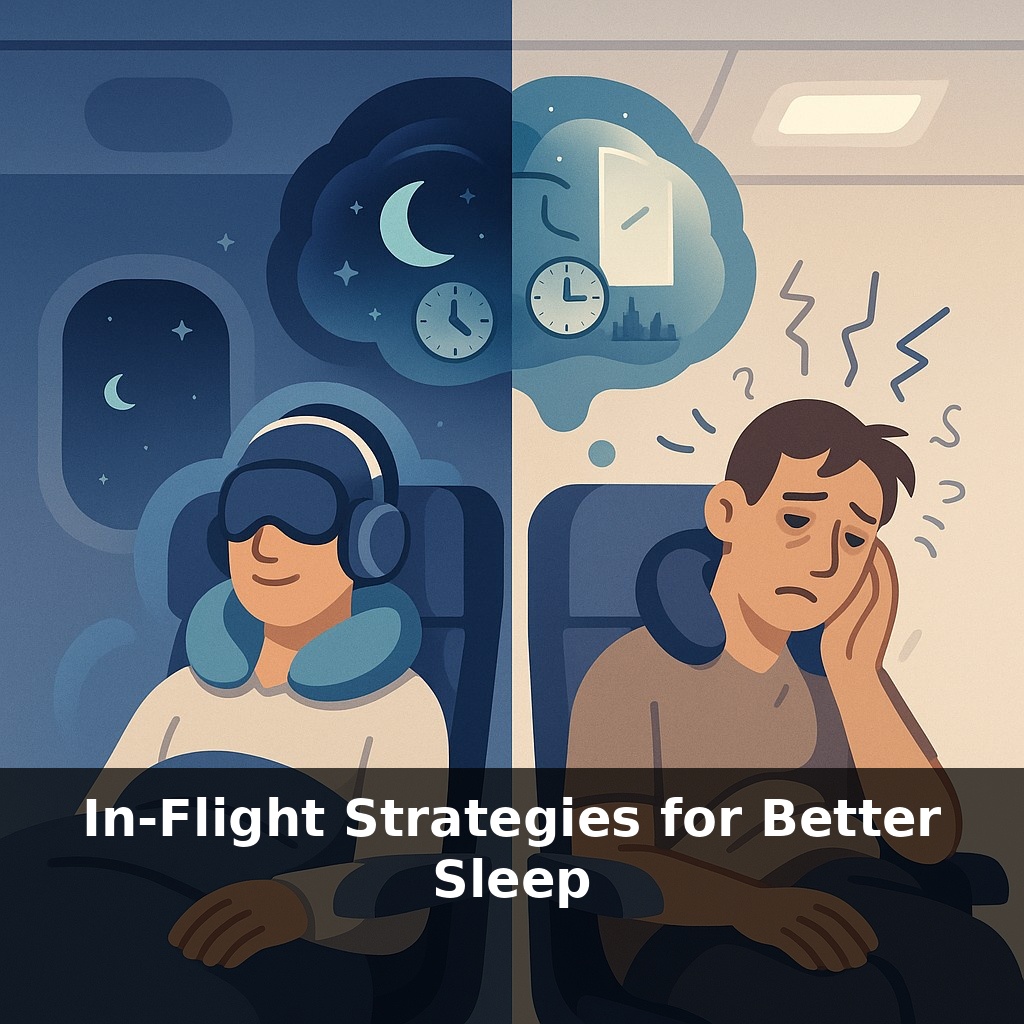
On a overnight flight from New York to Tokyo, two people in identical economy seats land feeling completely different: one groggy and wired, the other surprisingly rested. Same cabin, same food, same cramped space—so why does one body think it slept and the other didn’t?
The difference often comes down to strategy, not luck or “good sleeper” genetics. On a plane, your brain is trying to decide: is this a noisy office at noon or a dark bedroom at midnight? When the signals are mixed—bright cabin lights, upright posture, random meal times—it keeps you on alert, even when you’re exhausted.
In this episode, we’ll treat in‑flight sleep like a small design project: you’ll learn to adjust the three big levers you actually control up there—environment, timing, and body position—to quietly convince your brain, “Yes, this is night.” Instead of chasing sleep only when you feel tired, you’ll set things up so that by the time you want to drift off, your surroundings, your schedule, and your seat are already working in your favor—even in the middle seat of a fully booked red‑eye.
Now we zoom in on what actually changes your sleep up there. Think of the cabin as a stubborn coworker: it has its own schedule, its own preferences, and it’s not designed around you. The air is drier than most deserts, the lighting belongs in a conference room, and the seat was built for safety checklists, not spinal happiness. Yet within that rigid system, you get a surprising number of “dials” to tweak—when you eat, what hits your eyes and ears, how you angle your body, even how your skin senses temperature. Small, early tweaks to those dials often matter more than heroic efforts once you already feel wrecked.
Most people focus on sheer duration—“If I can just get 5 hours on this flight, I’ll be fine.” The data points somewhere else: *quality* and *alignment* matter more than raw minutes. Those three pillars you control don’t act in isolation; they stack. When you nudge all of them in the same direction, your brain stops fighting the setting and starts cooperating.
Start with what you can choose *before* you ever sit down. Route and seat selection quietly decide your ceiling for rest. An overnight eastbound with a departure close to your usual bedtime is fundamentally different from a “red‑eye” that leaves at 9 p.m. when your internal clock still thinks it’s late afternoon. Pair that with a window seat on the darker side of the cabin and you’ve just shifted odds toward sleep by a measurable margin. Add one more layer—sitting away from galleys and lavatories—and you’re carving out a low‑disturbance “micro‑zone” inside a chaotic tube.
Next comes pre‑flight phase‑shifting. Instead of a dramatic one‑night overhaul, research favors gentle nudges: 30–60 minutes earlier (or later) to your sleep and meal times for a few days. This isn’t about perfection; it’s about arriving at the gate already pointed roughly toward the schedule you’ll need in the air. When boarding time finally hits, your internal signals are already leaning in the direction of “this is when sleep *should* happen.”
Onboard, the goal is to choreograph *sequence*, not just tools. It’s the order that matters: first protect your senses (dimming screens, reducing blue‑heavy light, cutting noise); then support your body (recline, foot support, neck stability); then only if needed consider additives like caffeine timing or, under medical guidance, short‑acting aids. Think of it like a photographer setting up a shot: they don’t start by editing the image—they start by controlling light, angle, and stability so the raw picture is already close to what they want.
Finally, remember that your brain keeps a running “sleep quality story.” A short, well‑timed, protected 90‑minute block can leave you feeling more restored than three hours of fragmented dozing. So your real task is not “sleep as much as possible,” but “create one or two solid chunks your body can actually use.”
Think of each long‑haul you take this year as a different “sleep lab,” where you tweak just one variable at a time and watch what happens. On one trip, you might choose the window on the quieter side of the aircraft and commit to staying put—no wandering the aisle unless absolutely necessary. Notice: do you wake fewer times, or remember more continuous stretches of rest? On another, you could test a true dark period: cap pre‑flight screen use, switch to amber filters after boarding, and use an eye mask from the first dimming of cabin lights until breakfast service begins. A third “experiment” might focus on ergonomics only: small lumbar pillow, 20–30° recline as early as possible, feet supported on a bag instead of dangling. Log rough sleep blocks and how you feel 4–6 hours after landing, not just at touchdown. Over three or four flights, you’ll start to see your personal levers—the 20% of strategies that give you 80% of the benefit.
Cabins are quietly evolving into personalised “sleep ecosystems.” Airlines are testing zones where lights, sound, and seat movement adapt to your biometrics, like a hotel room that anticipates when you’ll drift off. Wearables could “negotiate” with the aircraft, dimming your row while your neighbour stays in daylight mode. As ultra‑long‑haul routes push past 20 hours, expect layouts to look more like shared sleeper trains than rows of rigid seats.
Over time, you’ll collect your own “flight playbook”: tiny rituals, preferred rows, a packing list that fits in one hand. Each trip becomes less like bracing for a storm and more like learning a familiar hiking trail—you still respect the terrain, but you know where the tricky parts are, and how to walk them so you arrive steady instead of spent.
Try this experiment: On your next flight over 3 hours, start a “sleep window” 90 minutes after takeoff—no screens, no work, just an eye mask, neck pillow, and low-volume brown noise or a calming playlist in your headphones. Before boarding, set your watch to your destination time and time that sleep window to match when you’d usually feel sleepy there (even if it feels early or late in real time). During the flight, stick to water or herbal tea only, skip alcohol and high-sugar snacks, and keep your reading light or screen brightness at the absolute minimum outside that window. After landing, jot down (mentally or in your phone) how long you think you slept, how groggy/alert you feel (0–10), and how quickly you fall asleep that first night, then repeat this setup on your next similar flight and compare how your body responds.