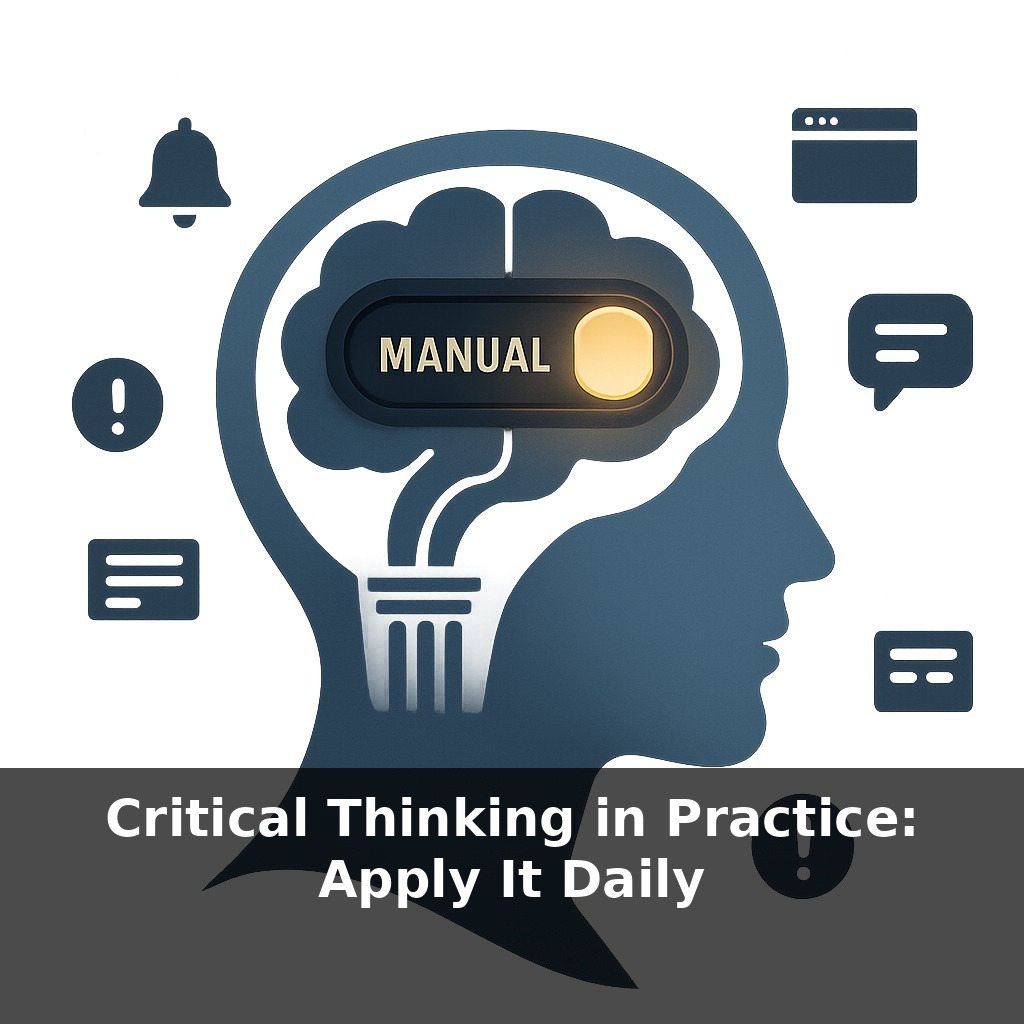
Right now, your brain is quietly sifting through more information in a single day than your grandparents saw in months—news feeds, emails, alerts, opinions. The twist? Most of those choices feel automatic. This episode asks: what happens when you flip that switch to manual?
Walk into your day tomorrow and count how many “default” decisions you make before 10 a.m.: which tab to open first, whether to skim that email, how seriously to take a headline, when to speak up in a meeting. Each one seems trivial, but together they nudge your career, your relationships, even your mood. The good news: critical thinking isn’t a lofty academic skill—it’s closer to a set of kitchen tools you can grab whenever you cook, not just on special occasions. In this episode, we’ll treat your daily routine as a testing ground. You’ll see how tiny moves—asking one more question, pausing five seconds, checking one contrary source—can turn routine reactions into deliberate choices. We’ll also look at how professionals in fields like medicine and engineering embed these habits so deeply that “thinking critically” becomes the default, even under pressure.
Think of today as a kind of “mental lab notebook.” You’re already making moves on autopilot; now we’ll trace a few of them in slow motion and see where small upgrades are possible. Research shows people who consciously analyze just a fraction of their daily inputs—say, one tricky email, one big purchase, one team decision—end up with fewer regrets and better outcomes over time. The goal isn’t to double-check everything; it’s to pick a handful of high-impact moments and apply structured questions, like a chef tasting and adjusting a dish before it leaves the kitchen.
Walk through a normal weekday and you’ll find the same thinking patterns popping up in very different places. That’s good news: it means you can practice one small move in multiple contexts until it becomes second nature.
Start with one of the most common pressure points: messages from other people. A coworker pings, “Can you jump on this today? It’s urgent.” Instead of reacting to the word “urgent,” try a three-step check:
1. **Clarify the claim** – “What exactly has to be done?” 2. **Check the stakes** – “What happens if this waits until tomorrow?” 3. **Test alignment** – “How does this compare to our other priorities?”
You’re not doubting the person; you’re sharpening the request so your decision fits reality, not just tone.
Shift to money decisions. A subscription offer says, “Only $12 per month!” A quick “pros–cons–fix” pass might look like:
- Pros: Convenience, access, maybe a discount. - Cons: Recurring cost, cancellation friction, you might not use it. - Fix: “I’ll try one month, set a calendar reminder to review, and cancel if it’s not pulling its weight.”
Now think about health and self-care. You read a headline: “New superfood cuts disease risk in half.” Before you overhaul your diet, run a tiny evidence check:
- Who’s making this claim? - What data are they using: one small study, or many? - Does another reputable source agree—or challenge it?
Even two minutes of checking a second source can keep you from chasing the trend of the week.
In team settings, structured questioning helps surface blind spots. In a meeting where everyone loves an idea, deliberately ask, “What would have to be true for this to fail?” You’re inviting the group to search for weak links early, when they’re still cheap to fix, instead of months later when they’re expensive.
You can also use brief self-audits. When you feel a strong reaction—enthusiastic or skeptical—note it as a signal, not a verdict. Ask: “What assumption is driving this reaction?” Maybe you’re assuming “New equals risky” or “Confident speaker equals credible.” Naming the assumption creates just enough distance to reevaluate.
These micro-skills add up. You won’t run formal methods on every choice, but applying a light version to a few key moments each day steadily trains the underlying muscles: noticing, questioning, comparing, revising.
You’re scrolling through a group chat when a rumor pops up: “Our company’s about to be acquired—friend in HR confirmed.” Instead of forwarding it, you treat the moment like a quick taste-test:
- First, you separate ingredients: statement (“we’re being acquired”), source (“friend in HR”), evidence (none yet). - Then you sample alternatives: could this be a misheard reorg, a stalled negotiation, or just drama? - Finally, you decide what’s safe to “serve”: maybe you note it, but don’t act until an official update appears.
You can do the same with a colleague’s bold proposal: “Let’s pivot to TikTok; everyone’s there now.” You ask, “Which ‘everyone’ do you mean? Our audience? Our competitors?” One or two targeted questions often reveal whether you’re chasing a mirage or spotting a real opportunity.
Even with your own plans—say, starting a side project—you can ask, “What would convince me to stop?” That pre-set exit condition keeps enthusiasm from turning into sunk-cost stubbornness.
In a world where AI drafts emails, sorts data, and even suggests diagnoses, your edge shifts from doing the task to judging the output. The more machines pre-chew information, the more you become a kind of “editor-in-chief” of your own life: deciding what to trust, what to ignore, and what needs a rewrite. Expect workplaces to reward people who can calmly challenge dashboards, forecasts, or AI suggestions instead of treating them as final answers. Schools and employers may soon train this explicitly, like cybersecurity or budgeting. Your challenge this week: Whenever you use a tool that recommends something—a route, a movie, an email reply—pause once a day to ask, “If this were wrong, what sign would I see?” Note just one example per day. By week’s end, look back and see where questioning would have saved you time, money, or frustration.
Treat today like a low-stakes rehearsal for tougher calls: test one belief, cross-check one claim, stretch one assumption. Over time, those quick checks stack up like automatic savings deposits—barely noticeable day to day, but powerful in the aggregate. The goal isn’t to be certain; it’s to be just curious enough to steer rather than drift.
Before next week, ask yourself: 1) “In which recurring situation this week (team meeting, email thread, or a decision with my manager) did I automatically accept the first explanation, and what 2–3 alternative explanations could also fit the facts?” 2) “The next time I feel certain I’m right about something at work, what specific piece of disconfirming evidence will I deliberately look for before I respond?” 3) “When I make my next important decision (budget choice, project priority, or hiring call), what assumptions am I treating as facts, and which one am I willing to temporarily ‘suspend’ to see what new options appear?”