Introduction to Ancient Scripts
📝 Transcript
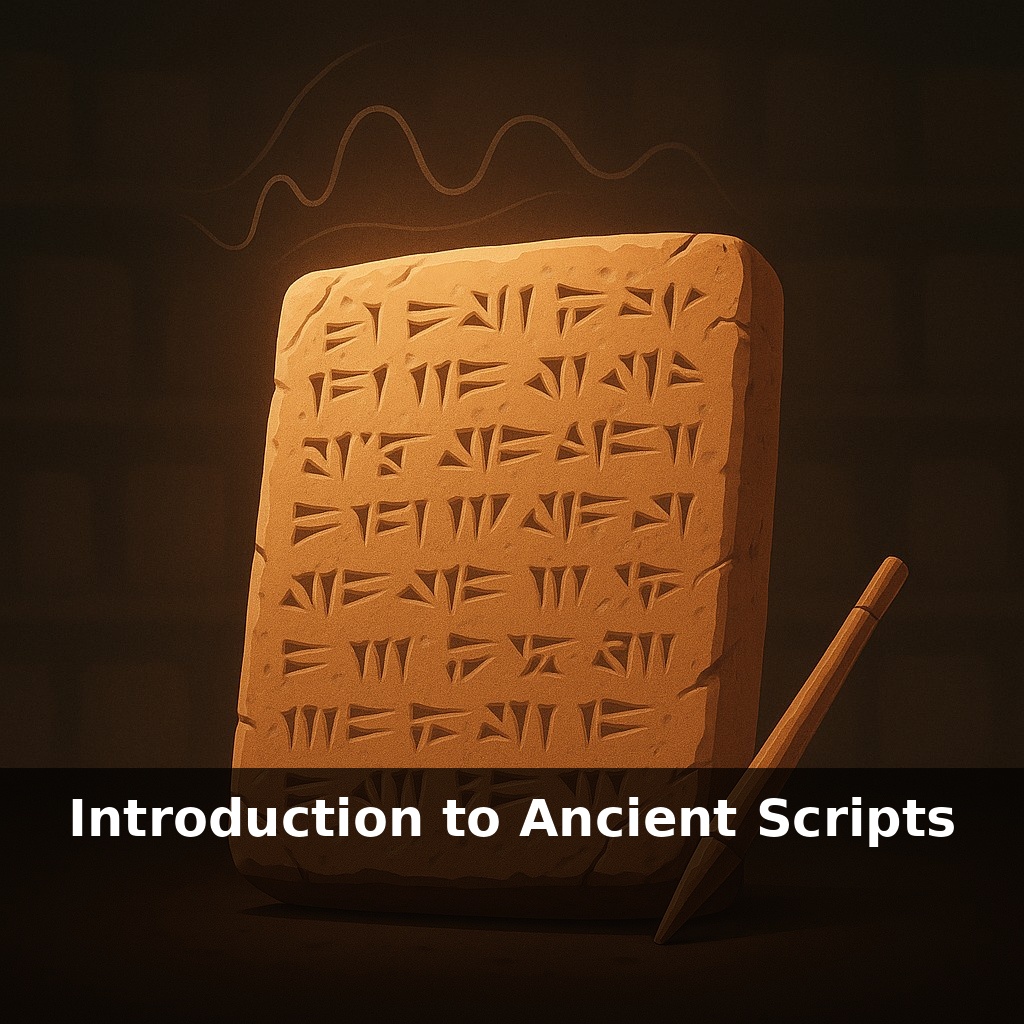
A library of half a million clay tablets exists, yet most of them have never been read. Somewhere in that silent backlog could be lost poems, tax disputes, or a teenager’s complaint. Today we step up to the shelf, pull one out, and ask: how do you read a voice that’s been dead for millennia?
Some of the oldest “books” on Earth were never meant to be read by us. Ancient scripts were practical tools first: ways to track harvests, swear oaths, praise gods, and fix borders. Yet as empires fell, their writing systems froze in place while languages evolved or vanished. Centuries later, we meet them as mute patterns: wedges, loops, and symbols with no built‑in legend.
To turn those marks back into meaning, scholars don’t just stare harder at the signs; they pull in clues from everywhere—bilingual texts, reused building blocks in different words, even the wear on a chisel stroke. A single repeated symbol beside drawings of grain, for instance, hints at “barley” more than “king.”
You can think of each script as a foreign city’s subway map: at first it’s a tangle of colored lines, but once you find just one reliable station name, the whole system slowly starts to organize around it.
Some scripts have generous clues; others are maddeningly stingy. Egyptian hieroglyphs came with the Rosetta Stone’s built‑in translation, while Linear A still stares back at us in stubborn silence. Between these extremes lie systems like cuneiform and Mayan glyphs, where thousands of signs evolved, merged, or split across centuries and cities.
To make sense of that shifting landscape, researchers catalogue every sign, its shapes, and its favorite neighbors—almost like botanists tracking related leaves across a forest. Patterns in how signs cluster, flip direction, or swap roles hint at whether we’re seeing sounds, words, or whole ideas compressed into a single mark.
At first glance, all those wedges and loops look equally mysterious. But the first big move in decipherment is ruthless simplification: what *kind* of system is this? Scholars start by stripping a script down to counts and patterns.
How many distinct marks are there? A few dozen different signs usually points to an alphabet or syllabary; hundreds or thousands suggest that many symbols stand for whole words or ideas. With cuneiform, for instance, painstaking cataloging over centuries has revealed roughly 5,000 distinct forms used across three millennia—far too many for each to be a single sound. That numerical clue steers researchers toward mixed systems where one sign might sometimes be a sound, sometimes a word, and sometimes a grammatical hint.
Direction is another quiet but powerful clue. Lines that consistently run left‑to‑right or right‑to‑left hint at a stable writing convention; alternating directions in successive lines can signal a tradition in flux. Changes in direction over time can even flag cultural shifts: when a region adopts a new prestige language or new scribal school, the flow of the script may literally turn around.
Next comes internal structure. Do certain signs always appear in clusters at the start or end of sequences? That repetition can betray things like titles, place names, or common endings. When a recurring cluster shows up on multiple stone doorways, but rarely on everyday objects, it starts to look suspiciously like “king of X” rather than “two goats.”
This is where computers have transformed the field. With hundreds of thousands of items—clay, stone, bone, metal—no human can hold every pattern in working memory. Statistical tools trawl through huge corpora, flagging which signs prefer each other’s company, which avoid each other, and which often trade places. When those patterns are mapped against archaeological context—say, comparing temple walls to humble receipts—layers of social meaning begin to surface.
Unicode quietly underpins a lot of this modern work. By giving over 300 ancient scripts standardized digital code points, it lets scholars on different continents search, tag, and share inscriptions with precision instead of relying on fuzzy photographs or improvised fonts.
Even so, progress is uneven. Less than a tenth of the vast cuneiform archive has been translated in full, leaving an enormous reservoir of untapped history. Meanwhile, scripts like the Indus signs or Linear A resist all these tools: the texts are short, contexts are fragmentary, and no clear bilingual “bridge” has turned up. The absence of long, varied examples makes frequency counts noisy and hypotheses fragile.
And yet, every tiny gain matters. When 85–90% of Mayan glyphs yield their values, that remaining fraction isn’t just trivia; it can hide entire nuances of ritual, politics, and personal names still locked away, waiting for the next pattern no one has thought to test.
On a stone wall in present‑day Iran, the Behistun inscription shows how a single monument can become a master key. Carved in three languages, it let scholars in the 19th century check guesses line by line, watching names like “Darius” repeat across versions. That kind of repetition is gold: proper names often stand out because they ignore normal spelling rules, letting researchers pin down sounds that don’t behave “politely.”
Elsewhere, progress comes from sheer quantity. When thousands of short, formulaic texts turn up in one site—say, boundary markers or dedications—patterns in where they’re found matter as much as what they say. A phrase that clings to city gates but not household objects starts to look like a legal or military term.
Sometimes, the material itself adds clues. Inscriptions scratched hastily on pottery shards tend to carry everyday language and nicknames, while carefully carved luxury items skew toward ritual or prestige vocabulary. That contrast helps separate ordinary speech from ceremonial display, one cluster of words at a time.
Less than 10% of known tablets translated means our historical timeline is still full of blank pages. As AI and imaging sharpen, we won’t just “read” more; we’ll link inscriptions to climate records, trade routes, even ancient genomes, weaving events into richer chains of cause and effect. Your challenge this week: whenever you see a modern logo or street sign, ask what a future researcher could infer about your culture from that fragment alone.
In the end, every decoded line is less a final answer than a new question: whose story is missing here, and why? As more scripts enter Unicode and more fragments go online, patterns of power, migration, and belief will sharpen. We’re not just filling a museum; we’re rebuilding a conversation across time, voice by painstaking voice.
Here’s your challenge this week: choose one ancient script mentioned in the episode—like Egyptian hieroglyphs, Linear B, or cuneiform—and learn to accurately write 5 authentic signs or characters from it by hand. Use a reputable online sign list or museum database to copy each sign, and next to each one, note its sound value or meaning exactly as described in the episode. Then, create a single postcard-sized “inscription” by combining at least 3 of those signs into a short name, word, or phrase (even if it’s just your own name approximated in that script). Finally, snap a photo of your inscription and compare it to a real artifact image in that script to see how close your line style, sign order, and layout are.
From this course
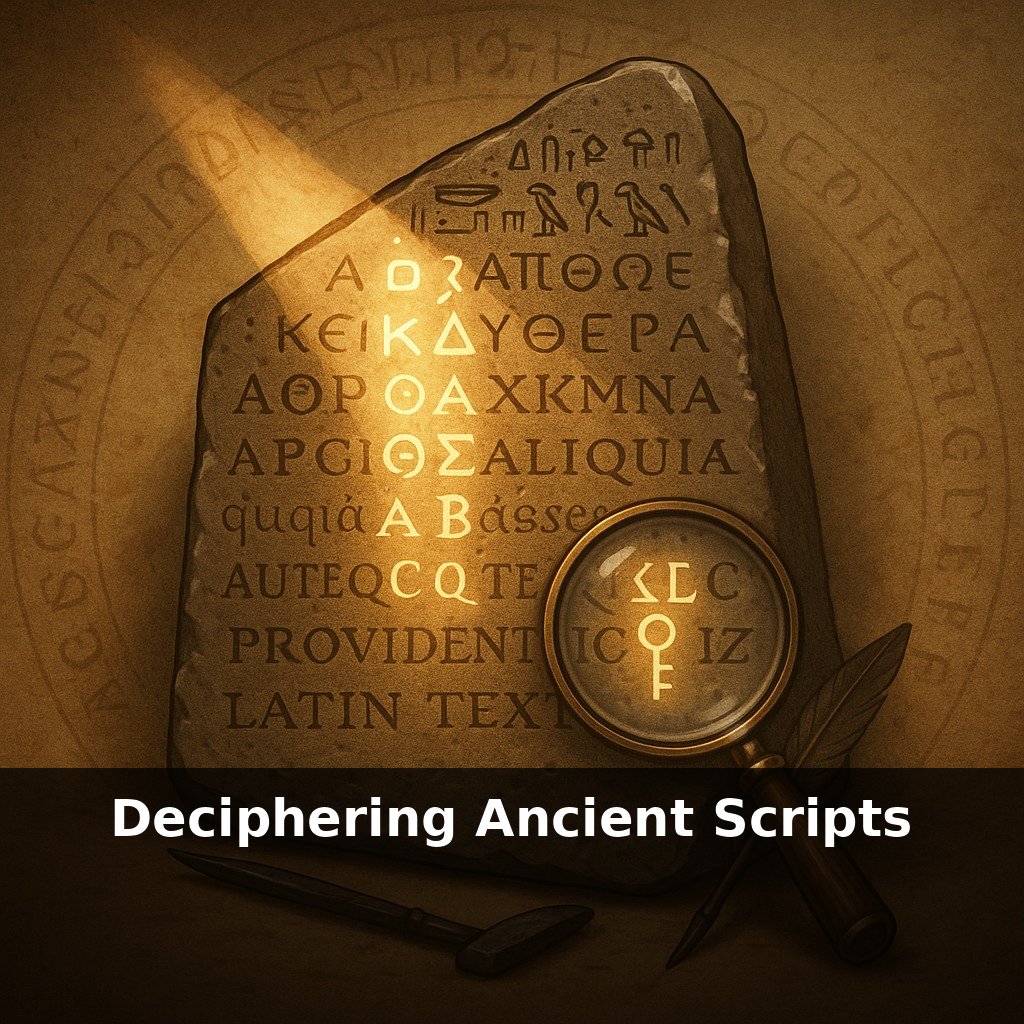
Deciphering Ancient Scripts
8 episodesUnlock all episodes
Full access to 8 episodes and everything on OwlUp.
Subscribe — $1.99/monthLess than a coffee ☕ · Cancel anytime