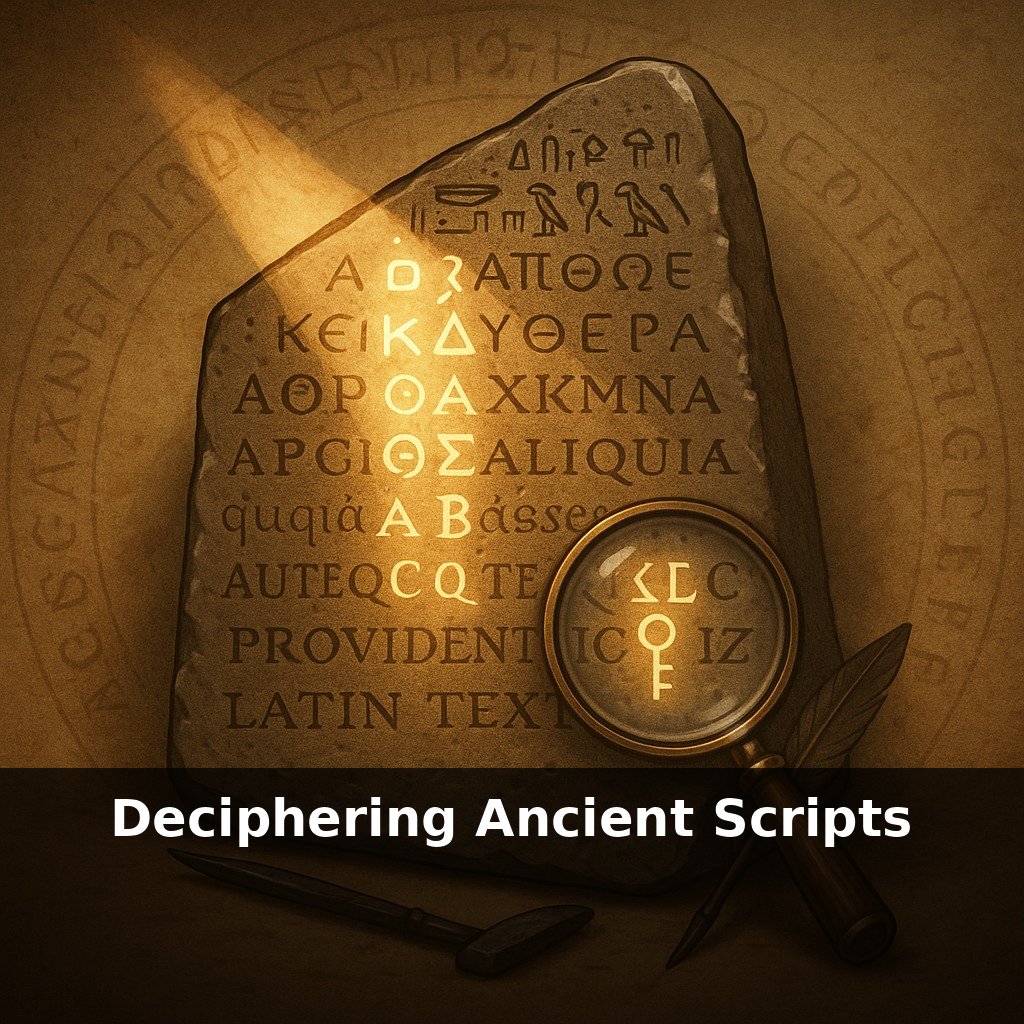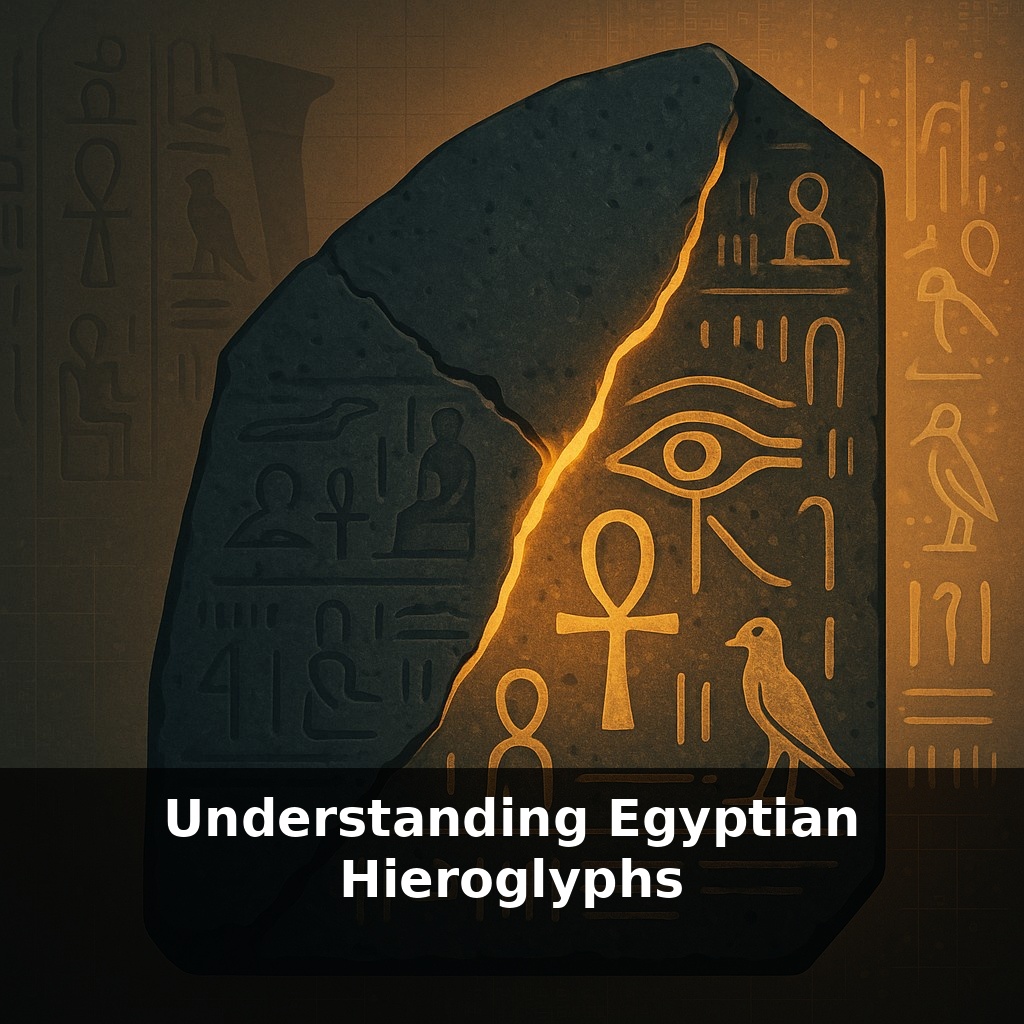
A writing system survived in Egypt for longer than the gap between Julius Caesar and today—then vanished so completely that even priests couldn’t read their own temples. Now, with one broken stone and modern code, those “silent” pictures are speaking again.
Hieroglyphs weren’t just carved on tomb walls; they saturated nearly every surface of ancient Egyptian life. Kings proclaimed victories on temple pylons, scribes scratched quick notes in ink on pottery sherds, and officials drafted tax records on papyrus that sometimes survived in the desert by sheer luck. Follow a single sign—the seated man, for instance—and you’ll meet it on royal monuments, in love poems, and in legal contracts, quietly shifting its role from “person” to specific sounds to a silent hint about meaning. The system flexed to fit the moment: monumental and meticulous in stone, brisk and almost cursive in everyday ink. And across centuries, scribes learned to balance beauty with efficiency, deciding when to stack signs, when to stretch them, and when to leave just enough for a trained eye to fill in the rest.
Walk along a temple wall and you’ll see that those carved lines don’t run left-to-right like English. They usually flow toward the faces of people or animals in the text, and can stack vertically in neat blocks, like stones in architectural plans. Nearby, a different surface might show the same language racing right-to-left in quick ink strokes. Within a single column, you might find a name wrapped in an oval enclosure, a short cluster for a god, and a compact label for an object, all fitted together like an artfully arranged gallery wall of meaning.
Step closer to those carved blocks and a quiet pattern emerges: most of the “tiny pictures” don’t stand alone. They cluster into compact units that Egyptian grammarians today call “words,” but the boundaries aren’t marked by spaces. Instead, your eye learns to see mini‑compositions: a core sound sign or two, a logogram here and there, capped with a determinative that silently nudges your interpretation in the right direction.
Take a group that writes something like “sꜣ.” On its own, it might be the word for “son,” but add a twisted‑flax sign and it can become “protection”; swap in a different ending sign and you’re suddenly reading a verb “to make.” The determinative at the end quietly disambiguates: a kneeling child for “son,” a sheltering sign for “protection,” a man with a tool for an action. To a learner, these bundles feel dense; to a trained scribe, they’re efficient shortcuts through a forest of homophones.
Names add another layer. When a king’s name is wrapped in an oval frame, that enclosure is doing political work: it carves out royal identity in the flow of text. Inside, scribes often combined signs for sound and prestige. A falcon for Horus might stand partly for the god, partly for the sounds of his name, and partly for the ideology he carries. Reading a royal titulary is less decoding letters than tracing a web of references—to gods, places, victories—that an elite audience was expected to catch.
Across time, the repertoire of signs expanded and shifted. Old Kingdom stonework looks almost conservative beside the exuberant arrangements of the New Kingdom, where extra signs might be added for clarity, elegance, or pious emphasis. Later still, priests of the Ptolemaic and Roman periods leaned into complexity, stacking dense “cryptographic” clusters in temple reliefs that play with multiple readings at once. What looks like ornament can double as theology: a single group might simultaneously spell a god’s name, depict his emblem, and allude to a myth.
Modern scholars map all this with sign lists—organized catalogues that give each sign a code, a bit like shelf marks in a vast library. Digital tools now let researchers search by those codes, by transliteration, or even by uploading a photograph and letting an algorithm suggest matches. In this way, patterns that once took careers to notice—regional spellings, temple‑specific puns, the rise and fall of rare symbols—can be traced across thousands of inscriptions in an afternoon.
A single cluster might pack in biography, prayer, and wordplay at once. Think of a craftsman’s label tucked near his work: a short sequence can record his name, his job title, and the workshop where he trained, all without a single gap between signs. Elsewhere, a blessing for the dead compresses an entire sentence—“given life, stability, and power forever”—into a tight chain of signs that any trained reader would expand in their head. On festival scenes, tiny captions identify offerings, but also hint at seasonal rhythms: different sign choices appear with different agricultural phases, letting historians track when texts were drafted or recopied. In love poetry, a word for “heart” might be written with extra care, pairing a standard spelling with a visually rich emblem favored in intimate contexts. And on border stelae, place names anchor political claims to specific deserts, oases, or foreign towns, so mapping their spellings today helps reconstruct shifting frontiers and trade routes across centuries.
Tour guides may soon carry tablets that quietly align ancient signs with live translations, like subtitles hovering over the past. Experimental models already test this on small chapel scenes, linking each cluster to parallel texts and variant spellings. As more monuments are scanned, networks of related phrases start to emerge, revealing which sanctuaries shared prayers, which border stones echoed distant edicts, and how regional schools subtly tuned shared formulas over centuries.
We’re only just starting to see what emerges when laser scans, satellite images, and AI meet those carved signs: erased names resurfacing like footprints after rain, family networks re‑knit across distant tombs, and travel itineraries traced from quarry marks to harbor graffiti, turning stone landscapes into something closer to a living archive.
Before next week, ask yourself: “When I look at a simple cartouche or name written in hieroglyphs (like the classic example of ‘Tutankhamun’), which individual signs can I already recognize, and what sound or idea does each one carry for me now?” Then ask: “If I pick just one short temple inscription or offering formula from the episode’s show notes (or a museum website), what hypotheses can I make about direction of reading, determinatives, and the overall meaning—before checking a sign list or translation?” Finally, ask: “Which aspect of hieroglyphs fascinates me most right now—phonetic signs, determinatives, or the art–writing blend—and what is one specific line of glyphs I can print or screenshot today to stare at, sketch, and ‘talk through’ aloud as if I’m explaining it to a curious friend?”