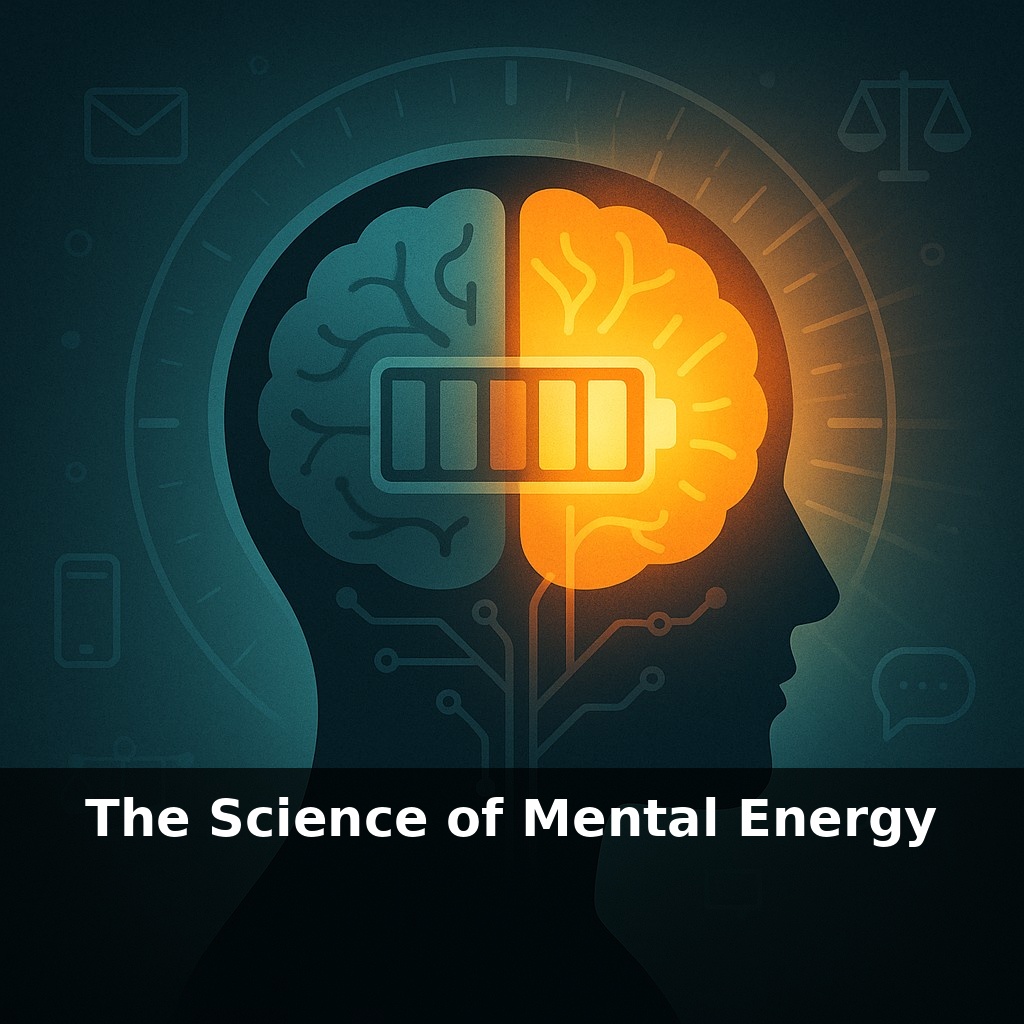
Your brain is a tiny organ that burns about a fifth of your body’s resting energy—yet we act like it’s infinite. In the time it takes to commute, clear email, and scroll your phone, you may have already spent most of today’s mental budget without noticing.
Parole judges in one study were harshest right before breaks and most generous just after eating—same laws, same crimes, completely different outcomes. That’s the quiet power of mental energy: it doesn’t just change how you *feel*, it changes what you decide is “fair,” “good enough,” or “too risky.”
In this episode, we’ll zoom in on that slippery resource behind your choices: mental energy. Not in a mystical way, but as something your brain spends, loses, and strategically defends. You’ll see why scrolling endless options can leave you weirdly drained, why “I don’t care, you pick” is often a depletion signal, and why your brain sometimes pushes you toward the laziest path even when you *know* it’s not best. Most importantly, we’ll connect these subtle shifts to everyday decisions—what you buy, who you say yes to, and when you quit early or push through.
Think about the last time you snapped “I don’t care” over something tiny—like picking a restaurant—with someone you *do* care about. That moment wasn’t just mood; it was your brain quietly signaling, “I’m done spending effort here.” Scientists see this in labs: after tasks that demand self-control or tough choices, people lean harder on shortcuts—habits, defaults, other people’s opinions. Your brain starts treating effort like a scarce currency, asking “Is this really worth it?” In this episode, we’ll explore how that internal cost–benefit math works, and why “too tired to choose” is often a rational response, not a personal flaw.
Here’s the twist: when scientists go hunting for a single “willpower fuel tank” in the brain, they don’t find one. Instead, they see a tug-of-war between *motivation* and *cost*. Your brain isn’t just asking, “Do I have energy left?” It’s also asking, “Why should I spend it on this?”
Neuroscience studies show that areas like the anterior cingulate cortex act a bit like an internal accountant, flagging when a task feels too effortful for the expected payoff. The more boring, uncertain, or pointless something seems, the more “expensive” it feels—*even if* you technically have capacity left. That’s why you can go from “I can’t read another email” to “somehow I watched three episodes of a show” without blinking. The effort meter isn’t about raw difficulty; it’s about *perceived value per unit of struggle*.
This is where context quietly shapes your mental stamina. In experiments, when people are told a task is meaningful or well-rewarded, they persist longer and show fewer depletion effects—even if the task is identical. Framing matters. A spreadsheet labeled “practice data” drains faster than the same sheet framed as “live project that helps real customers.” Your brain loosens the internal brakes when it senses stakes.
Social factors layer on top. If you expect to face more demands later—parenting all evening, a tough meeting, a risky conversation—your brain often starts conserving earlier in the day. It’s pre-emptive budgeting: “Don’t spend everything on inbox triage; you’ll need it tonight.” People in unstable environments, unfair workplaces, or chronic stress conditions can look “unmotivated” when, in fact, their brains are accurately predicting heavy future costs and hoarding effort.
There’s also a training effect. Research on beliefs about willpower finds that people who see mental stamina as something that *can* be expanded tend to show less drop-off across tasks. Not zero fatigue, but a different curve: they recover faster, and they’re more willing to re-engage. Believing “this is a muscle” doesn’t magically add energy, but it changes how quickly your brain hits the “not worth it” button.
One way to think about it: in finance terms, your brain is constantly negotiating interest rates on effort. High-interest tasks (low meaning, low control, low reward) feel costly; low-interest tasks (clear purpose, progress, recognition) feel surprisingly affordable over long stretches. The numbers in your neural “account” matter—but so do the terms of the deal.
Think about three different “energy profiles” in your day. In the morning, you might breeze through choosing clothes, planning tasks, even tackling a tricky email. By mid-afternoon, that same inbox feels heavier; you skim, defer, or accept defaults. At night, you may outsource completely: “Can we just order the usual?” Same person, same abilities—different *terms* under which your brain is willing to spend effort.
Now zoom out. A startup founder deciding pricing, a nurse triaging patients, and a parent juggling kids’ schedules all face effort trade-offs—but their “interest rates” differ. The founder may gladly spend hours on strategy but balk at bookkeeping. The nurse might tolerate rapid-fire clinical calls yet feel drained by hospital politics. The parent may joyfully invest in bedtime stories while avoiding one more school form.
Like a traveler choosing when to splurge on a nicer hotel versus sleep in the car, your brain quietly decides where comfort, safety, meaning, or future payoff justify the extra mental miles—and where they don’t.
As interfaces shrink choices and AI handles routine calls, the real frontier becomes *where* you still spend effort. Teams may start treating meetings like scarce lab time—scheduled when group “mental interest rates” are lowest, guarded from low-value chatter. You might learn to stagger hard conversations the way athletes stagger peak races, protecting recovery windows. Families could even design weekly “low-decision days,” the cognitive equivalent of a quiet hiking trail away from city noise.
When you notice yourself defaulting to “whatever’s easiest,” that’s often a signal, not a flaw. Just as hikers read trail markers to avoid getting lost, you can treat these moments as cues: pause, zoom out, and ask, “Is this choice worth fresh attention—or can I safely automate it?” Over time, that habit quietly reshapes how and where your best thinking shows up.
Before next week, ask yourself: 1) “If I mapped my day in 90–120 minute ‘deep work’ blocks and true recovery breaks (no phone, maybe a short walk or eyes-closed rest), where exactly tomorrow could I place just ONE of those high-energy blocks—and what will I deliberately protect it from (notifications, meetings, multitasking)?” 2) “Looking at my usual ‘energy leaks’—doomscrolling, late caffeine, sugary snacks, or constant context switching—which ONE am I willing to experiment with replacing for 3 days (e.g., swapping the 3 p.m. scroll for 10 minutes of sunlight + movement), and how will I remind myself in the moment?” 3) “Tonight, what is one concrete change I can make to my pre-sleep routine (e.g., no screens 30 minutes before bed, dimmer lights, or a consistent wind-down time) that would most improve tomorrow’s mental energy—and what might get in the way of me actually doing it?”