Every day, you make tens of thousands of choices—yet almost none of them follow rules you’ve actually designed. You have a budget for money, maybe a plan for workouts, but your biggest life decisions? Those are often improvised on the spot. Why do we leave that to chance?
Most people’s “system” for decisions is just: react, hope it works out, repeat. But research from psychology and behavioral economics shows that the people who consistently make good calls don’t just “trust their gut”—they quietly run on customized decision frameworks.
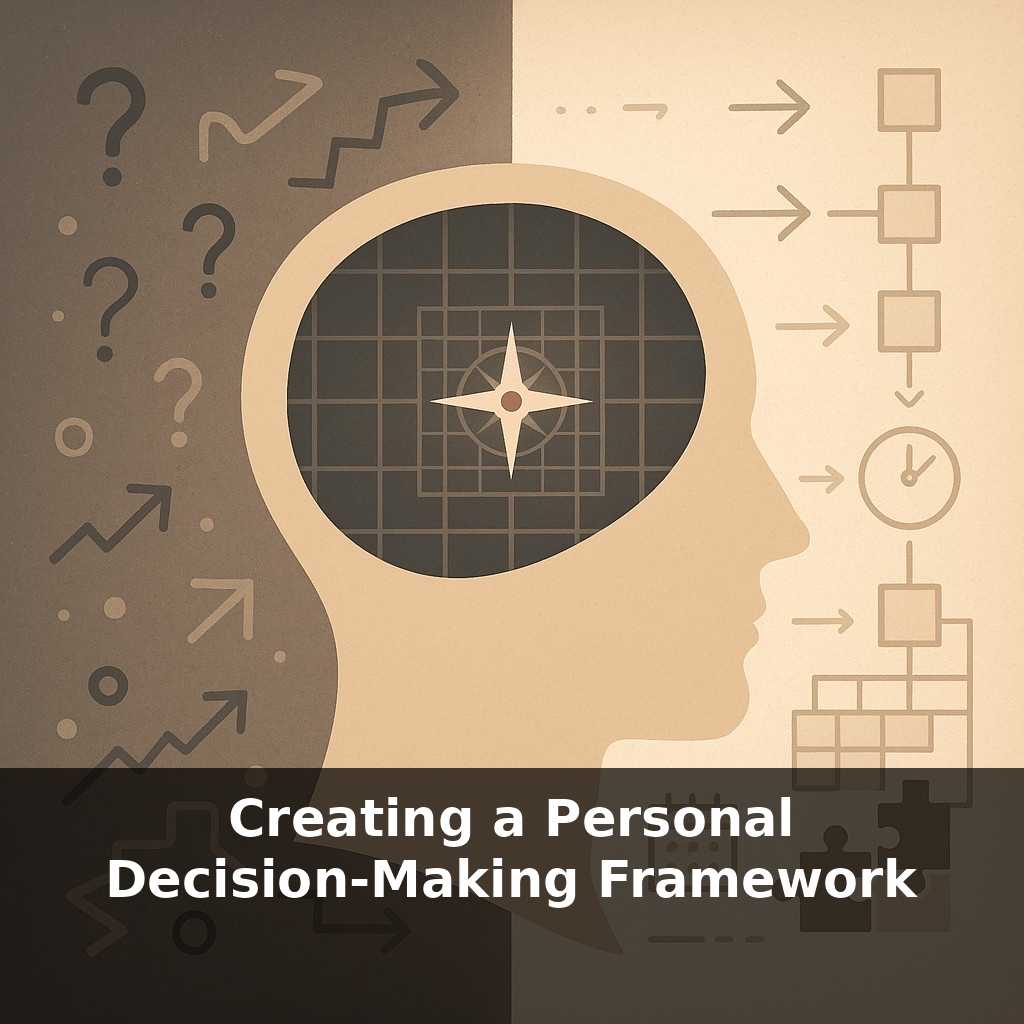
These aren’t rigid scripts. They’re more like a personal playbook: clear categories of decisions you face again and again, simple rules for each, and a way to learn from what went wrong last time. That structure dramatically cuts down the background noise of constant micro-choices and keeps your limited willpower for the moves that actually matter.
In this episode, we’ll map how to build a framework that fits your brain, your schedule, and your values—so your important calls stop depending on how tired you happen to be that day.
Think of this as moving from “making it up as you go” to quietly running a customized operating system in the background. In the research, people who do this don’t necessarily work harder; they design their days so fewer moments depend on willpower at all. Instead of treating every fork in the road as a fresh dilemma, they pre‑decide how they’ll handle the ones that show up over and over. That might look like default rules for money, health, and work, or checklists for stressful situations, so your future self has a safety rail when your present self is tired or stressed.
Most people try to “be more decisive” by pushing harder in the moment. A better move is to change the *type* of work your brain is doing: less ad‑hoc judging, more following pre‑built rails you’ve already thought through when you were rested.
A good starting point is to surface the decision patterns that quietly repeat. Not the dramatic life forks, but things like: “Do I say yes to this invitation?”, “Do I escalate this issue at work or let it ride?”, “Do I buy this now or later?” These aren’t random; they cluster into a handful of recurring types—social, financial, health, deep‑work vs. shallow‑work, learning, and so on. Once you see the clusters, you can stop treating each instance as a brand‑new puzzle.
From there, you can assign each cluster a light structure:
- **Criteria**: What must be true for a “yes”? For example, a freelancer might say: “I only accept projects that hit two of three: good money, good portfolio value, enjoyable team.” - **Defaults**: The action you take if you *don’t* think further. “If a meeting has no agenda by the day before, I decline.” “If a purchase is over $200, I wait 48 hours.” - **Escalation rules**: When does this leave autopilot and get full attention? “If a decision affects my next 12 months or more, I schedule a dedicated session; it never gets decided via text.”
Research on checklists in high‑stakes fields shows that simple, visible structures work best when they’re embedded where the decision actually happens: a one‑page sheet near your desk, a note pinned to your phone’s home screen, a calendar block that reminds you when to switch from reactive tasks to higher‑order choices.
Crucially, your framework has to respect how your brain’s energy fluctuates. Morning‑type people put complex tradeoffs—negotiations, strategic planning—into earlier hours. Night‑owls reverse that. You’re not just choosing *how* to decide, but *when* to put certain decisions in front of your tired or fresh self.
The last piece is a tiny reflection loop. After a meaningful call—changing jobs, ending a project—capture two lines: “What signal did I use?” and “What did I miss?” Over time, patterns emerge: maybe you overweight urgency, or undervalue long‑term learning. That’s not a failure of intuition; it’s input for upgrading next month’s rules so your future choices compound instead of repeating the same blind spots.
A practical way to start is to treat one area of your life like an experiment in “decision architecture.” Take weekly dinners, for instance. Instead of standing in front of the fridge debating options, you set up three rotating themes—“fast,” “healthy,” and “social.” Each theme has two or three go‑to meals. Now the only decision is which theme tonight, not reinventing the menu from scratch.
You can scale the same idea to work. Say you’re constantly torn between deep projects and reactive tasks. You might reserve two fixed “no‑meeting mornings” and create a short checklist you glance at before breaking the rule: “Is this urgent, important, and mine to handle?” If not, it’s deferred or delegated.
Over time, you can treat your rules like an investment portfolio: periodically rebalance. Maybe your “always say yes to opportunities to present” rule served you last year, but now you’re overcommitted. Updating that rule is part of keeping your framework alive, not rigid.
A well-tuned framework today could soon act like a personal “control tower” for your attention. As AI tools watch patterns in your calendar, keystrokes, even heart rate, they’ll be able to nudge you: “Decide this contract now; postpone that email.” The risk is drifting into autopilot, outsourcing not just effort but agency. The opportunity is to reserve your sharpest hours for fewer, more transformative calls—treating routine decisions like indexing a fund, and rare, high‑impact ones like active investments.
Think of this as tuning an instrument: at first you’ll be adjusting constantly, but over time the notes start landing where you want them. As your patterns get clearer, you can invite tools, teammates, or family into parts of the system, like co‑pilots. The point isn’t rigidity; it’s having just enough structure that curiosity can safely take bigger risks.
To go deeper, here are 3 next steps: 1) Open a free Miro or FigJam board and build your personal “decision dashboard” with four columns labeled: Values, Non‑Negotiables, Constraints, and Experiments—then plug in inputs using the 10 core values list from Brené Brown’s *Dare to Lead* as your starting menu. 2) Install the Notion “Decision Journal” template by Farnam Street (FS Blog) and use it on your very next real decision (e.g., job change, project to start/stop) so you capture: options, expected outcomes, risks, and a clear “revisit date” to review how your framework performed. 3) Block 45 minutes to watch one core mental‑models resource—either Shane Parrish’s “Mental Models for Better Thinking” talk on YouTube or read the first three models in *The Great Mental Models, Vol. 1*—then update your dashboard by tagging which model (e.g., opportunity cost, inversion, second‑order effects) you’ll explicitly run every big decision through this month.