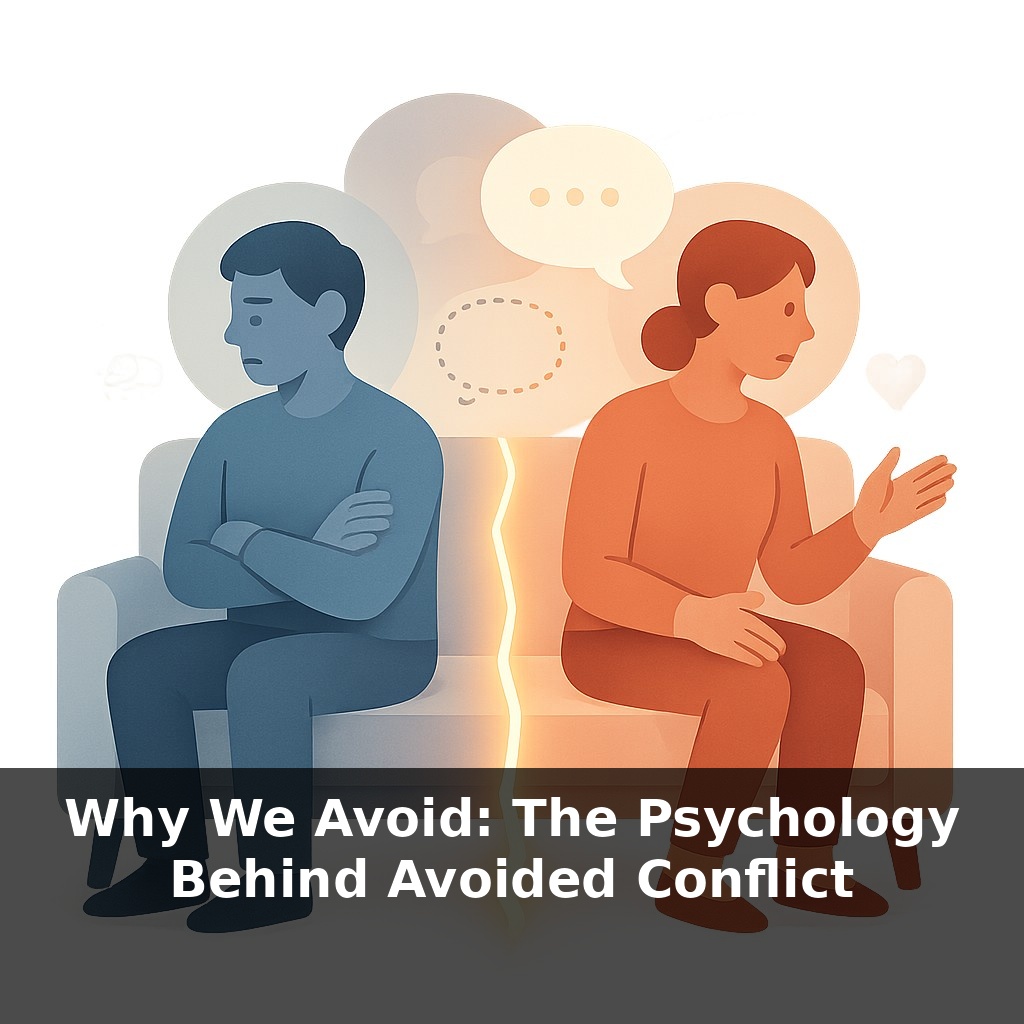
Why We Avoid: The Psychology Behind Avoided Conflict
📝 Transcript
About half of people admit they’ve dodged an important conversation for months. Now jump to a tense meeting, a strained marriage talk, or a friend you’re quietly resenting. The paradox: we avoid conflict to feel safe, yet that very avoidance is what quietly puts our relationships at risk.
Here’s the twist most of us miss: your brain isn’t just reacting to conflict itself—it’s reacting to what conflict *means* about belonging, status, and safety. A raised eyebrow in a meeting can register like a slammed door. A partner’s sigh can feel less like “I’m tired” and more like “You don’t matter.” Layer on top the rules you absorbed growing up—don’t upset Dad, don’t talk back to teachers, don’t make things awkward—and you start to see why your body hits the brakes before you’ve even decided what you think. At work, that might sound like, “It’s not worth it.” At home, “Now’s not a good time.” Over time, these tiny hesitations quietly redraw the map of what feels speakable in your life—and what stays locked behind your teeth.
Zoom out, and a pattern appears: our reactions aren’t just personal quirks, they’re shaped by the “rules of the room.” In some families, raising your voice meant you cared; in others, it meant danger. Some workplaces reward blunt debate, while others quietly punish the person who “makes waves.” Over time, we calibrate ourselves like thermostats, constantly adjusting to avoid social “too hot” moments. Add in past experiences—who exploded, who withdrew, who punished honesty—and your present-day silence often turns out to be an old survival strategy doing its best in a new landscape.
Here’s the part your nervous system doesn’t announce out loud: it isn’t only trying to keep you from *pain*, it’s trying to keep you from *uncertainty*. A tough conversation doesn’t just risk raised voices or awkward silence—it threatens your ability to predict what happens next. And brains love prediction. Predictable tension (“we don’t talk about that”) often feels safer than unpredictable honesty (“if I say this, anything could happen”).
So when a difficult topic appears on the horizon, your mind quietly runs a cost–benefit analysis that’s heavily biased toward the status quo. It overestimates the danger of speaking up (“they’ll be furious,” “I’ll look stupid”) and underestimates the danger of staying quiet (erosion of trust, slow burnout, stalled projects). Psychologists call this *loss aversion*: losing emotional security in the moment feels twice as painful as gaining clarity later feels good.
Layered on top of that is *identity protection*. Conflict can feel like a referendum on who you are: Am I competent? Kind? Lovable? Many people would rather carry silent resentment than risk seeing themselves as “the difficult one,” “the needy partner,” or “the disloyal employee.” So we edit our words to preserve a preferred self-image, even when that image is costing us connection.
There’s also a hidden social calculus at work. If your boss controls promotions, if your partner controls the budget, if your friend controls access to a wider circle, your nervous system tracks that power balance and quietly adjusts your voice’s volume. Avoidance can be a rational short-term strategy in skewed power systems. The trouble is, when everyone is running that same private math, whole teams and families start orbiting around the most reactive or most powerful person in the room.
Over time, this shapes culture in subtle ways. New hires learn which topics never surface in meetings. Kids learn which subjects make a parent go quiet. Couples learn which wounds are “off-limits.” What looks from the outside like calm is often a network of unspoken agreements: I won’t touch your tender spots if you don’t touch mine.
And still, the system leaks. Resentment shows up as sarcasm, “forgetfulness,” chronic delay, or flat disengagement. Decisions get safer but dumber. Creativity shrinks to fit whatever won’t rock the boat. The short-term relief of avoidance quietly trades away the long-term benefits of honest friction.
In a product team, the designer notices a pattern: every roadmap meeting dies the moment anyone questions the VP’s favorite feature. No one says, “We’re scared to push back.” Instead, people show up “too busy” to prepare, or nod along then privately message each other, “This won’t work.” Six months later, the launch flops—not because the team lacked insight, but because the room couldn’t tolerate friction long enough to use it.
At home, a couple never directly talks about money. One partner quietly tracks every expense; the other avoids checking the account at all. Arguments surface over restaurant choices, “laziness,” or whose turn it is to plan vacation, but the core tension stays offstage. Each unresolved moment is like humidity in summer air: invisible until a storm finally breaks, shocking everyone with its intensity.
Notice how, in both cases, people aren’t just dodging topics; they’re redesigning daily life to minimize emotional risk—often at the expense of results, intimacy, and growth.
When avoidance becomes the norm, whole systems start to warp around it. Promotions go to the agreeable, not the insightful. Problems surface on social media before they surface in meetings. Kids learn to debate online but freeze up at the dinner table. As remote work, global teams, and public accountability grow, the cost of silence rises: people will simply leave rooms where their voice can’t land. The future advantage belongs to those who treat disagreement as a trainable skill, not a personality trait.
Next step isn’t to bulldoze into every hard talk; it’s to notice earlier, subtler signals: the email you rewrite three times, the topic that always “runs out of time,” the joke that lands a bit too sharp. Treat these as trailheads. Following just one of them with gentle curiosity can start rewiring what your mind believes is possible.
Here’s your challenge this week: Choose one low‑stakes situation you’ve been avoiding—like correcting a coworker’s recurring mistake, telling your partner you feel overwhelmed by chores, or pushing back on a friend’s last‑minute plan changes—and schedule a 10‑minute conversation about it within the next 48 hours. Before you talk, pick just one feeling (for example, “anxious” or “resentful”) and one need (for example, “clarity” or “more support”) that you’ll clearly name out loud during the conversation. During the discussion, notice and silently label any safety trigger the episode described (“I’m fearing rejection,” “I’m fearing anger,” or “I’m fearing being the bad guy”) at least once instead of changing the subject or backing down.
Unlock all episodes
Full access to 6 episodes and everything on OwlUp.
Subscribe — $1.99/monthLess than a coffee ☕ · Cancel anytime