About 8 in 10 kids say they’ve had serious fights with a brother or sister—yet many of those same siblings end up as each other’s emotional “home base” as adults. In this episode, we’re stepping into that gap between conflict and connection inside your family.
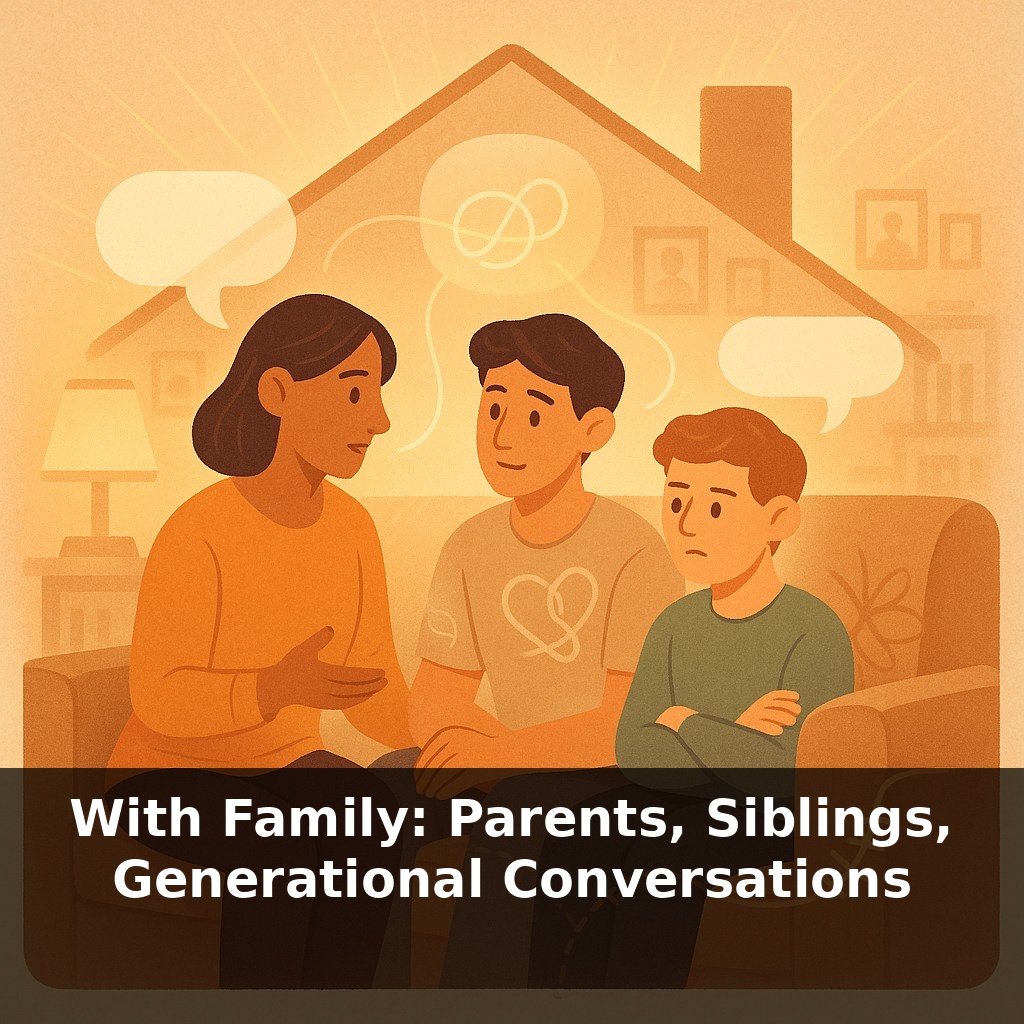
Up close, family conversations can look messy—half-finished sentences, old jokes, sharp comments that land harder than anyone meant. Underneath, though, there’s usually a quiet question driving each voice: *Do I still matter to you in the way I hope I do?* Parents may speak in “updates”—grades, schedules, health—while siblings trade in teasing, and grandparents reach for stories. Each style is like a different “dialect” of the same language: *care*, filtered through generation, temperament, and culture. When these dialects collide, we get eye rolls, shutdowns, or sudden explosions that seem to come from nowhere. In this episode, we’ll slow down enough to see the patterns: who usually pursues, who withdraws, who mediates, and how digital life quietly rearranges all of it. From there, we’ll experiment with small, deliberate shifts that can change the whole family tone.
Some families operate like a group text with no moderator—everyone dropping comments, nobody quite sure what lands. Others feel more like a formal meeting with an unspoken agenda and strict roles: the worrier, the fixer, the ghost. Underneath those roles are nervous systems constantly scanning: *Is this safe? Is this worth it?* That’s where family-systems thinking helps. Instead of asking, “Who’s the problem?” it asks, “What happens right before the eye roll, the shutdown, the blow-up?” In this episode, we’ll zoom in on those micro-moments and experiment with changing just your part of the dance.
Think of this section as a quiet audit of how your family actually *talks*, as opposed to how you wish it worked on paper. Start by noticing *channels*: Who prefers voice notes, who writes long texts, who only really opens up in the car, on a walk, or while doing dishes together? Research on multigenerational households shows that when families respect each person’s preferred channel—even if they don’t share it—the total amount of honest communication goes up.
Next, layer in *timing*. Every family has “high-voltage” windows (late-night, right after work, just before dinner) when everyone is more reactive, and “low-voltage” ones (doing a task side-by-side, early weekend mornings, shared TV time) when people are softer around the edges. Many blowups are less about topic and more about trying to have a delicate conversation in a high-voltage moment. Developmentally, this matters: a teenager cornered at 10 p.m. about life plans is different from that same teen chatting while you drive to get food.
Now look at *hierarchies* and *loyalties*. In some families, alliances run vertically (parent–child duos); in others, horizontally (siblings vs. adults). Add in culture—how your community treats age, gender, birth order—and you start to see why the same comment lands as “loving concern” to one person and “controlling” to another. When an older parent repeats advice, they may be enacting a cultural script about responsibility, not trying to invalidate your adulthood.
This is where meta-communication becomes powerful: saying out loud *why* you’re bringing something up and *what kind of response* you’re hoping for. “I’m not asking you to fix this; I just want you to know what’s going on,” or, from a parent, “I’m about to give unsolicited advice—do you have capacity for that right now?” Families that practice this tend to have less guesswork and fewer secret scorecards.
Sibling dynamics add another layer. That 80% who report rivalry? Many are actually negotiating identity: “Who am I in this family if you’re the smart one, the funny one, the responsible one?” Constructive conflict—arguing rules, fairness, space—can help siblings update those roles, especially in adulthood, where old labels often lag behind current realities.
Finally, notice how tech reshapes *access*. A group chat where everyone shares memes can be emotional “warm-up,” not avoidance. But when hard topics only happen in public threads, nobody feels fully safe. Families often do best with a mix: light, frequent contact in shared spaces plus occasional, intentional one-to-ones where deeper topics are explicitly invited and contained.
A practical way to see these dynamics is to zoom in on tiny, ordinary scenes. Your parent texts, “Call me when you can,” and your body spikes like it’s an emergency. When you finally connect, they just want to tell you a neighbor’s news. On the surface, it’s a mismatch in urgency; underneath, it’s two different expectations about what “staying close” looks like. Or think about siblings planning a holiday: one sends spreadsheets and menu options, another replies with a thumbs-up and goes quiet. The organizer may read that as indifference, while the quiet sibling thinks, “You’re better at this—I’m staying out of the way.” Across generations, a grandparent telling the same childhood story for the fifth time might feel like background noise until you ask, “What were you most afraid of back then?” and the story suddenly updates from entertainment to a window into their values—and the fears still shaping their advice to you now. Each of these moments is a doorway: small, specific, and easy to miss when everyone rushes past.
By 2030, more of us will live in “stacked” households where college kids, newborns, and frail elders share a hallway. That squeezes very different needs—silence, stimulation, autonomy—into one soundscape. Add AI that can flag tension in your voice or summarize long text threads, and families may lean on software the way we lean on dishwashers: helpful, but useless if no one loads it. The opportunity: normalize tiny, regular check-ins on how you talk—like wiping the counter, not remodeling the kitchen.
Families rarely transform through one big talk; it’s closer to learning a new recipe together—awkward first tries, then small tweaks until it tastes right for everyone. As roles evolve, you can keep quietly renegotiating: “What do you need from me now?” Over time, even brief, honest check-ins can turn a tense household into a more breathable place to land.
To go deeper, here are 3 next steps: 1) Pick one “generational script” you heard in the episode (like how your family talks about money, emotions, or success) and spend 20 minutes exploring it with the **“Family Scripts” worksheet** from Therapist Aid or the free **Genogram** templates on **GenoPro** to map how that script shows up across at least three generations. 2) Invite a parent or sibling into a 30–minute “story swap” using 2–3 questions from the **“Parents & Grandparents” section of The New York Times’ *36 Questions to Ask Your Family*** and record it on your phone (or use the free **StoryCorps** app) so you can literally hear how perspectives differ by generation. 3) Choose one book that matches the tension you resonated with most—e.g., **“Adult Children of Emotionally Immature Parents” by Lindsay Gibson** for emotional distance, **“It Didn’t Start With You” by Mark Wolynn** for generational trauma, or **“Set Boundaries, Find Peace” by Nedra Tawwab** for boundary issues—and commit to reading just one chapter tonight, jotting 3 follow‑up questions you want to ask a family member about that exact theme.