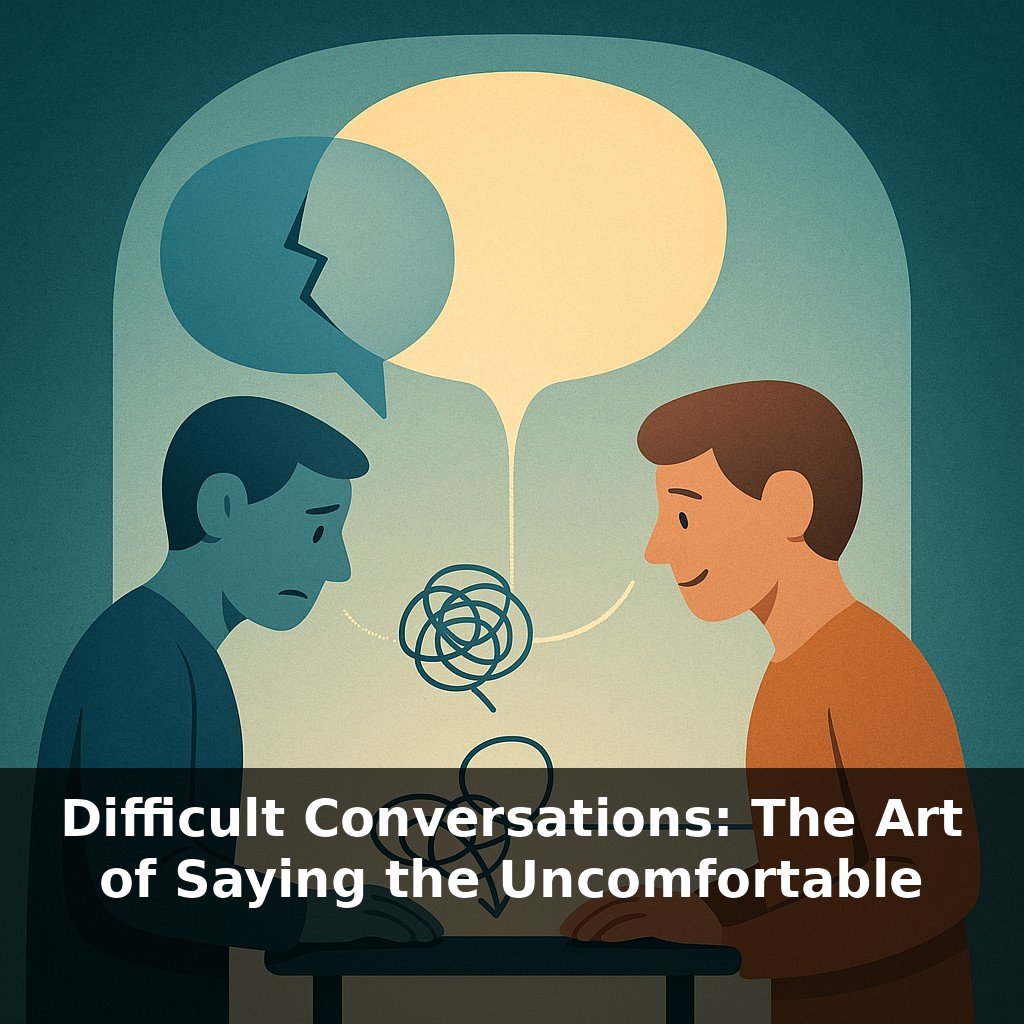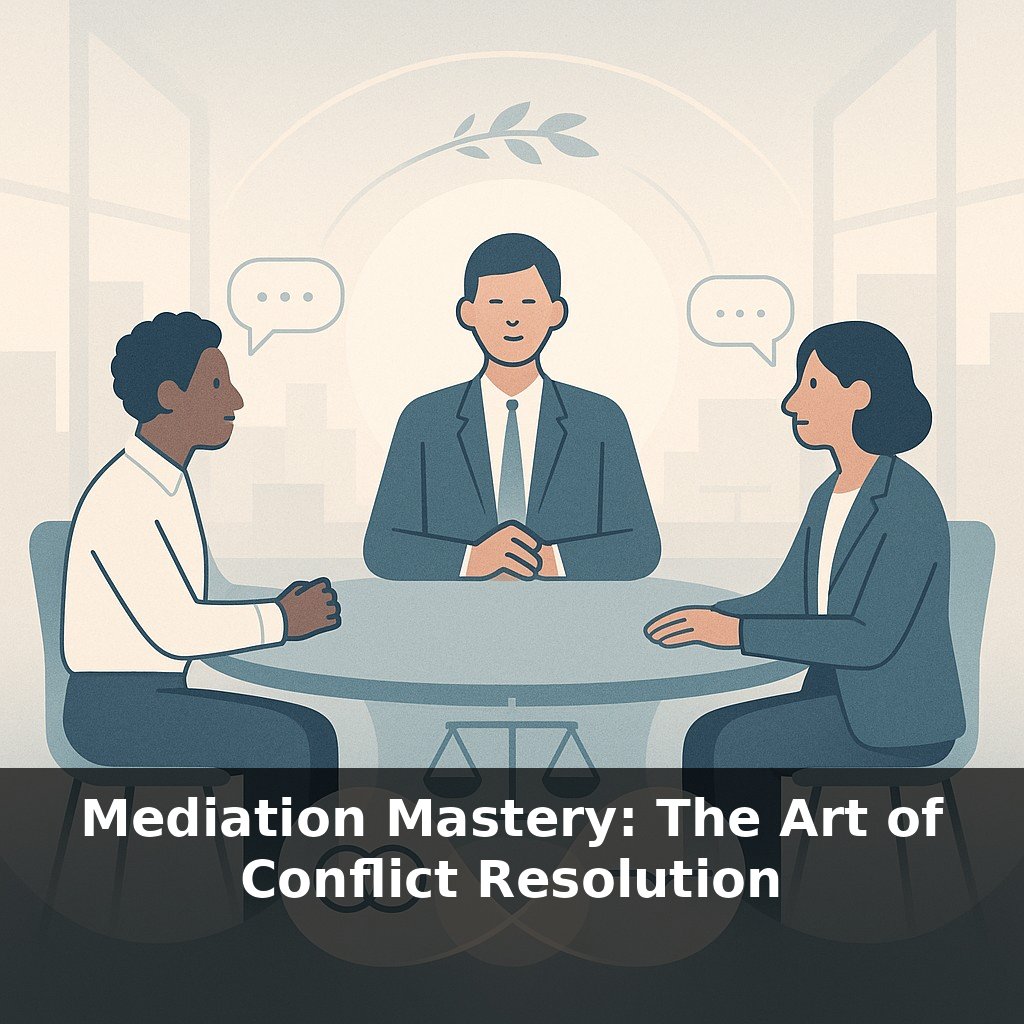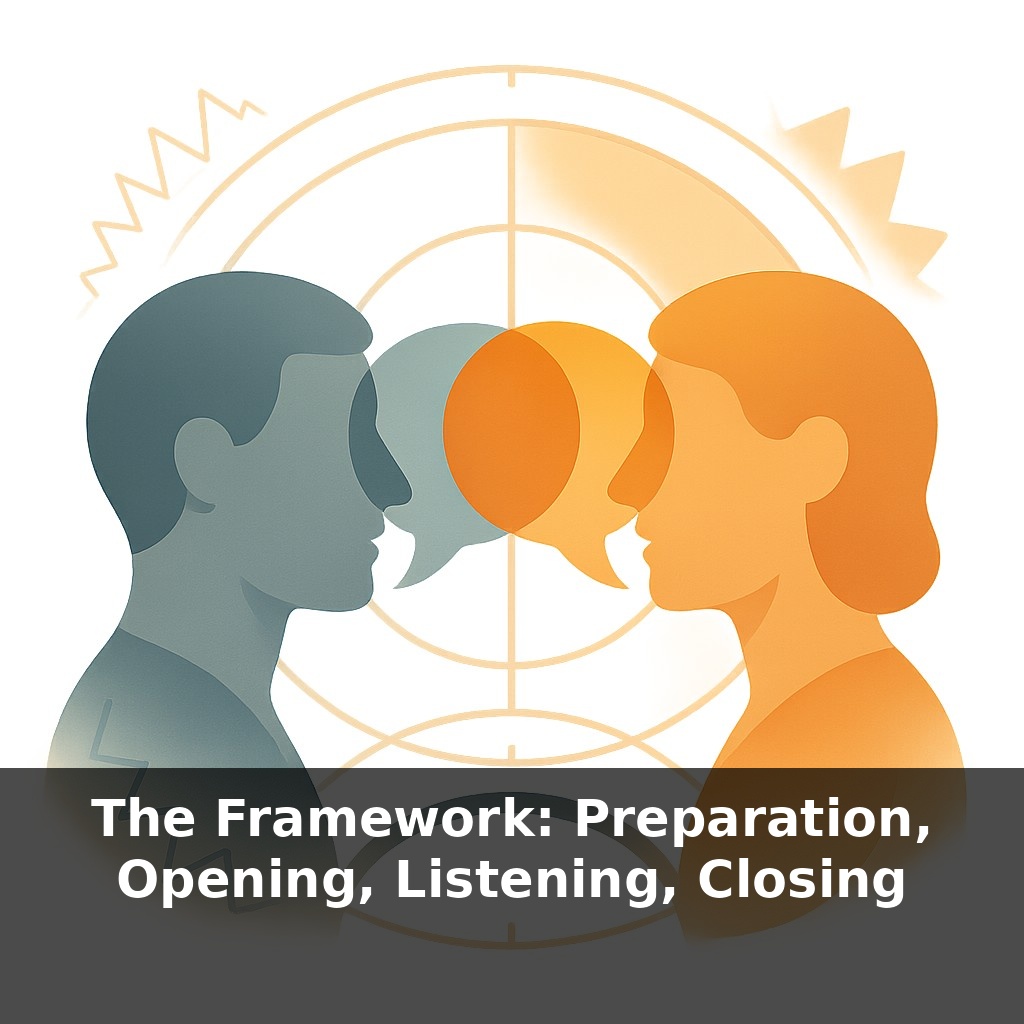
Most “difficult” conversations don’t fail because of the topic—they fail because of the shape. A clear four-part structure can quietly turn a tense salary chat, a breakup talk, or a performance review from a landmine into a bridge. The twist? Most people never learn that structure.
Most of us learn to “wing it” instead. We vent in the car on the way over, rehearse a few lines in our head, and then hope our good intentions somehow survive contact with someone else’s fears, pride, or exhaustion. Sometimes it works; often it doesn’t. The other person hears a surprise attack where we thought we were offering clarity. We hear stubbornness where they’re actually feeling cornered.
Inside organizations, this improvisation tax is huge: projects stall, trust erodes, and small tensions calcify into “we just don’t work well together.” At home, the pattern looks softer but cuts deeper—circling the same arguments, avoiding topics that matter most.
This is where a more deliberate framework earns its keep: not as a script, but as rails that keep the talk from sliding into old ruts.
The research is blunt: when stakes rise, our brains downshift. Stress narrows attention, memory fragments, and we default to habits—interrupting, defending, over-explaining. That’s why even smart, kind people can walk out of a hard talk thinking, “How did that go so sideways?” It’s not just emotion; it’s biology colliding with complexity. A simple, predictable sequence gives your nervous system something to hold onto, like footholds on a climbing wall, so you can stay steady enough to notice nuance instead of just surviving the moment. In this episode, we’ll unpack those footholds and how to use them in real life.
Preparation, in this framework, starts well before you open your mouth. It’s not about scripting the whole exchange; it’s about deciding what game you’re playing. Are you trying to punish, persuade, understand, or solve? Those intentions leak out in your tone and word choice whether you name them or not. Writing down, “My purpose is to understand what’s getting in the way of their performance and agree on one concrete change,” already steers you away from a blame session.
Good preparation also separates three often-tangled threads: facts, stories, and fears. Facts are what a camera would see. Stories are the meaning you’ve layered on: “She doesn’t care,” “He’s checked out.” Fears are the quiet “and if that’s true, then…” spirals—“…I’m not respected,” “…this project will fail,” “…I chose the wrong partner.” When you walk into the room without surfacing these, you argue about calendars and wording while actually fighting about respect and security.
Next comes the Opening, which is less grand speech and more setting the terms of engagement. A clumsy start—“We need to talk”—can spike defensiveness before any content appears. A better opening makes three things explicit: why you’re talking now, what you hope to achieve, and how you’d like to talk. For example: “I’d like us to look at how deadlines have been going this quarter, and see if we can find a way that works better for both of us. I’ll share what I’m seeing, and I really want to hear what it’s been like on your side too.”
Listening is where most people think they’re skilled and where the data says we’re not. If the University of Minnesota work is right and we naturally drop half of what we hear, then in tense moments we’re dropping even more. Disciplined listening means you’re doing three parallel tasks: tracking content (what they say), emotion (how they feel), and impact (how what they say lands on you). Paraphrasing—“So from your side, the priority shifts made it impossible to hit that deadline”—tests whether you actually caught all three.
Finally, Closing turns a good conversation into real-world change. That doesn’t require harmony; it requires specificity. “So what will be different next Tuesday?” is a more useful closing question than “Do we agree?” You’re looking for clear owners, timelines, and a plan for checking back in—plus a brief acknowledgement of the relationship: “This was uncomfortable, and I appreciate that you stayed in it with me.”
Used together, Preparation, Opening, Listening, and Closing form less a rigid script than a reliable arc. When a talk starts veering off, you can quietly ask yourself, “Which part did we skip?” and guide things back on track.
Your brain loves patterns, so let’s give it some. Think of one real conversation you’ve been avoiding: telling a friend you feel taken for granted, asking a manager for clearer priorities, or admitting to a partner you’re overwhelmed. Now map it onto the PO‑LC arc.
Preparation might look like jotting three bullet points: what you’ve noticed, what you’re worried it means, and what you’d like instead. Opening could be a single sentence that orients them: “I want to talk about how we’ve been dividing things at home, and see if we can make it feel fairer for both of us.”
Listening gets real when you hear something that stings and, instead of defending, you get curious: “Say more about that,” or “Can you give me an example?” You’re not agreeing; you’re gathering data you didn’t have.
Closing might be as small as: “Let’s try this for two weeks and then revisit,” or, “We’re not aligned yet, but here’s one thing we both care about…” Your challenge this week: pick one low‑stakes conversation and deliberately walk through PO‑LC, even if it feels a bit mechanical.
Frameworks like PO‑LC are starting to act less like scripts and more like “conversation GPS.” As tools quietly track pace, pauses, and turn‑taking, they can nudge you: “You skipped the Opening” or “Name one concrete next step before you hang up.” Think of it as lane‑assist for dialogue—still your hands on the wheel, but subtle corrections that prevent relational fender‑benders and help you stay aligned with the destination you actually care about.
Over time, PO‑LC becomes less like rails and more like rhythm—closer to learning a dance than memorizing steps. You start noticing micro‑turning points: a raised eyebrow, a shorter sentence, your own urge to interrupt. Each is a tiny fork in the road. The framework doesn’t remove emotion; it just gives you somewhere skillful to place it.
Start with this tiny habit: When you open your calendar for the day, whisper to yourself, “What’s the real outcome I want from my next conversation?” and jot a 3-word goal in the meeting title (e.g., “clarify budget ask”). Before you click “Join” on any call, take one slow breath and choose one opening question you’ll ask first, like “What would make this a great use of your time?” After the meeting ends, before closing the tab, rate your listening from 1–5 in the notes (no explanation, just the number). Finally, as you stand up from your chair, decide one clear closing sentence you’ll use next time, starting with “So what we’ve agreed is…”.