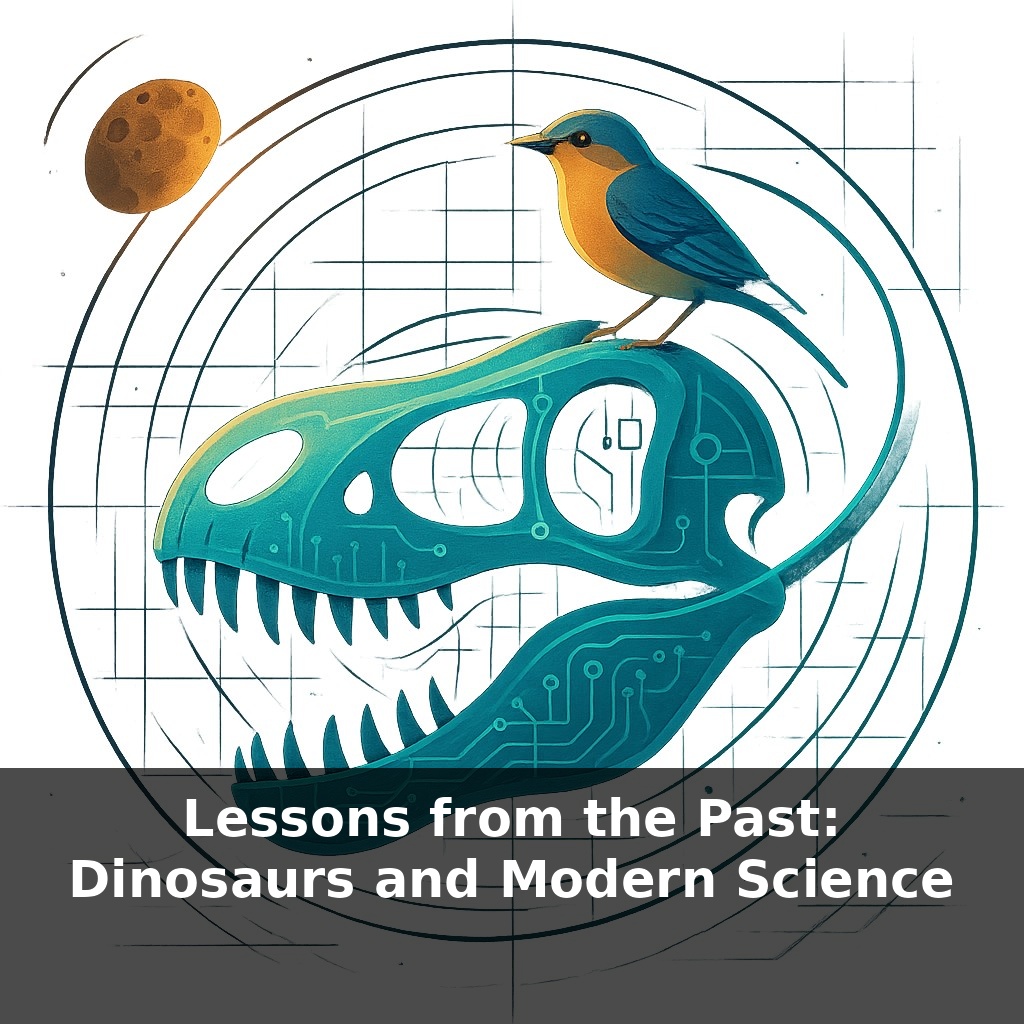
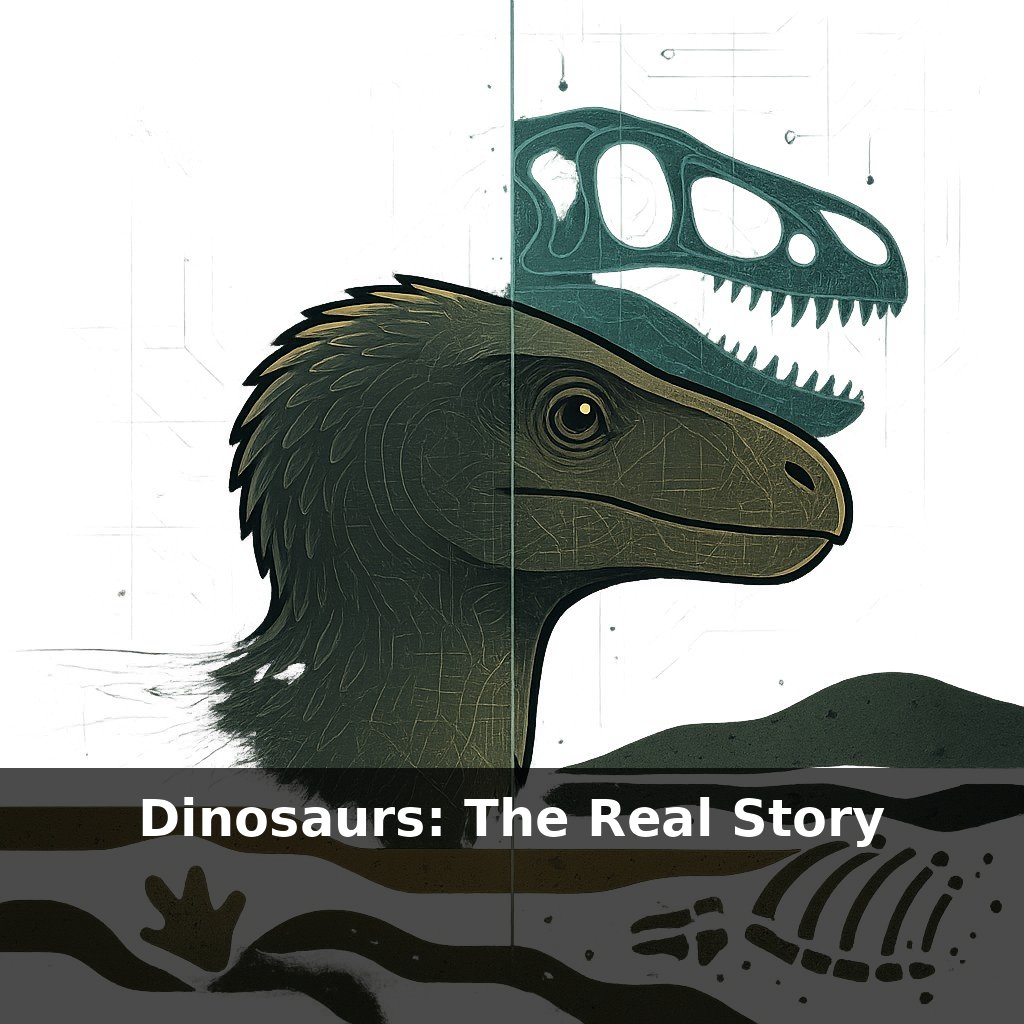
Sixty million years ago, the same lineage that led to the birds singing outside your window survived cataclysmic events. In this episode, we’ll journey from those resilient ancestors to a world-crushing asteroid, to labs where CT scanners and particle beams read fossils like medical records—and show how dinosaur science shapes our future.
Sixty million birds share the planet with us today—twice as many species as mammals—and every one of them is a tiny, fine‑tuned dinosaur experiment still running in real time. In this episode, we move from merely *looking* at ancient bones to treating them as data-rich prototypes. Engineers borrow tricks from sauropod skeletons to build lighter aircraft components; doctors study bone growth rings to understand stress, healing, and even pediatric development; roboticists test raptor‑style legs to design machines that can sprint, jump, and recover from a stumble. Instead of treating extinction as a full stop, we’ll treat it as a plot twist, asking how survival reshaped this lineage into hummingbirds, penguins, and condors. Think of it as opening the “R&D lab notebook” of Earth’s most successful large animals and reading the ongoing experiments written in living wings and hollow bones.
A thousand or so non‑avian dinosaur species have names, yet paleontologists suspect roughly twice that number still lie hidden in rock and drawers, waiting to be described. That means our “sample size” for testing ideas about deep‑time climate, extinction, and adaptation is only half built. Now add birds—living dinosaurs that outnumber mammals nearly two to one—and the dataset explodes into the present. With synchrotron beams resolving pigment grains smaller than bacteria and simulations probing how asteroid impacts reshaped ecosystems, dinosaur research starts to look less like stamp collecting and more like a sprawling, unfinished field experiment.
Sixty‑six million years ago, an object the size of a small city hit Earth with a punch of roughly 10^8 megatons of TNT—millions of times more powerful than the largest nuclear test. That single event didn’t just end most dinosaur lineages; it reset the rules of which body plans, metabolisms, and behaviors could survive global crisis. Modern climate scientists use the K–Pg boundary as a stress‑test scenario: how fast did temperatures spike, how long did food webs take to recover, which environments acted as refuges? When they model future warming, they check their results against this deep‑time catastrophe to see whether their equations can reproduce the patterns actually recorded in rock.
Those patterns become clearer as technology sharpens. High‑energy beams now reveal pigment‑carrying melanosomes in fossil feathers below 100 nanometers, letting researchers reconstruct not just colors but functions: dark wing tips that resist wear, camouflage that might have shaped predator–prey arms races, even heat‑absorbing patches that tweaked local temperature control. Climate, behavior, and physiology start to connect, pixel by pixel.
Biomechanics joins in from another angle. Sauropod neck vertebrae, for instance, could be up to 60% air by volume, braced with internal struts. Aerospace engineers borrow that architecture for ultra‑light panels, but physiologists ask a different question: how do you move blood and oxygen efficiently through such an extended system? The answers loop back to medicine, where similar flow‑and‑support problems appear in everything from children’s spines to artificial implants.
The numbers themselves tell a story of continuity rather than disappearance. Roughly a thousand non‑avian dinosaur species have formal names, and perhaps double that number still wait in stone or museum drawers. Yet their living relatives have exploded into nearly ten thousand bird species, outnumbering mammals almost two to one. That uneven balance is a test case in evolutionary resilience: why did this branch diversify so explosively while others stalled or vanished?
Studying dinosaur skeletons, skin chemistry, and extinction patterns is like sports analysts combing through decades of game footage: not nostalgia, but a hunt for strategies that keep working as the rules, players, and arenas change. By treating the deep past as a running experiment instead of a closed story, modern science turns ancient disasters and recoveries into practical hypotheses about our own planetary future.
When researchers model dinosaur joints, they sometimes hand the resulting “digital skeletons” to robotics labs, which treat them like challenging new sports moves. A two‑legged robot trained on theropod‑style gait can practice sharp pivots and sudden stops, then feed those motion strategies back into warehouse bots or planetary rovers that have to stay upright on unpredictable ground. Skin and feather data stream into another field: conservation biologists compare ancient heat‑management tricks with those of modern birds in warming habitats, asking whether certain color patterns or feather layouts predict resilience. Even cancer research gets a foothold here. Some titanosaurs show bone overgrowths and healed lesions; pathologists compare these to modern tumors to see which cell behaviors have barely changed in 100 million years, hinting at deeply rooted vulnerabilities. And by mapping where different dinosaur groups thrived along ancient coastlines, climate modelers test whether their simulations can reproduce shifting habitat bands under past greenhouse conditions.
Deep time becomes a testing ground for choices we haven’t made yet. By comparing ancient heatwaves, habitat shifts, and recovery times, planners can rank today’s risks like coaches setting play priorities. Genome work on living lineages may soon let labs “rewind” specific traits, not to revive monsters but to probe how bodies adapt—or fail—under stress. And as asteroid‑defense drills borrow from past impacts, virtual ecosystems train students to spot tipping points before they arrive.
Instead of treating deep time as a museum wing, we can use it like a lab notebook still open on the bench. New tools will keep decoding muscles, microbiomes, even ancient diets from trace molecules, then stress‑testing our climate models and materials science. Your challenge this week: spot one everyday design that quietly echoes a much older, wilder world.