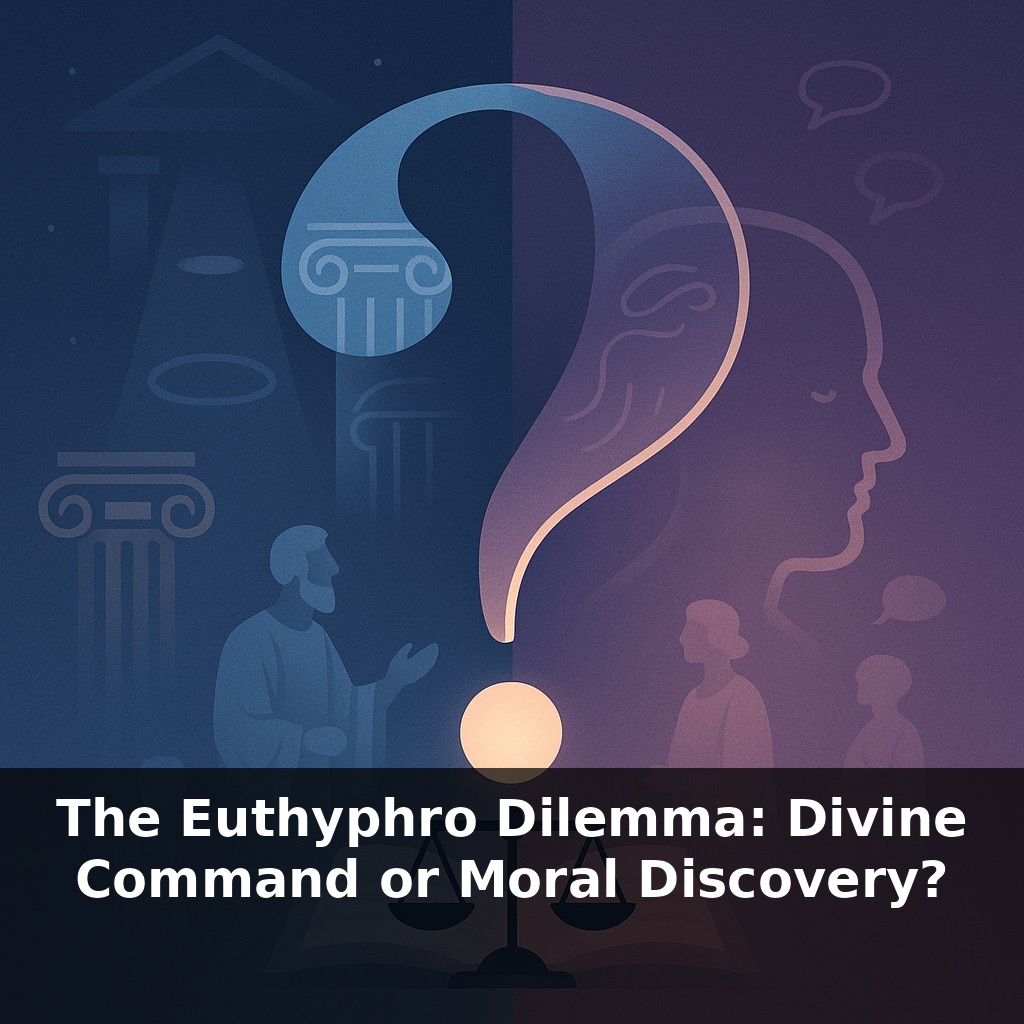
The Euthyphro Dilemma: Divine Command or Moral Discovery?
📝 Transcript
“Morality doesn’t need God.” That’s what about half of people in the U.S. now say. A parent pauses before lying to protect their child. A judge hesitates over a harsh but legal sentence. In those split seconds, whose voice should matter more: conscience, or command?
Socrates cornered Euthyphro with a question that still unsettles believers and skeptics alike: does rightness flow from a higher will, or does any will—divine or human—have to answer to a deeper standard? Today, the tension shows up in quieter ways. A doctor weighs patient confidentiality against a family’s desperate plea. A software engineer debates whether to ship a feature that’s legal, profitable, and yet potentially addictive. In moments like these, appeals to rules, outcomes, or gut feeling can clash. The Euthyphro dilemma presses us to ask: when these sources pull apart, which one has the final say—and why? Philosophers have offered intricate blueprints, from rooting value in a perfect nature to insisting that goodness “just is” a basic feature of reality. But living with this question may matter more than solving it.
Religious traditions often answer by saying: “trust the source.” If the divine will is perfectly wise and loving, then following it should align with what’s best for us, even when we don’t see how. Secular thinkers push back: they note that different scriptures, sects, and leaders claim conflicting commands, like rival software updates competing for control of the same device. Meanwhile, psychologists track how people actually choose: we revise our principles after hard cases, defer to communities we respect, or quietly bend rules for people we love. The dilemma sits beneath these patterns, quietly shaping which compromises feel honest—and which feel like betrayal.
Philosophers usually map the Euthyphro terrain into three broad routes.
The first keeps a strong version of divine command. On this view, an action’s status depends on a perfectly free, authoritative choice. Robert Adams’ influential twist tries to soften the arbitrariness worry: he argues that commands flow from a loving character, so the kind of commands that seem abhorrent—cruelty for its own sake, betrayal of the innocent—would be impossible from such a source. Critics respond that this leans heavily on prior ideas of love and worth that already look like an independent standard.
The second route sidelines commands and roots normativity in features of the world: pleasure and pain, flourishing and harm, fairness and respect. Here, a deity might still matter as creator, sustainer, or ideal observer, but not as the legislator who makes acts right simply by willing them. Moral realism in this sense treats facts about cruelty, deception, or exploitation as discoverable—more like physics than policy. Disagreement then looks less like clashing edicts and more like flawed measurement, bias, or limited data.
A third family of views tries to fuse these strands by focusing on character rather than orders. Instead of asking which rules a perfect being would announce, they ask what it would be like to embody perfect wisdom, justice, and care. Commands, liturgies, and laws become tools for shaping that kind of life, not the ultimate foundation. On this model, revelation might function like a carefully designed training program: drills, habits, and constraints aimed at cultivating the abilities that track what really matters, including where current intuitions are unreliable.
Empirically, the picture complicates further. The modest boost in prosocial behavior under religious priming suggests that, at least in some settings, people act a bit better when reminded of an observing presence, shared stories, or sacred standards. But the data don’t tell us whether they are responding to fear of sanction, admiration of an ideal, a sense of belonging, or something else entirely.
For personal deliberation, the dilemma becomes less an abstract puzzle and more a standing audit: when a perceived command clashes with your considered judgment about harm, fairness, or dignity, which side do you treat as the error signal—and what would ever justify flipping that choice?
A developer weighs whether to implement an algorithm that keeps users scrolling longer. Legal? Yes. Profitable? Definitely. But their team’s split: some appeal to company principles about user well‑being, others say, “If leadership signs off, that settles it.” The live question beneath the meeting room tension is whether authority creates the “ought,” or merely recognizes it.
History offers sharp contrasts. Abolitionists like Frederick Douglass appealed to a justice they took to stand in judgment over religiously defended slavery. Meanwhile, some defenders of segregation once cited sacred texts to justify laws we now find appalling. Were reformers disobeying the highest standard—or finally aligning with it?
Think of a championship coach who both writes the playbook and studies the game’s objective realities. When the coach changes a strategy mid‑season, is that a new rule of the game—or a better reading of what wins? The distinction tracks how we read any claimed source of guidance: as creator of the target, or as its most skilled interpreter.
As AI, law, and culture interlock, the dilemma quietly shapes code, courts, and classrooms. Software teams must decide whether to treat policies like fixed “patch notes” or as provisional guesses at a deeper best‑practice. In global politics, coalitions need shared “rules of the game” that neither erase faith traditions nor depend on any single one. Interfaith projects, bioethics boards, even workplace charters all become test labs for whether we are obeying, discovering, or co‑creating the ought.
Treat this puzzle less like a riddle to solve and more like open‑source code you’re always refactoring. Each hard choice is a commit: sometimes you follow a spec, sometimes you override it when tests—lived consequences, dialogue, doubt—fail. Your challenge this week: notice one moment you “obey” and one you “revise,” and ask what you trusted most.
From this course
Echoes of Ethics: Legendary Philosophical Dilemmas
7 episodesUnlock all episodes
Full access to 7 episodes and everything on OwlUp.
Subscribe — $1.99/monthLess than a coffee ☕ · Cancel anytime