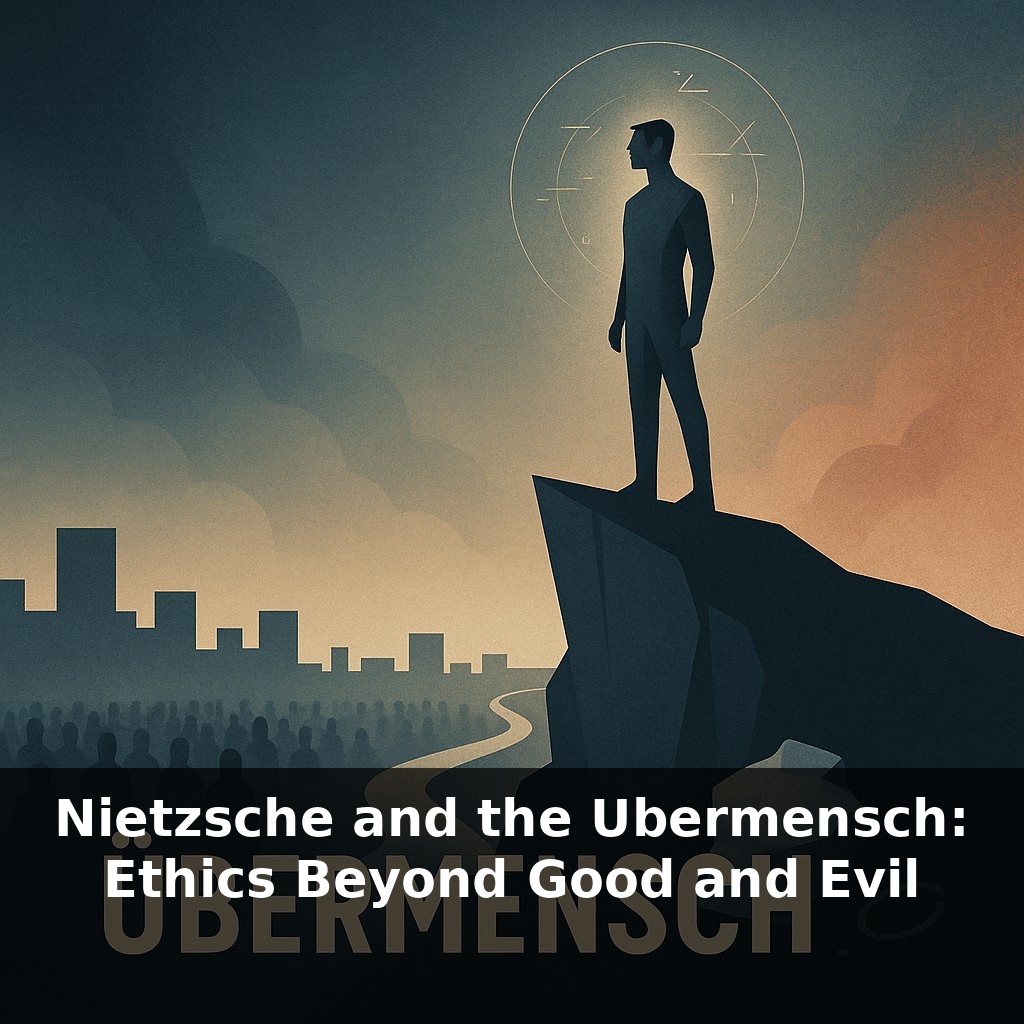
Nietzsche once wrote, “God is dead.” The surprising part isn’t the death—it’s what comes next. A world still buzzing with laws, morals, and guilt, but no ultimate referee. In that world, whose rules are you really following—and who gave them that power?
Nietzsche thinks most of us live on “moral autopilot.” We inherit ready‑made judgments—selfless is good, selfish is bad; obedience is noble, disobedience is suspect—and we run them without ever checking the code. That’s where the Übermensch enters: not as a comic‑book superhero, but as a human who dares to ask, “What if these values aren’t mine at all?” For Nietzsche, our familiar moral language hides a history of power struggles, resentments, and compromises. He suspects that much of what we call “conscience” is just old social pressure whispering in a modern voice. The Übermensch is his risky proposal for what a person might look like who notices this—and doesn’t collapse into cynicism or nihilism, but responds by crafting a style of life that feels internally earned, rather than externally imposed.
Nietzsche sharpens the stakes by insisting that “good” and “evil” are not cosmic labels but historical inventions—tools shaped by those who needed to tame, guide, or sometimes weaken certain kinds of people. In Beyond Good and Evil he peels back the polished surface of moral language to expose older battles over strength, vulnerability, and control. Instead of asking, “Is this rule correct?” he asks, “Who benefits from this rule, and what does it do to the person who obeys it?” That shift turns ethics into a live experiment: each value you hold becomes a clue about the kind of life you’re quietly training yourself to live.
Nietzsche thinks the real turning point isn’t when you *reject* inherited values, but when you can finally *see through* them. That’s why his Übermensch talk in *Thus Spoke Zarathustra* is surrounded by psychological portraits: the last man, the tight‑laced moralist, the herd. They all share one trait—fear of standing alone with their own deepest drives and saying, “Yes, this is mine.”
For Nietzsche, going “beyond good and evil” is less about breaking rules and more about outgrowing them. The crucial question becomes: are your highest principles expressions of your particular energies—or clever disguises for fatigue, resentment, or fear? He suspects that many noble‑sounding ideals—universal compassion, equality at any cost, suspicion of excellence—can secretly function as weapons of the discouraged against the vivid, or of the cautious against the risk‑taker.
This doesn’t mean Nietzsche sides with the bully. He’s alert to how easily the language of “strength” can mask vulgar domination, nationalism, or cruelty. His notebooks warn against hunting for higher types in flags or crowds: whenever a mass movement claims to embody greatness, he hears the rumble of mediocrity organizing itself. The Übermensch is always singular, never a party platform.
So what does creation of new values look like in practice? Nietzsche hints at three moves:
1. **Radical honesty about motives.** Before praising an ideal, ask what part of you it empowers. Your ambition? Your fear of being disliked? Your fatigue with conflict?
2. **Selective affirmation.** Not every impulse deserves to be crowned as a value. The task is to affirm those tendencies that make you more able to bear reality—uncertainty, loss, complexity—without retreating into comforting stories.
3. **Artistic rigor.** He often compares ethics to art: a strong life has style, coherence, and the courage to cut what doesn’t fit the emerging whole. Taste becomes a moral faculty: you learn to feel which habits cheapen you.
The specter haunting all this is nihilism: the moment when old meanings collapse and nothing yet shines in their place. Nietzsche doesn’t treat this as a phase to skip, but as a test. If you can endure that exposed space without rushing back to ready‑made certainties, you clear room for values that are not just inherited, but hard‑won—and unmistakably your own.
A runner aiming for a personal record doesn’t ask, “What’s the universally correct pace?” They track splits, watch their breathing, and adjust—even if a coach’s old plan says otherwise. Nietzsche thinks ethical life, at its highest, looks closer to that: experimental, responsive, tuned to what stretches your capacities without breaking them.
Consider someone in a prestigious job that slowly numbs them. The “responsible” script says: stay, be grateful, don’t risk it. A Nietzschean move isn’t reckless quitting for thrills; it’s asking which path makes you feel more *awake* and more able to carry difficulty. Maybe that means building a side project that eventually replaces the job; maybe it means transforming the role from within.
Or take relationships: instead of defaulting to “never cause conflict,” you might value conversations that are uncomfortable but deepening. The test is not “Was I nice?” but “Did this encounter enlarge or diminish both of us?”
A century from now, Nietzsche’s challenge may feel less like rebellion and more like basic survival skill. As algorithms steer choices and edit genomes, “default settings” won’t stay neutral; they’ll quietly script lives. Treat his call as training in ethical “code review”: who wrote this script, what does it optimize for, and do I consent? In that world, learning to revise your own values becomes less a luxury and more a civic competency.
So Nietzsche leaves us with a risky invitation: treat your life like a draft, not a final copy. Traditions can be raw material, but you choose what survives the edit. Instead of asking “Is this allowed?” you might ask “Does this deepen my grip on reality?” Not a license for ego trips, but an ongoing experiment in becoming someone you can bear to be.
Try this experiment: For one day, treat a single ordinary activity—like your job, workout, or creative hobby—as your “will to power” training ground. Before you start, clearly reject one inherited rule you normally follow there (for example, “I must always be agreeable in meetings” or “I should only make ‘safe’ art”) and consciously replace it with your own principle that feels more life-affirming and bold. Then, act through the day as if you were the creator of values in that context, noticing where you feel more alive, where you feel resistance, and whether people’s reactions actually matter as much as you assumed. In the evening, honestly ask yourself: “If I lived like this more often, would my life feel more like a ‘yes’ to existence or a ‘no’?”