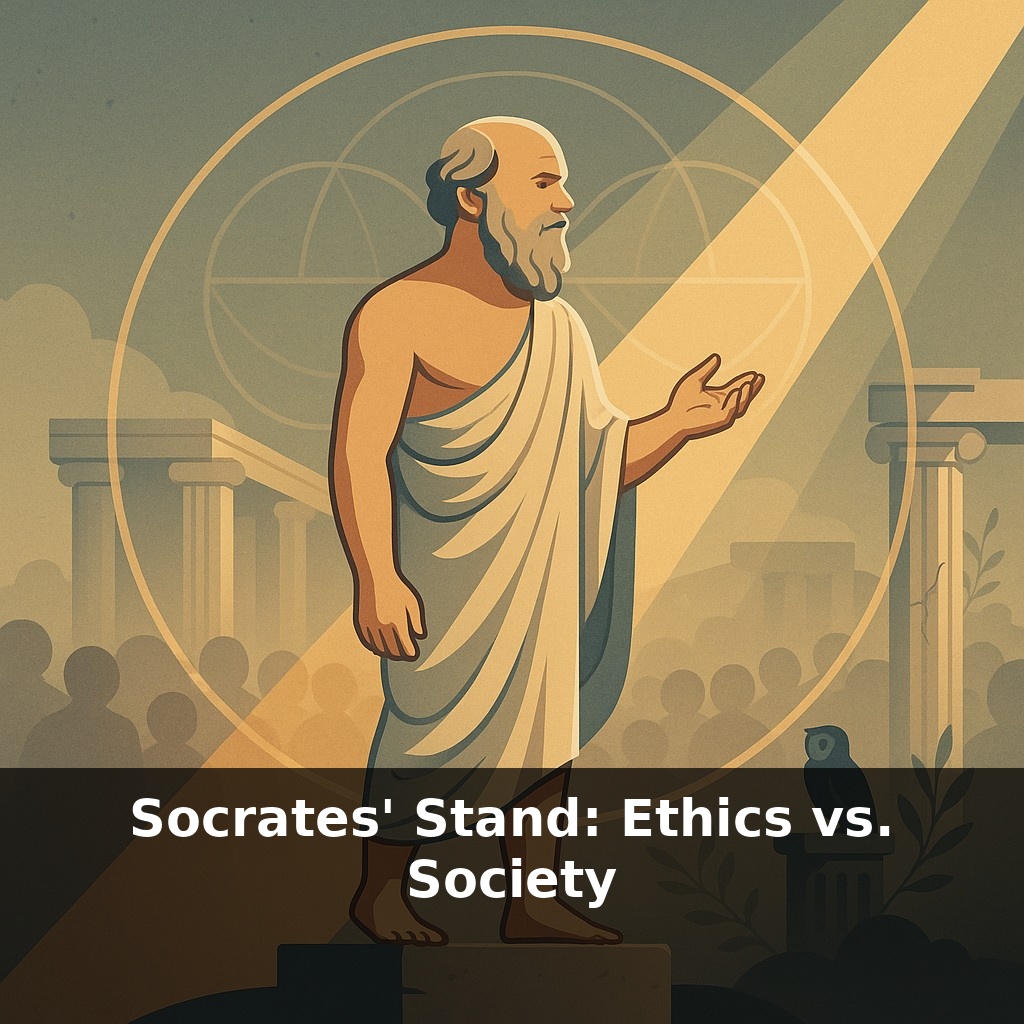
On a bright morning in ancient Athens, a barefoot old man walks into court, fully expecting to die—and refuses to defend himself the way his friends beg him to. He claims there’s something even worse than death. This episode asks: was he right?
The Athenian court isn’t just deciding one man’s fate; it’s stress‑testing an entire city’s values. Socrates stands there accused of corrupting youth and disrespecting the gods—but underneath the legal charges lurks a sharper question: who gets to define what a “good life” is, the individual conscience or the collective voice?
While the jury weighs his case, Socrates quietly runs a different trial in his own mind. Not “How do I survive this?” but “What kind of person will I become if I bend?” His friends urge him to play the game: flatter the jurors, parade his family, beg for mercy. He refuses, sensing that once he trades integrity for safety, the exchange can’t be undone—like building a house on a crooked foundation that will twist every floor above it.
Socrates doesn’t just argue; he redefines what counts as “losing.” For him, the real defeat would be living in a way his own mind could no longer respect. So when the jury votes—by a margin small enough to sting but large enough to kill—he treats the verdict less as a personal tragedy and more as a stress test of Athenian values. His friends later press him in dialogues like the *Crito*: why not flee, bend the rules just this once? Socrates turns the question around: if laws are like the load‑bearing beams of a city, what happens when you saw through them whenever fear spikes?
Socrates sharpens his position with two moves that still unsettle readers. First, he claims that doing wrong damages the doer more than any punishment hurts the body. Second, he insists that this holds even when everyone around you disagrees—even when they can legally kill you for it.
In Plato’s *Apology*, he tells the jurors that if they let him go only on the condition that he stop questioning people, he will disobey. He’d rather face their sentence than betray what his lifelong inquiry has shown him: that untested certainty is dangerous, especially when it has power. His “gadfly” role isn’t self‑flattery; it’s a diagnosis of what happens when a city becomes too sure of itself to tolerate criticism.
Yet in the *Crito*, when escape is possible and even arranged, he declines. This can sound contradictory: the man who defied public opinion now bows to its verdict. But Socrates draws a sharp line between refusing to act unjustly and actively breaking the structure that makes any shared life possible. If he fled, he argues, he’d be undermining the very framework that allowed him to argue, teach, and challenge his fellow citizens in the first place.
The result is a position that frustrates both rebels and loyalists. He refuses to flatter the crowd, but he also refuses to treat his own judgement as a license to tear up agreements whenever they hurt. His stance becomes a kind of prototype for later thinkers of civil resistance: you may openly challenge a community’s decisions, and even suffer their penalties, but you must not casually warp the procedures that let disagreement be handled without perpetual violence.
Modern debates about whistleblowers, conscientious objection, and free speech still echo his problem. How far should a person go in resisting what they see as wrongdoing? When, if ever, is it right to step outside the agreed rules rather than absorb the blow from within? Socrates leaves us not with a policy manual but with a demanding example: accept personal risk before you ask the moral fabric of your community to carry the strain.
Consider a modern scientist at a government agency who discovers unsafe data being buried. No law forces her to stay silent, but every incentive nudges her to “play along.” If she speaks up, she may lose her job, reputation, even friends. If she doesn’t, she keeps her comfort—and must live with what she allowed. Her dilemma tracks Socrates’ in structure: the real battlefield is internal, not just legal or professional.
Or think of an employee at a tech company asked to help design software that nudges users toward addiction‑level engagement. The contract is legal, the paycheck welcome, the praise tempting. But each small “yes” shifts the line of what they can accept next time.
Here’s where Socrates’ legacy bites: he suggests that your deepest commitments are proved precisely when the crowd is mildly, not monstrously, wrong—when the pressure is just enough to make compromise seem reasonable. The choice is rarely between obvious heroism and villainy, but between slightly altering your course now and waking up years later in a life you no longer recognize.
Future Socratic “gadflies” may surface less in courts and more in code reviews, research labs, and policy teams training AI. As systems learn from past behavior, the quiet choice to flag a biased dataset or reject a manipulative design can redirect entire feedback loops. Think of a software patch that silently prevents a future crash: small, principled interruptions today could keep tomorrow’s institutions from “locking in” harmful defaults as unchangeable moral operating systems.
Socrates leaves us with an uncomfortable test: not “Would I die for my beliefs?” but “Where do I quietly edit them to fit in?” Think of each small silence like skipping a software update—harmless today, but over time your inner code drifts from the person you thought you were. The open question is which future self you’re currently training.
Start with this tiny habit: When you feel a twinge of “this doesn’t feel quite right” in a conversation, silently ask yourself, “What would Socrates question here?” and form just one honest question in your head. Then, if it’s safe, calmly ask a softer version out loud, starting with “Help me understand…” instead of going along quietly. Each time you do this, you’re taking a mini Socratic stand—no speeches, just one small, courageous question.