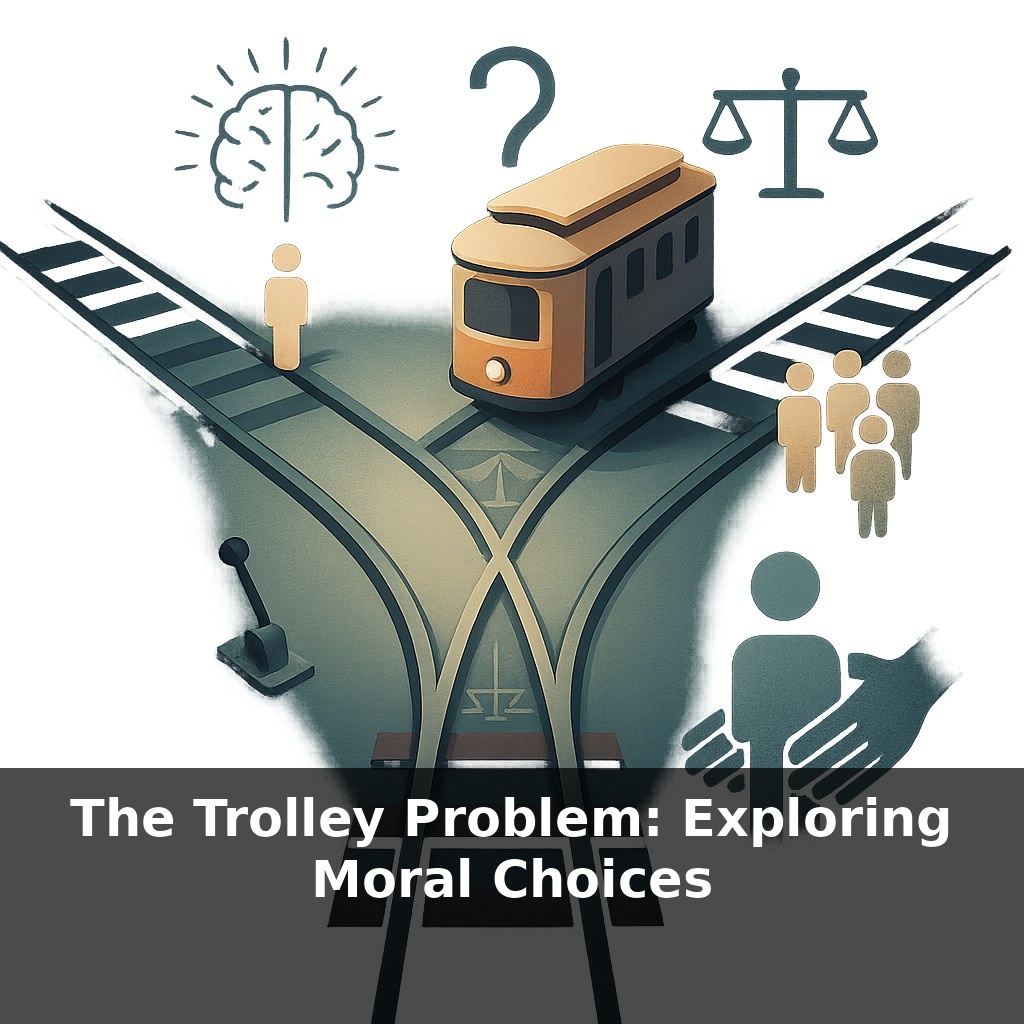
Someone pulls a lever. A trolley shifts tracks. One person dies, several are saved. Most people say, “I’d do it.” Now change one detail: no lever, just your hands on a stranger’s back. Same lives saved—very different gut response. Why does a tiny twist reshape our morals?
Now zoom out from the tracks. Philosophers turned this quirky puzzle into “trolleyology,” a whole micro‑field devoted to probing where our moral lines actually are—and how easily they bend. Today, it’s no longer a classroom game. Engineers quietly face trolley‑style choices when they design self‑driving cars, hospital software, even content‑moderation systems. Whose safety gets prioritized when not everyone can be protected?
Lawyers and policy makers, too, wrestle with how much “sacrifice for the greater good” we’re willing to encode into rules. The unsettling twist: our instincts aren’t just private feelings; they’re being translated into algorithms and protocols that could one day decide who lives, who gets care, or who takes the digital fall when something goes wrong.
Greene’s fMRI studies hint at what’s happening under the hood: abstract trade‑offs tend to light up more “cold” cognitive regions, while up‑close harm pulls in our emotional circuitry. That helps explain why a lever feels different from a shove, even when the outcome matches. Large‑scale projects like the Moral Machine go further, revealing patterned quirks: some cultures lean toward sparing the young, others the law‑abiding, others those with more “social role” to play. It’s less a single moral code and more a patchwork, stitched from history, religion, and everyday expectations.
Shift now from brain scans and survey graphs to the structure of the dilemma itself. The classic setup hides a quiet sleight of hand: it freezes the world so only two options remain, as if the brakes failed, the radio’s dead, and every bystander is paralyzed. In real crises, people improvise. Operators pull emergency cords, shout warnings, or try kludgy work‑arounds. That gap between the stripped‑down puzzle and messy reality is where much of the modern debate lives.
Philosophers use the trolley family to tease apart different “moral ingredients” the simple story bundles together. There’s intention: are you aiming at harm, or foreseeing it as a side‑effect? There’s means: is the harm a tool you use to achieve the goal, or a tragic byproduct? There’s proximity and “personal force”: levers, switches, code, and institutional rules feel psychologically distant from hands‑on contact, even when responsibility is comparable on paper.
This is where distinctions like doing vs allowing harm, or killing vs letting die, become more than word games. Redirecting a runaway train that will otherwise kill many is framed as preventing a larger disaster, even if one person will now be hit; pushing someone into danger feels like creating a new wrong, not merely steering an existing one. Critics argue our intuitions here might be biased by storytelling tropes and legal conventions rather than deep principles.
The medical world has wrestled with these tensions for decades. Withdrawing a ventilator, reallocating an ICU bed, or choosing among patients for a scarce transplant organ all echo trolley structures, but with added layers: prior commitments to patients, informed consent, discrimination law, and public trust. A choice that looks cleanly “numbers‑based” from afar can corrode legitimacy if people feel they’ve been treated as expendable.
Designers of autonomous systems confront a similar tension to architects choosing where to place load‑bearing columns: some trade‑offs are unavoidable, but how you distribute the load—and who approved that blueprint—matters. The IEEE’s guidance pushes teams to make these trade‑offs explicit, document alternatives considered, and involve stakeholders who might otherwise be reduced to abstract dots on a track diagram.
A good way to see how these trade‑offs surface is to leave the tracks entirely and walk into a software sprint. A team building a hospital triage app debates a rule: in a bed shortage, prioritize patients with the highest chance of recovery. On the whiteboard, it’s a clean rule; in practice, it might repeatedly sideline chronically ill patients who already distrust the system. Another team designing social‑media safety tools must choose: tune aggressively to block hate speech and risk silencing activists, or relax filters and accept more harm reaching vulnerable users. Neither option is “neutral”; both encode a ranking of whose risk counts more.
One more layer: which voices shape these blueprints? A city transit authority piloting an automated braking system might invite only engineers and executives to the table—or add disability advocates, bus drivers, and insurers. Same technology, different distribution of risk, because different people got to say what “acceptable loss” looks like.
As sensors, data, and AI fuse into everyday tools, the “track layout” stops being hypothetical. City dashboards will quietly reroute ambulances, blackout‑prevention grids will cut power to some neighborhoods before others, and hospital software will reshuffle waiting lists in real time. The deeper implication: hidden settings and defaults become moral levers. The next frontier isn’t just asking what’s right, but who holds those levers, and how visibly they are labeled.
So the next time headlines debate whose data, comfort, or access gets trimmed “for efficiency,” notice the track beneath the language. In practice, these choices look less like heroic rescues and more like quiet edits to code, budgets, and maps—subtle reroutings that, like a city’s plumbing, decide who gets pressure and who lives with a slow drip.
Before next week, ask yourself: 1) “If I were actually standing at the lever in the classic trolley scenario, which matters more to me in that moment—minimizing total harm (saving five) or refusing to intentionally cause harm (not pushing the lever)—and why?” 2) “Thinking about my real life (my job, my relationships, my community), where am I already trading off the needs of the many versus the few—who are the ‘five’ and who is the ‘one’ in those choices?” 3) “If I imagine the ‘fat man on the bridge’ variation, what concrete boundary do I discover about what I would never do, even if it saves more people—and what does that reveal about the values I want to live by this week?”