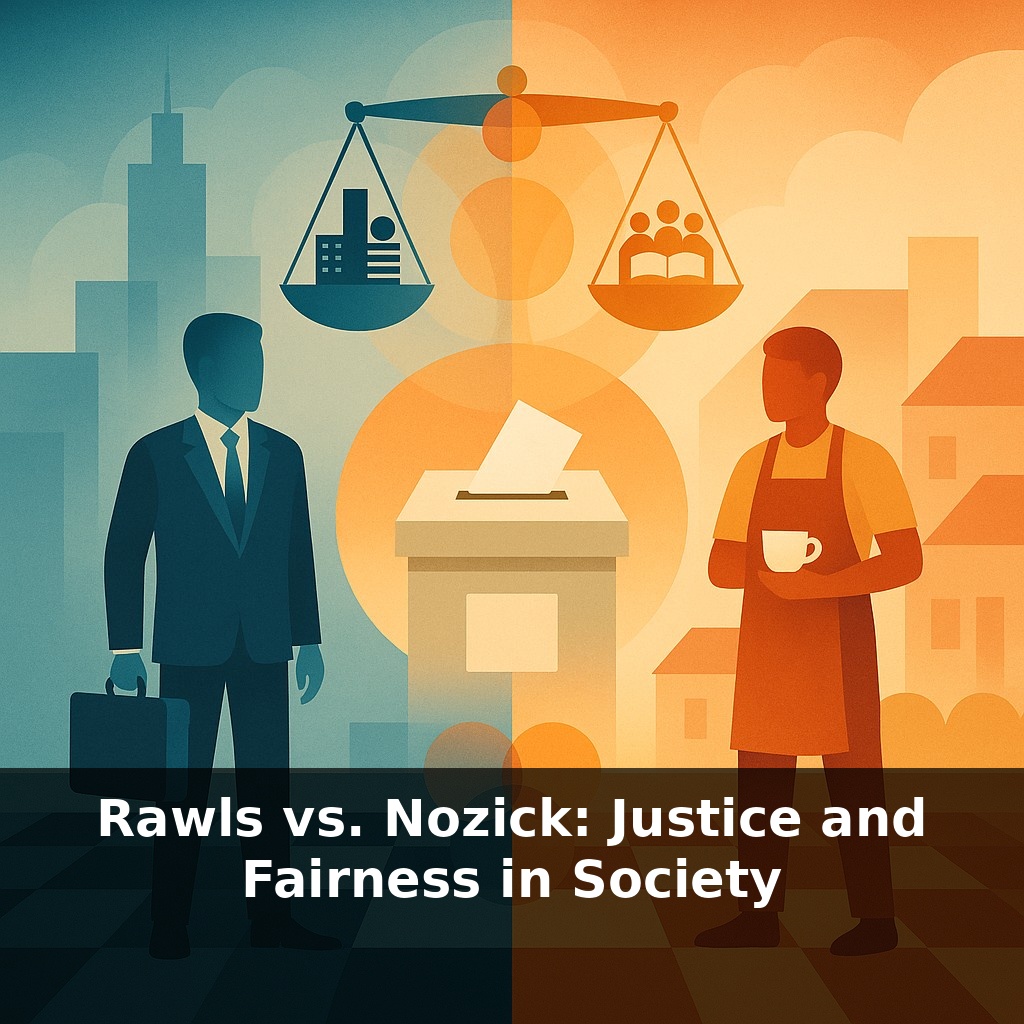
A billionaire and a barista walk into the same voting booth—and, for a brief moment, they’re political equals. But should they be economic equals too? In this episode, we wade into a deep puzzle: when does fairness mean sharing, and when does it mean leaving people alone?
Rawls and Nozick step into this tension from opposite sides of the board. Rawls asks us to design society as if we didn’t yet know who we’d be in it—rich or poor, healthy or sick, naturally talented or not. From that radically uncertain standpoint, he claims, we’d choose institutions that cushion life’s worst lotteries and make the floor as high as possible for those who land on it. Nozick, by contrast, starts not from uncertainty but from ownership: your mind, your body, your talents, and whatever you peacefully earn with them. For him, the central question isn’t “How should we slice the pie?” but “Who baked which part of it?” That shift transforms debates over taxes, welfare, and regulation from technical tweaks into moral fault lines. In this episode, we’ll put both visions under stress: inheritance, billionaires, safety nets, and the state’s proper edge.
Rawls takes his next step by asking where risk should land in a decent society. He’s less worried about heroic self‑reliance and more about people hit by illness, unemployment, or bad timing—forces no budgeting app can fix. That’s where his “difference principle” bites: inequalities are only acceptable if they lift those who’d otherwise be stuck at the bottom. Nozick, meanwhile, zooms in on the process: if contracts were voluntary and rights respected, he’s largely done asking questions. We’re left toggling between safety nets and strong locks, between cushioning falls and honoring every deal.
Rawls sharpens his view by asking what, exactly, we owe each other when outcomes hinge on traits we didn’t choose. Think of natural talent, family wealth, even being born in a stable country. Rawls calls these “arbitrary from a moral point of view.” You didn’t earn your starting hand, so he argues we should design institutions that don’t let those arbitrary advantages harden into permanent social hierarchies. This leads him to defend progressive taxation, strong public education, and access to healthcare—not as charity, but as part of a fair background structure within which people then pursue their own plans.
Crucially, he isn’t trying to micromanage every paycheck. Once the basic rules are set—equal basic liberties, fair chances to qualify for desirable roles, and a system that benefits the least advantaged—citizens are largely free to make deals, start firms, or fail at them. He wants a just “framework,” not a constantly intervening referee.
Nozick starts somewhere else: with side‑constraints on what we may do to each other. For him, even excellent outcomes don’t justify using someone’s labor or earnings without consent. His entitlement theory asks three questions about any holding: Was it acquired justly? Was it transferred justly? Was any injustice rectified? If those checks are passed, then the resulting pattern—whether wildly unequal or not—is morally acceptable. On this view, most taxation for redistribution looks less like sharing and more like partial ownership of workers by the state.
That’s why his ‘Wilt Chamberlain’ story matters. Once people are free to pay to see their favorite star, any carefully engineered distribution will keep fracturing. To preserve a specific pattern, authorities must keep stepping in—tracking, freezing, or reversing voluntary exchanges. Nozick sees this as a slide toward treating citizens as resources to be managed.
The clash surfaces in concrete policies. A universal basic income, for instance, can be read as Rawlsian insurance against brute bad luck—or as a Nozickian violation of those who are taxed to fund it. In modern debates over billionaire wealth, inheritance taxes, and corporate regulation, you can often hear an echo: are we correcting for unchosen brute luck, or trespassing on legitimate holdings? Rawls and Nozick give us rival lenses for answering that question.
Consider two concrete flashpoints: inheritance and “superstar” salaries. Take inheritance first. A Rawls‑leaning legislator looks at a vast family fortune and asks: what tax rules prevent yesterday’s advantages from hardening into tomorrow’s closed doors? She might support steep estate taxes paired with heavily funded public universities and apprenticeships. A Nozick‑leaning counterpart instead asks: if parents earned this within just rules, who are we to block their final gift? For him, an aggressive estate tax feels less like fairness and more like retroactive veto power over a lifetime of choices.
Now turn to tech founders or esports champions earning millions. A Rawlsian policymaker might back high marginal tax rates on those earnings to expand disability insurance or rural clinics. A Nozickian worries that, once the state can always “reclaim” part of each new success, people will think twice before investing the years of risk and effort that make such innovations—or careers—possible.
Rawls–Nozick tensions are already baked into code. Think of a ride‑sharing app: its pricing algorithm can be tuned like a soundboard—one slider boosts driver pay, another lowers rider cost, a third rewards loyal high‑spenders. A Rawls‑style tweak might prioritize struggling neighborhoods; a Nozick‑style tweak might spotlight pure transaction freedom. As AI allocates loans, housing, even ad visibility, these “sliders” quietly decide whose life gets a little easier—or harder.
In the end, you don’t have to pick a lifelong team Rawls or team Nozick. You can treat them like two lenses in a pair of glasses, sliding one in front of the other as issues shift—from climate loss and automation to data ownership or gig work. Your challenge this week: notice which lens your gut reaches for every time you say, “That just isn’t right.”