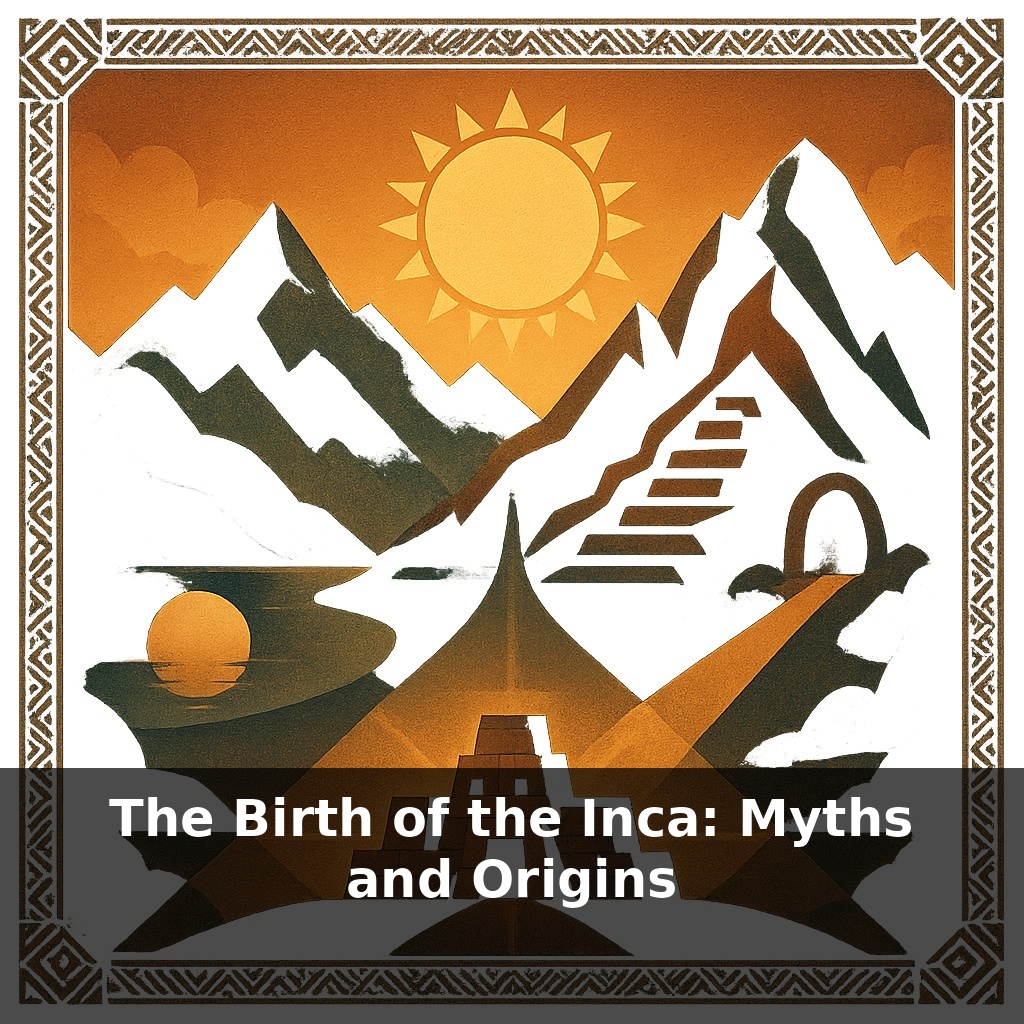
The Birth of the Inca: Myths and Origins
📝 Transcript
High in the Andes, an empire rose without the wheel, money, or a written alphabet—yet it ruled millions across four vast regions. In this episode, we’ll step into the moment that empire claimed it was born: not in history books, but from a lake, a cave, and the sun itself.
The Incas didn’t just tell origin stories; they engineered them. Two different birthplaces, two different journeys, yet both point toward the same destination: Cusco at the center of everything. It’s as if they drafted multiple “pilot episodes” for their past, then kept them all in circulation because each spoke to a different audience. One version tied them to sacred waters and far-off highlands, another to local landscapes and nearby communities, letting different regions see a piece of themselves in imperial beginnings. Like a carefully designed city plan, these narratives mapped power onto terrain: every shrine, mountain, and roadway could double as both real geography and living evidence that the empire’s rise was written into the bones of the Andes themselves.
Those stories didn’t float in a vacuum; they were anchored to real mountains, islands, and shrines people could walk to. As the Inca state expanded, priests, architects, and rulers threaded myth onto the land itself, turning valleys into chapters and mountaintops into punctuation marks. Archaeology shows earlier highland powers like Tiwanaku and Wari had already sketched sacred geographies across the Andes; the Incas redrew those lines, plugged themselves into old pilgrimage routes, and upgraded them. Think of it as remodeling an ancient cathedral rather than building a new chapel from scratch.
Strip away the poetry of lakes and caves, and a sharper pattern appears: both stories quietly solve political problems. Each gives the dynasty a divine sponsor, a route through contested territory, and a charter to rule people who were there long before any “first Inca” arrived.
In the Manco Cápac and Mama Ocllo cycle, the key move isn’t just sacred parentage—it’s mobility. They don’t beam into the landscape; they travel through it, staff in hand, testing the ground until it sinks in just the right place. That golden staff is more than a magic prop. It’s a portable survey tool, a way to claim, “This valley isn’t just convenient farmland; the cosmos itself marked it out as our capital.” When later rulers pushed into new regions, they could echo that pattern: we’re not invading, we’re fulfilling an old, celestial itinerary.
The Pacaritambo version works differently. Instead of a tidy couple, you get a whole crowd: Ayar siblings, rival claims, alliances, betrayals. Each figure can be linked to a lineage, a hill, a village. Now origin isn’t a straight line; it’s a branching diagram that can fold new groups inside it. A conquered clan might hear: your ancestor was there, in the beginning, at the cave. Resistance is softened when your own past has been braided into imperial time.
Spanish chroniclers caught fragments of this logic, but each filtered it through different agendas. Garcilaso de la Vega, with both Inca and Spanish heritage, leaned into the polished, sun-blessed storyline, elevating his mother’s ancestors as noble lawgivers. Others, like Cieza de León or Betanzos, recorded versions closer to local memories—messier, more crowded, less flattering. Modern archaeologists read these accounts the way a code-breaker reads multiple corrupted files: not for a single “true” story, but for shared structures underneath.
Radiocarbon dates from early Cusco masonry and temples on the Island of the Sun help anchor those structures in time. They hint that long before any emperor claimed descent from Inti, people were already trekking to those shrines, leaving offerings, and telling stories about beginnings. The Inca genius was to inherit those older circuits, then reroute the meaning: same mountains, same islands, but now all paths led to their dynasty.
Think of the myths as the empire’s “source code” and the landscape as the hardware it ran on. When the state marched into a valley, it didn’t just bring soldiers; it brought a storyline that could be installed in local shrines. A hill that once anchored a village’s founding tale might be reclassified as a waypoint in the dynasty’s long migration, its shrine woven into a larger ritual calendar. That shift didn’t erase older meanings so much as stack them—like adding a new software layer over an existing operating system.
Archaeologists spot these updates in stone and soil. A local temple suddenly gains a new platform aligned with imperial roadways; offerings change from purely regional styles to mixed bundles including prestige goods from far-off provinces. Oral accounts echo the same layering: elders remember how their grandparents’ stories placed ancestral heroes at certain springs or rock outcrops, and how later priests began reciting imperial prayers at the same spots, subtly editing the opening lines of community memory.
Future implications unfold on several fronts. As Indigenous scholars reclaim narrative authority, schoolbooks may pivot from “legends” to layered historical sources, like reading an old map for both routes and border politics. aDNA studies could redraw migration diagrams, forcing updates to long-accepted timelines. Meanwhile, heritage tourism is surging; without careful planning, sacred sites risk becoming theme parks, even as local communities push for models where they act as co-authors, not background extras, in how origins are told.
In the end, Inca beginnings feel less like a single prologue and more like a playlist—different tracks queued up for different ears. As new digs, satellite surveys, and Indigenous voices remix the archive, fresh verses keep surfacing. Your challenge this week: notice which “origin stories” around you quietly steer who belongs, who leads, and what futures seem possible.
Unlock all episodes
Full access to 6 episodes and everything on OwlUp.
Subscribe — $1.99/monthLess than a coffee ☕ · Cancel anytime