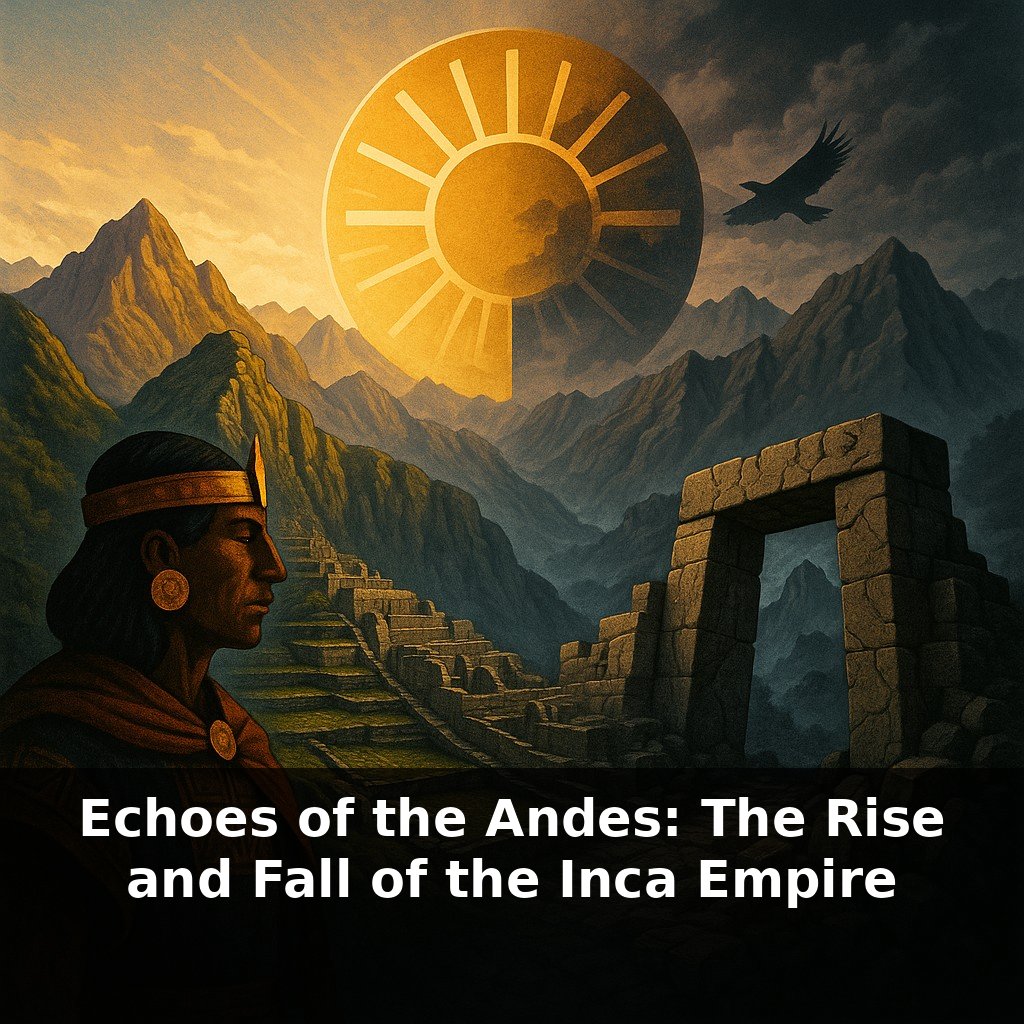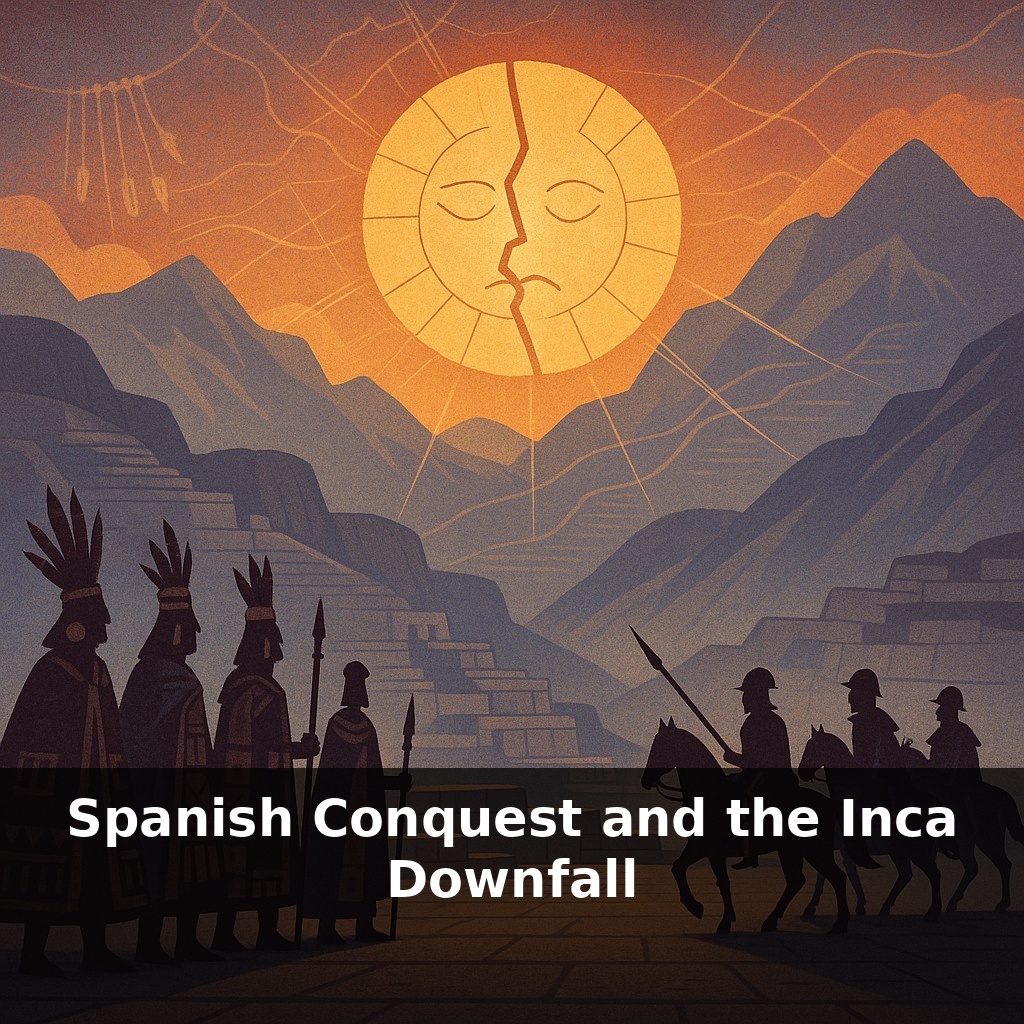
An empire ruling millions across the Andes unraveled in less time than a human lifespan. In one mountain plaza, a few dozen foreign horsemen faced a festival crowd of Inca nobles—and by nightfall, the world’s largest empire was mortally wounded. How did that happen so fast?
Twelve million people, thousands of miles of roads, storehouses packed with food—and the whole system cracked in barely a generation. The plaza clash you just heard about was dramatic, but it was only the most visible shock. Beneath the surface, the empire’s foundations had already been drilled through by events that looked, at first, like ordinary bad luck: a sickness no one understood, a succession dispute that seemed fixable, a few distant strangers treated as curious guests rather than existential threats.
To trace the downfall, we have to follow parallel storylines: a virus moving faster than armies; two brothers turning a family argument into a continent-wide war; and a handful of Spaniards learning to turn local grudges into ladders of power. Each thread alone was dangerous. Woven together, they formed the noose that tightened after Cajamarca.
Your challenge this week: pick one modern system—political, economic, digital—and map three separate weak points that, if they collided, could trigger a cascading failure. Don’t focus on obvious disasters; look for “ordinary” stresses that might intersect: a key leader’s absence, a quiet technical flaw, a simmering internal rivalry. Sketch how each could seem manageable on its own, yet together become unstoppable. By the end of the week, compare your notes to the Inca case: which combinations, not single causes, do you now see as most dangerous?
The next twist in this story is timing. None of the shocks hit in a clean sequence; they overlapped, like several storms crossing the same coastline. Smallpox didn’t just kill leaders—it scrambled the calendar of rituals and labor rotations that kept food, soldiers, and messages moving. At the same time, new Spanish faces were drifting into ports and highland towns, gathering rumors the way a search engine quietly indexes pages. Local lords made quick tactical bets—back one brother, test the newcomers—without yet seeing how those choices might link up into something irreversible.
Spanish observers later bragged that “a handful of Christians” broke a continent, as if bravado and gunpowder explained everything. The reality on the ground was messier and, in some ways, more unsettling: the visitors arrived as improvisers, not master planners, and they walked into a political landscape already full of sharp edges.
Start with the brothers’ war. By the time the strangers reached the highlands, veterans on both sides were exhausted, supply networks had been bent toward armies instead of harvests, and local nobles had gambled on winners and losers. Atahualpa’s victory didn’t heal those rifts; it magnified them. Defeated factions resented new purges and confiscations. When the newcomers appeared, they didn’t see “invaders” so much as a new tool that might reverse their losses.
That’s where Spanish tactics suddenly mattered. Steel swords and horses terrified people at first encounter, but their deeper power lay in how they reshaped choices. A mounted fighter could move faster than runners and hit harder than most bodyguards. That made a small escort feel like a roaming veto: any provincial lord who hosted the newcomers had a portable threat—and shield—inside his courtyard.
The visitors listened carefully. Reports of forced resettlements, harsh labor drafts, and recent punishments became a kind of political map: here was a valley angry about new governors; there, a clan sidelined from ritual power. Align with the sullen, reassure the cautious, isolate the loyalists. In several regions, disgruntled nobles lent guides, interpreters, and warriors, turning a tiny foreign column into the visible tip of a much larger, mostly local, spear.
One useful way to picture this is less as a “conquest” launched from Europe and more as a series of internal power struggles in which an unexpected third player kept being invited to the table. Each invitation made short-term sense to the host. Put together, they created a path straight toward Cajamarca—and to a trap no single faction had intended to build.
Think of the crisis less as a single wall collapsing and more as a whole city’s infrastructure failing room by room. In one district, smallpox didn’t just remove leaders; it also erased specialists—record-keepers who managed quipu archives, engineers who knew which terraces needed reinforcement before the rainy season. Losing them is like a modern data center misplacing its only staff who understand the legacy code that runs the grid.
Elsewhere, succession struggles had a quieter but similar effect on trust. Provincial elites hedged their bets, holding back food or labor until they were sure which heir would prevail. That hesitation resembled a sports team where half the players aren’t sure the coach will last the season: they’ll still show up, but they stop diving for loose balls.
At the same time, newcomers were mapping these hesitations with care—who delayed tribute, who changed ritual attendance, who quietly shifted garrison locations. Each hesitation flagged a place where loyalty could be flipped with promises, threats, or both.
Colonial rule didn’t just replace one ruler with another; it rewired how power, knowledge, and land worked. Forced labor drafts pulled people from their fields like key players yanked mid‑match, warping local economies for distant mines and cities. Later, nationalist histories often framed this story as a simple “loss,” but current debates in the Andes treat it more like a disputed contract—who signed away what, and under which kinds of pressure, is still being actively renegotiated.
Even today, Andean communities debate which parts of that past to preserve, reject, or transform. Quechua and Aymara speakers, village councils, and land movements are testing how much of the old political “code” can be rewritten without losing identity—like renovating a lived‑in house room by room while people are still sleeping inside.
Try this experiment: Pick one key moment from the conquest—like Atahualpa’s capture at Cajamarca or the civil war between Atahualpa and Huáscar—and “rewrite” it as if you were an Inca advisor trying to outmaneuver Pizarro. For 20 minutes, sketch out (in any format you like) the specific decisions you’d change: how you’d handle the Spanish demands for gold, gunpowder weapons, horses, and religious conversion, and what alliances inside the empire you’d strengthen or break. Then compare your alternate timeline with what actually happened in the episode and notice which Spanish advantages (disease, steel, internal division, etc.) still feel impossible to overcome—even in your best plan.