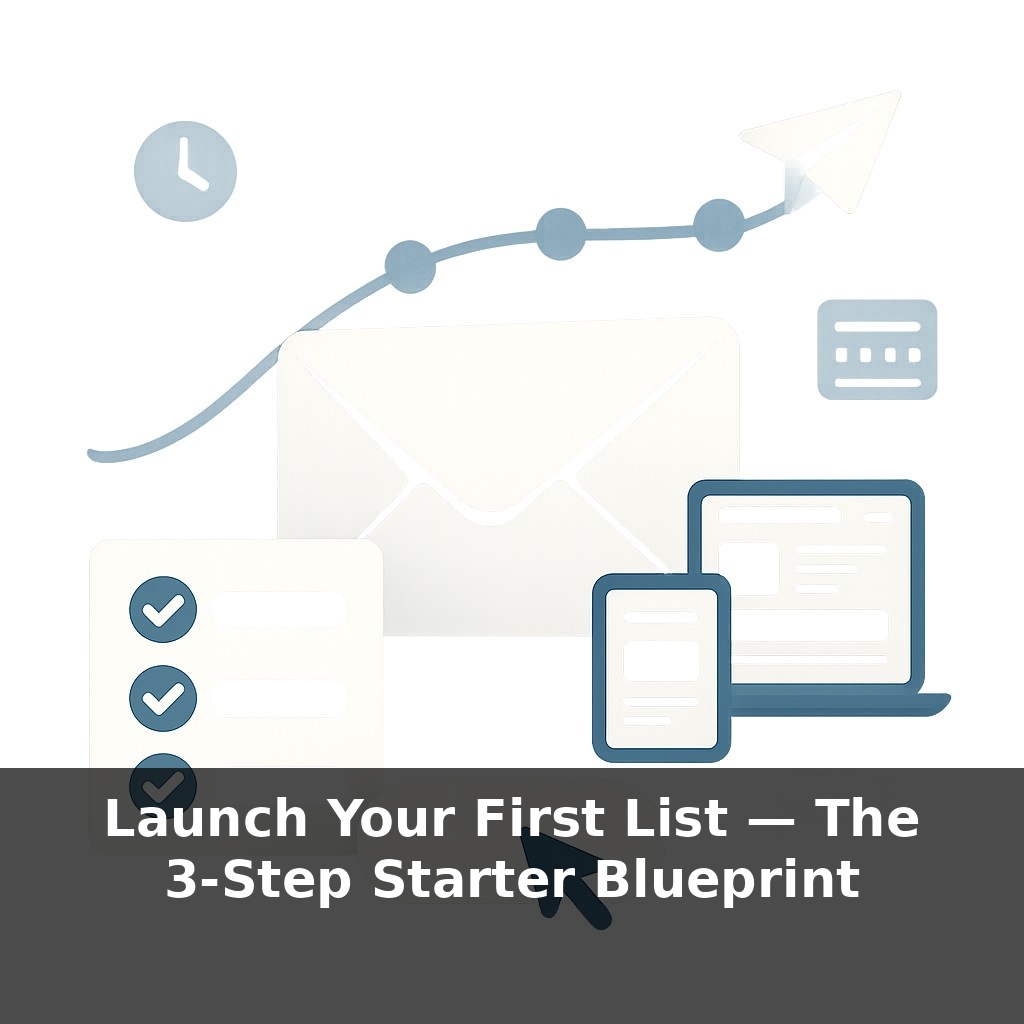
Launch Your First List — The 3-Step Starter Blueprint
📝 Transcript
Right now, more people check email than use almost any social platform—yet countless creators still wait for a “perfect website” before starting a list. In this episode, we’ll flip that script and launch your first email list using just three simple, doable moves.
That “I’ll start later” list you’ve been thinking about? It can become real a lot faster—and with far less tech—than most people assume.
Today we’re zooming in on the *first version* of your list: not the glossy, fully automated machine, but the lean setup that can start collecting subscribers and sending value this week.
Instead of juggling tools and tactics, we’ll focus on three concrete decisions: where your emails will live, why people should care, and how they can raise their hand to hear from you. Think of it like prepping a simple weeknight meal: you don’t need a chef’s kitchen, just the right ingredients, a clear recipe, and a way to serve it hot.
By the end of this episode, you’ll know exactly which platforms to shortlist, how to make a promise subscribers actually want, and how to publish a sign-up form—even if all you have right now is a social profile.
You don’t need a big audience to make this work—you need a clear invitation and a reliable way to keep in touch. With more than 4.3 billion people using email and ROI hovering around $36–$40 for every dollar spent, even a tiny, focused list can outperform a busy social feed. Think of this phase less like “launching a marketing channel” and more like opening a reserved table for your most interested people: they raise their hand, you save their seat, and you show up with something worth serving. As we go, we’ll stack small, practical choices that make it easier to start than to stall.
Step one is choosing an ESP, but don’t treat it like a forever marriage. Treat it like picking a starter tool: reliable, simple, and “good enough” for the next 6–12 months. At this stage you care about three things: - Can you actually understand the dashboard without a two-hour tutorial? - Does it let you send broadcast emails and basic automations (like a welcome email)? - Is it priced so you won’t hesitate to keep it when you’re not making money yet?
Most modern tools offer a free tier to a few hundred or thousand subscribers. Start with one that feels intuitive on first click. If you feel lost inside the interface in the first 10 minutes, that friction will quietly delay every email you intend to send.
Once the tool is picked, the real asset isn’t the tech—it’s your ongoing promise. A vague “get updates” message won’t move anyone. Turn it into a specific, repeatable commitment. For instance: - “One email every Friday breaking down a real client case study.” - “Three quick growth experiments a week you can test in under 20 minutes.” - “Monthly teardown of a landing page—with before/after examples.”
Notice these aren’t topics; they’re ongoing deliverables. You’re telling people what cadence to expect and what practical outcome they’ll get. That clarity not only boosts signups, it also makes it easier for you to sit down and actually write.
Now make joining feel almost effortless. Short forms typically win: name and email, or even just email if your ESP allows personalization later. Each extra field is a decision point where someone can bail. Use your audience promise as the headline on the form, and make the button copy specific: “Send me the teardown series” beats “Subscribe.”
If you don’t have a site, lean on what you *do* have: - A standalone landing page from your ESP - The link in your social bio - A pinned post or highlight walking through why the list exists and who it’s for
Then, when the first person subscribes, don’t wait for “many.” Write to that tiny group like VIPs from day one. The habit you’re building now—showing up consistently for a small, specific audience—is the same habit that will make a much bigger list profitable later.
Think of this phase like a chef testing a brand‑new menu item during a slow lunch shift. You’re not guessing in the dark—you’re running tiny experiments with real people, then tweaking fast.
Example one: A freelance designer chooses “Figma tips” as her ongoing angle. Instead of announcing a grand “newsletter,” she posts a single carousel on LinkedIn titled “Steal my 3 quickest client‑wow tricks.” Slide 5 invites people to join her list for “one 5‑minute Figma shortcut every Tuesday.” Twenty signups later, she looks at which post slide got saves and shapes her next email around that.
Example two: A fitness coach runs two slightly different opt‑in forms: one promising “busy‑parent workouts under 15 minutes,” the other “no‑equipment strength plans.” After a week, the first form gets 3x more signups. He doesn’t overthink it; he leans fully into that angle, updates his bio link, and writes his first three emails just for exhausted parents trying to stay in shape.
In both cases, the “right” direction emerges from tiny real‑world signals, not brainstorming in isolation.
Laws tightening around data tracking will quietly push your list from “nice asset” to core survival tool. As cookies crumble, brands without direct access to readers will feel like drivers losing GPS in a storm. Expect smarter ESP features that suggest segments, subject lines, even send times based on subtle behavior patterns you’d never spot manually. Treat each new subscriber as both a reader and a research partner; their clicks map where your products and services should evolve next.
As that first trickle of subscribers arrives, treat them like early tasters at a new food stall: ask what they’re hungry for, notice what they come back for, and adjust the menu fast. Over time, you’re not just “sending emails”—you’re shaping a living feedback loop that quietly points to offers, services, and collaborations you couldn’t have planned alone.
Here’s your challenge this week: open your email service provider and create a simple 3-email starter sequence for one specific freebie you’d actually want to offer (for example: a “5-Minute Morning Routine Checklist” or “Beginner Pinterest Promo Guide”). Today, write Email 1 as a warm welcome that tells subscribers who you are and delivers the freebie link, Email 2 as a quick “here’s how to use this” value email, and Email 3 as a soft invitation to your paid offer, discovery call, or waitlist. Then, create one opt-in form and embed it on a real page (like your homepage or a new “Free Resources” page), and share that page link once on social media before the day ends.
From this course
Zero-to-$1K Email Marketing Blueprint
10 episodesUnlock all episodes
Full access to 10 episodes and everything on OwlUp.
Subscribe — $1.99/monthLess than a coffee ☕ · Cancel anytime