The Marvel of Mimicry - Masters of Disguise
📝 Transcript
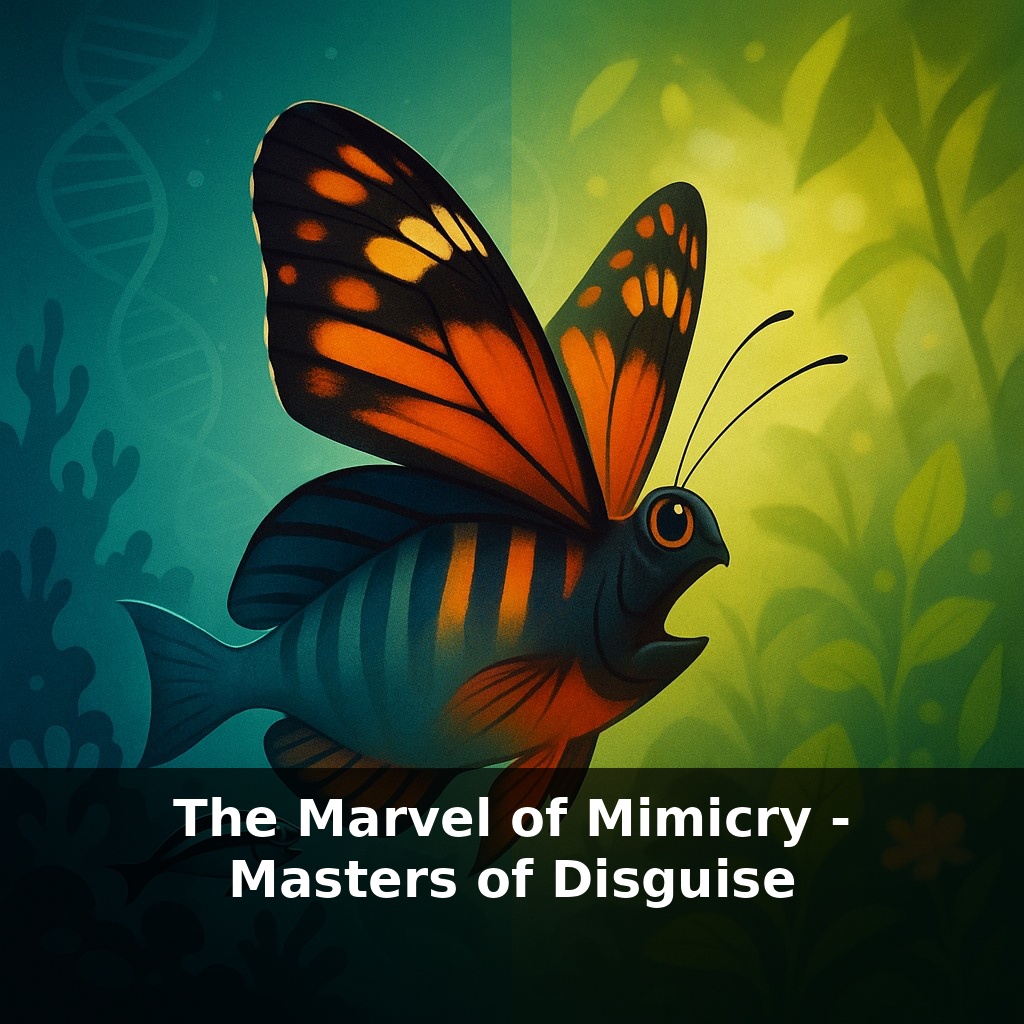
A fish hovers at a coral reef “car wash,” opens its mouth to be cleaned—then loses a chunk of fin. On land, a tasty butterfly survives by wearing the colors of a toxic cousin. Across the planet, survival often belongs not to the strongest, but to the best impersonator.
For evolution, deception isn’t a quirky side note—it’s a recurring best-seller. Across continents and oceans, very different creatures have independently “discovered” the same trick: let someone else do the hard work of earning a reputation, then copy the look. Over 3,000 insect species are now known to participate in vast mimicry rings, like living uniforms that signal “don’t touch” to hungry predators. On coral reefs, a few millimeters of patterning can separate a helpful cleaner from a stealthy fin-biter. In the open ocean, cuttlefish and octopuses push this to an extreme, rewriting their appearance in milliseconds with skin that behaves more like a high-speed display than a passive coat. These shape-shifters don’t just blend in; they edit what other animals *think* they’re seeing, hijacking hard-wired expectations about danger, safety, and food.
Predators and prey aren’t just reacting to colors and shapes—they’re reading a crowded, noisy “info feed” where signals can be hacked. Some insects copy not just warning colors but flight style, timing, even preferred hangouts, fine‑tuning the illusion to the expectations of local birds. On coral reefs, blenny impostors thrive only as long as cleaner wrasses remain common enough to “authenticate” the disguise, a biological version of riding on a trusted brand. Meanwhile, butterflies in mixed-species flocks share similar warning outfits, spreading the cost of educating predators across an entire community of look‑alikes.
A warning pattern or clever disguise doesn’t appear out of nowhere; it’s sculpted by the very brains it aims to fool. A bird that easily spots orange-and-black prey will “train” the local butterflies over generations, favoring any lineage whose colors trigger that bird’s built‑in caution or confusion. The result isn’t just one mimic trailing a single model, but intricate communities of look‑alikes all tuned to the same audience.
Not all impersonations are visual. Some flower mantises smell like nectar and reflect ultraviolet patterns that exploit how bees see, turning a hunting perch into a counterfeit blossom. Bolas spiders swing sticky silk threads laced with fake female moth pheromones; male moths home in on what their senses insist is romance, only to become dinner. Here, evolution is reverse‑engineering another species’ dating app and forging the perfect profile.
Sound can be faked too. Certain katydids copy the mating calls of multiple species, responding with just the right rhythm to lure in hopeful males. Even birds get duped: fork‑tailed drongos in African savannas have been caught switching between authentic alarm calls and fabricated ones, scaring meerkats off food, then swooping in to steal it. These vocal mimics succeed because they exploit reflexive “don’t think, just act” responses.
Chemistry adds yet another layer. Some non‑stinging insects carry traces of ant or wasp odor, slipping through fortified nests as if they belong. Others mimic the cuticular chemicals of toxic species so closely that predators spit them out on taste alone. In ants, entire beetle lineages have evolved bodies, movements, and scents that pass internal security checks, giving them access to brood chambers rich in food.
Dynamic masters like the mimic octopus push the idea further by stringing multiple disguises into a sequence, choosing one pattern while crossing open sand and another when near coral or sea grass. The key is context: a good mimic doesn’t just resemble something else; it resembles the *right* thing, in the *right* place, at the *right* moment. Evolution supplies the repertoire, but local conditions decide which costumes stay in the closet and which become everyday wear.
Think of an app that skins itself to match whatever platform you’re on: same underlying code, different interface, tuned to a user’s expectations. Many mimics work the same way, but with bodies instead of software. Hoverflies, for instance, don’t just echo wasp stripes; some species match the seasonal timing of their models, peaking in abundance when real wasps are common enough that predators “trust” the pattern. On forest floors, dead‑leaf frogs carry this further, with asymmetrical blotches that mimic fungus, worm holes, and even curled edges—fine details that matter to a hunting snake’s pattern-recognition system.
In tropical streams, juvenile fish often resemble floating leaves or seeds and drift with the current, adopting not only the look but the *behavioral script* of debris. Some reef crustaceans glue bits of sponge or algae onto themselves, periodically “updating” their camouflage outfit as the background community changes. Even eggs can play: certain cuckoos lay eggs whose speckles and base color track local host populations so closely that each host species effectively gets its own counterfeit line.
As we decode these genetic “costumes,” designers eye fabrics that re-pattern like stock tickers reacting to market shifts, letting soldiers, workers, or wildlife biologists blend into new surroundings on demand. Road signs and delivery drones might flash evolving patterns that wildlife instinctively respects, cutting collisions. And AR field guides could overlay hidden mimic patterns on live animals, turning hikes into real-time labs for watching evolution experiment with perception.
Mimics hint that evolution is less a march and more an arms race of perception, where bodies prototype ideas the way startups test features. As climates shift and habitats fragment, new “beta versions” of disguise will appear—and fail. Your challenge this week: spot one living thing that blends or fakes, and ask: who is it tricking, and what story is it telling?
From this course
Evolutionary Oddities
7 episodesUnlock all episodes
Full access to 7 episodes and everything on OwlUp.
Subscribe — $1.99/monthLess than a coffee ☕ · Cancel anytime