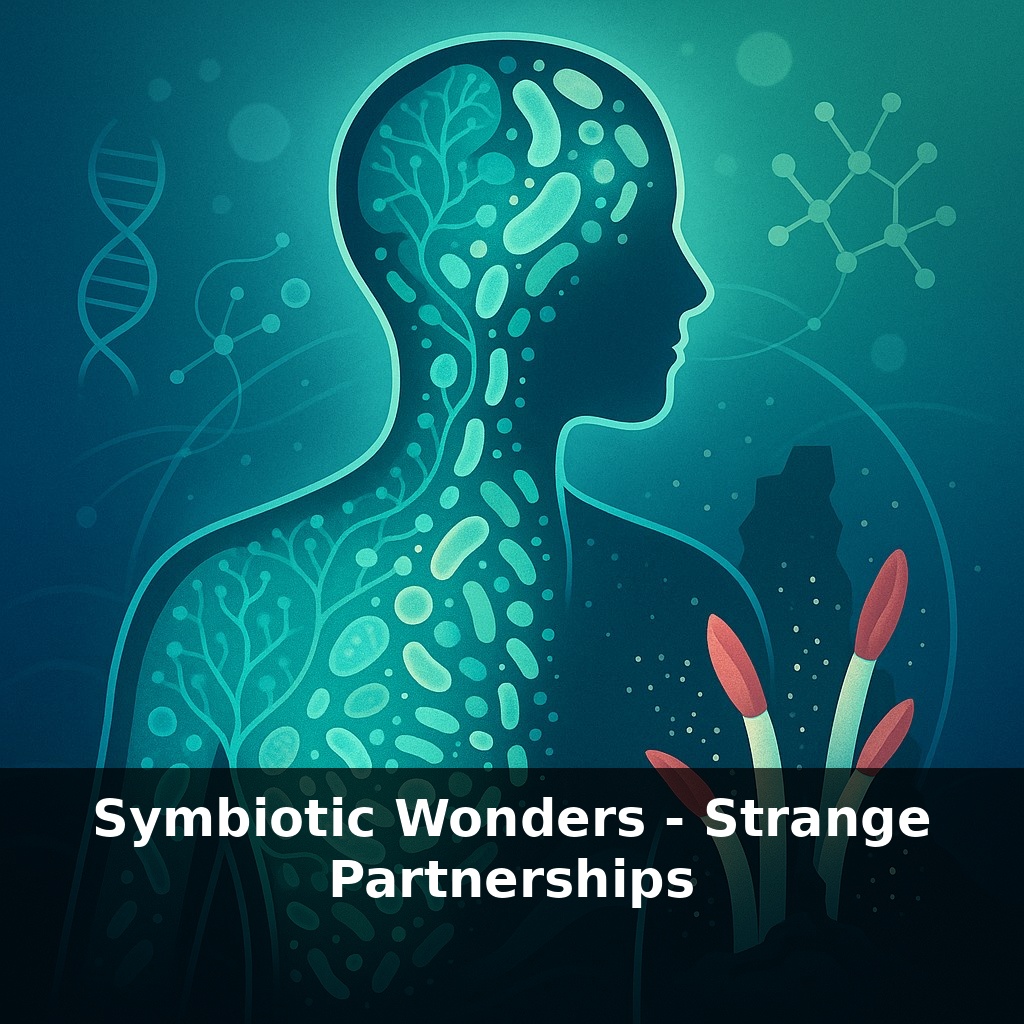
Right now, as you listen, most of the cells “in your body” aren’t actually human. They’re microscopic hitchhikers, busy digesting, defending, and even shaping your mood. So here’s the strange question: where do *you* end and your silent partners begin?
Those hidden partners don’t just tag along; they’re busy striking deals everywhere life exists. Deep in the ocean, giant tube worms have no mouths or guts at all—they outsource digestion entirely to bacteria living inside their bodies. In rainforests, some ants have become full‑time farmers, tending underground fungal crops so specialized that neither ant nor fungus survives alone. Even most plants quietly plug into vast fungal networks that ferry nutrients between trees like an underground supply chain. And symbiosis isn’t always friendly: tapeworms, rust fungi, and wasps that turn caterpillars into living incubators all sit on the darker end of the partnership spectrum. From life’s smallest components to sprawling ecosystems, evolution keeps returning to the same strategy: don’t go it alone—team up, exploit, negotiate, or merge.
Symbiotic oddities don’t just link two species; they can rewire entire lineages. Ancient microbes that once merely shared space with early cells became mitochondria, turning a loose collaboration into a permanent corporate merger. Most plants quietly sign contracts with fungi that boost nutrient intake so effectively that forests we see today simply wouldn’t exist without them. Corals, powered by their resident algae, build reefs that feed millions of people. Even parasites, from wasps to worms, can push hosts to evolve new defenses, setting off biological arms races that reshape ecosystems.
Symbiotic partnerships fall along a sliding scale, not into neat boxes. Even the “mutual benefit” label can flip depending on context. Take cleaner wrasses that pick parasites off big reef fish. Most of the time, both sides win: the cleaners get food, the clients get a health spa. But when parasites are scarce, cleaners start nibbling on clients’ protective mucus instead. The relationship briefly tilts toward parasitism, then swings back as clients punish cheaters by swimming off or chasing them. Same species, same behavior toolkit—different spot on the spectrum, depending on who’s hungry and who’s watching.
Plants and their live‑in microbes show the same blur. Many crop species host bacteria in their roots that fix nitrogen, turning unusable atmospheric N₂ into fertilizer. Under nutrient‑poor conditions, that service can double yields. In heavily fertilized fields, the same bacteria may become freeloaders, taking sugars while providing little in return. Farmers are now trying to “tune” soil partnerships with designer microbial mixes—essentially editing the guest list in the plant’s underground apartment complex.
Then there are three‑way (or more) partnerships that only make sense as networks. Some tropical aphids are protected by ants that herd them and drink their sugary secretions. Inside the aphids live bacteria that manufacture essential amino acids. If a wasp attacks, yet another symbiont—defensive viruses carried by the wasp—can sabotage this inner supply chain. Ecologists mapping these links sometimes discover that removing a single parasite or microbe can unravel protections several steps away, like yanking a line of code from a running program and crashing unexpected processes.
Even within our own bodies, the line between helper and exploiter isn’t fixed. Gut microbes that aid digestion can, under stress or antibiotic disruption, trigger inflammation or invade damaged tissue. Some intestinal worms dampen immune responses so effectively that researchers are cautiously testing them—or their molecules—as treatments for autoimmune disease and allergies.
Through all these examples, the pattern is less “good guys versus bad guys” and more “constant negotiation under changing rules.” Evolution, it seems, favors partners that can renegotiate the contract on the fly.
Some of the strangest partnerships hide in plain sight. Consider leafcutter ants: beyond their famous gardens, they host specialized bacteria on their bodies that secrete antibiotics to protect the fungal crop from mold. It’s a three‑layered alliance—plant leaves, farmed fungus, microbial “pesticides”—that rivals industrial agriculture in complexity.
Or look at snapping shrimp that share burrows with nearly blind goby fish. The shrimp does the digging and maintenance; the goby acts as a living periscope, flicking its tail to warn of danger. Break the duo apart and both become easy targets.
Even your skin is a quiet negotiation zone. Certain microbes help crowd out pathogens, but the balance shifts with sweat, soap, and stress. Dermatologists are exploring “probiotic lotions” that seed helpful strains the way bakers add starter to dough.
Technologists are taking notes, too. Bioengineers are experimenting with mixed microbial “workforces” to clean wastewater or make biofuels, pairing species the way app designers integrate different software services to handle security, storage, and user interaction all at once.
Symbiotic thinking is now leaking into design. Engineers test “living materials” where bacteria patch tiny cracks in concrete like microscopic road crews. Doctors explore microbial cocktails tuned less like single drugs and more like whole restaurant menus, each strain supplying a different service. Your challenge this week: notice every “two‑part invention” around you—moss on a wall, lichens on trees, even apps sharing data—and ask what each partner might be getting out of the deal.
In the end, these living alliances act less like static labels and more like shifting contracts. A virus that once hijacked our genome now helps embryos implant, like a former hacker securing the server they broke into. As we learn to read these renegotiated deals, our own survival may depend on choosing when to partner—and when to walk away.
Start with this tiny habit: When you notice any two things interacting in your day (like bees on a flower, mold on bread, or birds on a tree), pause for 5 seconds and quietly ask yourself, “What might each one be getting out of this?” Once today, pick one of those pairs and do a 30-second search on your phone about their relationship—just long enough to learn one cool fact. Then, tell one person (or a notes app) that fact in a single sentence, as if you’re explaining a weird symbiotic partnership from the episode.