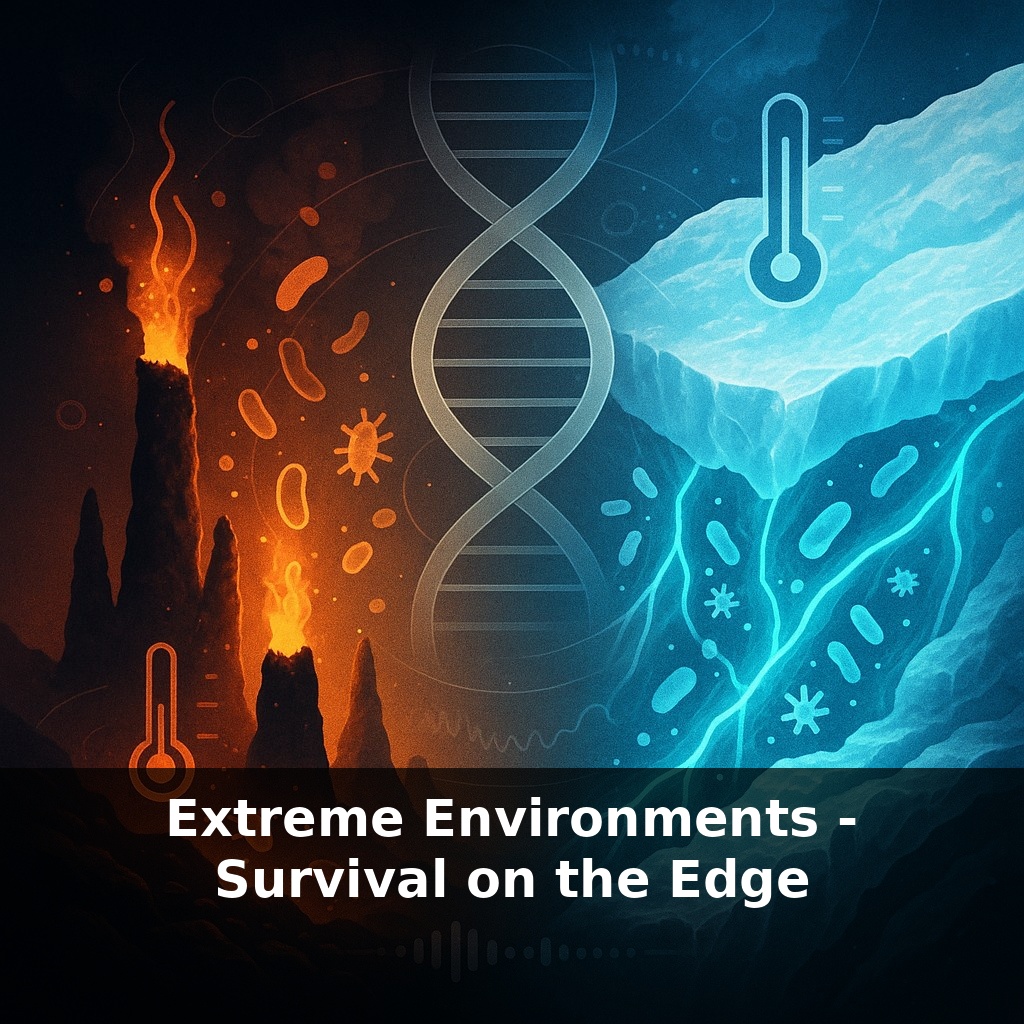
Water boils, yet life keeps growing. In scalding deep‑sea vents hotter than a kitchen oven, microbes knit DNA and divide as calmly as garden plants in spring. One slip outside their razor‑thin comfort zone, though, and they die faster than you could cool a cup of tea.
At the other end of the spectrum, some organisms treat Antarctica’s buried saltwater pockets as cozy winter cabins. Psychrophilic algae idle along at –20 °C inside tiny brine veins threaded through the ice, where liquid water clings on like the last late‑night customer in a closing café. Higher up, in sun‑blasted deserts and labs, the bacterium Deinococcus radiodurans shrugs off radiation that would shred a human genome, quietly stitching its chromosomes back together. In the deep ocean’s trenches, the snailfish Pseudoliparis swirei patrols 8,000 meters down, enduring pressures that would crumple a submarine hull. And in hypersaline lakes, Halobacterium salinarum prospers in brine nearly ten times saltier than the sea, tweaking its internal chemistry the way a chef adjusts seasonings to keep a sauce from splitting. Each of these specialists has turned a deadly stress into ordinary background noise.
On Earth, “extreme” rarely means empty; it usually means “we haven’t learned who lives here yet.” When biologists first sampled boiling hot springs, glacier cores, acid mine runoff and crushingly deep sediments, they expected traces of life at best. Instead, they uncovered whole communities quietly trading nutrients, recycling elements and even shaping global cycles of carbon, nitrogen and sulfur. These organisms lend us tools: heat‑proof enzymes make PCR routine, salt‑loving proteins stabilize drugs, radiation‑tolerant systems guide cancer therapies—and all of them expand where we dare to look for life beyond Earth.
Extremophiles earn their name not just by enduring stress, but by rewriting biology’s “standard settings.” Instead of one universal recipe for life, they reveal a menu of biochemical strategies, each tuned to a different edge of possibility.
In scalding habitats, proteins that would normally unfold are reinforced with extra bonds and snugly packed cores. Their membranes swap in sturdier lipids, trading flexibility for stability so the cell doesn’t leak apart. At the cold end, the trick flips: enzymes loosen up, gaining flexible loops that stay mobile near freezing, while membranes become more unsaturated and fluid so they don’t turn to butter in the chill. Salt‑dwellers solve a different puzzle—how to keep water from being sucked away. Many simply match the outside with high internal salt or compatible solutes, then evolve protein surfaces that actually *need* that salty broth to function.
Acid lovers in drainage pools or volcanic lakes push this further. Some keep their interiors near neutral by running powerful proton pumps and building unusually tight cell walls; others redesign their molecules so that even when bathed in acid, key reactions still run. On the opposite flank, alkaliphiles at pH 10–12 must hang on to protons that constantly want to diffuse out, so they sculpt micro‑gradients across their membranes, creating tiny pockets where energy can still be harvested.
Pressure introduces yet another axis of design. In trenches, many cells incorporate more unsaturated fats and specialized protein folds that resist being squeezed into inactive shapes. Their ribosomes, chaperones and repair systems favor variants that keep working when every molecule is pressed from all sides.
Across these extremes, a recurring theme emerges: robustness paired with fragility. The same tweaks that make an enzyme unstoppable at 100 °C leave it useless at room temperature; a salt‑loving protein may clump instantly in fresh water. Extremophiles are often more specialized than “ordinary” organisms, not less. They aren’t primitive throwbacks clinging to marginal niches; they are recent, refined answers to very particular problems.
And they are everywhere. Sequencing studies of soils, oceans, and even building dust suggest that lineages with extremophile relatives account for much, perhaps most, of microbial diversity. “Normal” conditions, from a planetary perspective, might actually be the exception.
Industrial chemists quietly exploit this biological risk‑taking. Want a detergent that scrubs stains in scalding wash cycles? Borrow an enzyme from a heat‑addicted archaeon. Need a catalyst that keeps working in solvents that would normally wreck proteins? Extremophiles from alkaline lakes or toxic waste sites often oblige. One company scaled up fermentation of salt‑loving microbes to produce carotenoid pigments without needing sterile, freshwater vats—few contaminants dare to invade brine tanks.
Astrobiologists push this logic off‑world. If Earth’s “normal” is just one narrow strip of the possible, then briny Martian subsoils or Europa’s pressurized ocean look less like dead ends and more like unvisited neighborhoods. NASA’s instrument teams now test electronics and drills in chambers that mimic those extremes, guided by where similar conditions on Earth already host life.
Your challenge this week: map your own “habitable zone.” Notice when you think “nothing could live there”—a dry rooftop, a dish sponge, a forgotten jar—and then check what’s actually growing.
Future missions may treat icy moons less like barren rocks and more like unregulated “innovation hubs” for alien biochemistry. Engineers are already prototyping reactors that run on brine, heat and pressure instead of delicate lab glassware, turning factory floors into testbeds for extremophile‑style chemistry. Your challenge this week: whenever you adjust a thermostat, fridge, or tap, ask what kind of organism might treat that setting as prime real estate.
Extremophiles hint that Earth isn’t a single story, but a library of survival manuals written in different “dialects” of chemistry. As we decode more of them, we may learn to store vaccines without fridges, clean spills without harsh solvents, even design habitats for other worlds the way gardeners plan microclimates on a balcony—one niche at a time.
Before next week, ask yourself: 1) “If I suddenly lost heat, clean water, or communication for 48 hours like those polar and desert expeditions, what exactly would I *do first*, second, and third—and where are the weak spots in that plan right now?” 2) “Looking at my home and daily routine, what is one ‘hostile environment’ stressor I could realistically rehearse for this week—like a no-power evening, a limited-water day, or a no-phone window—and what skills (navigation, first aid, improvising shelter) would I focus on during that mini-drill?” 3) “In the way those teams survived by clear roles and trust, who are my ‘survival team’ people locally, how would we contact and support each other if normal systems failed, and what conversation could I start with one of them today to make that network real instead of theoretical?”