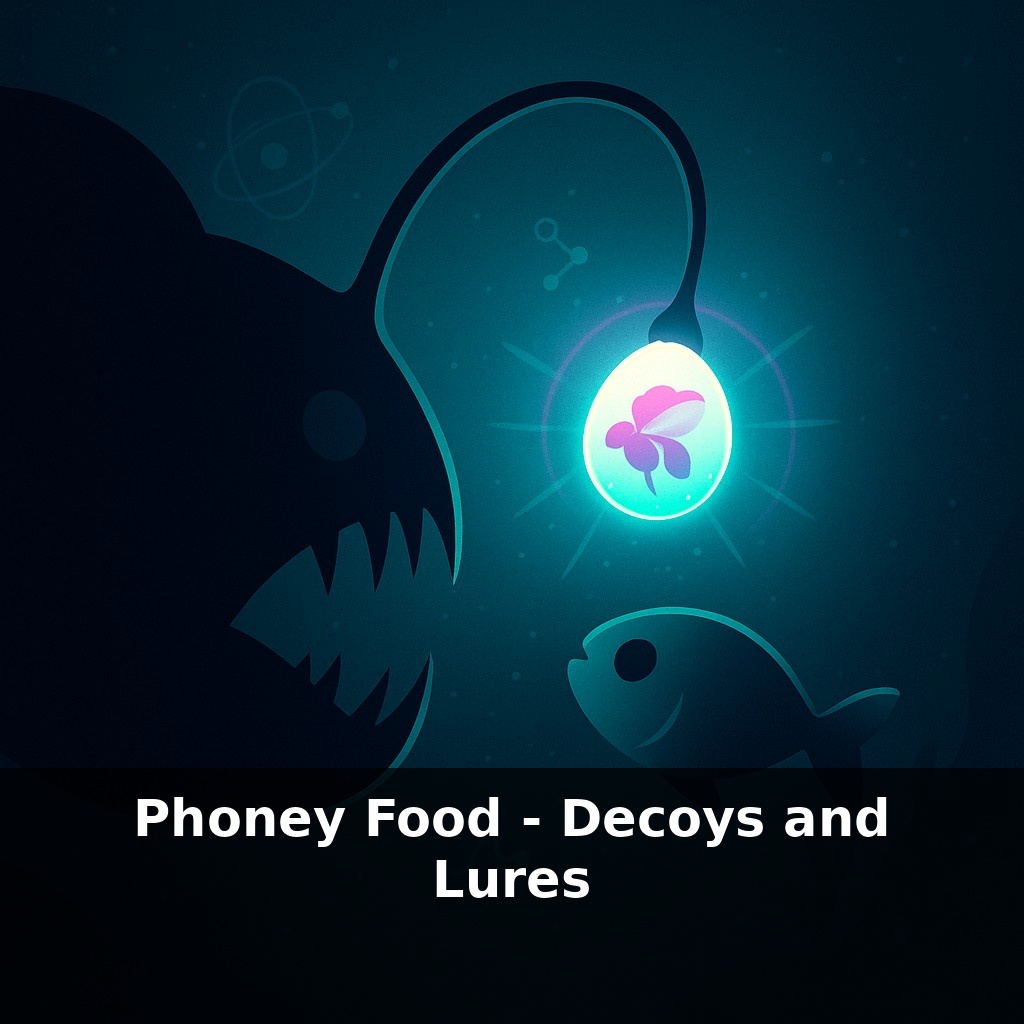
A tiny fish darts toward what looks like a glowing snack in the deep ocean—then vanishes in a single bite. In nature, not all “food” is meant to be eaten. Some of it is bait, custom‑built to hijack hunger itself. Today, we’re following the fakes that eat you back.
Some of the sneakiest “meals” in evolution aren’t even animals. Certain orchids grow petals that look and smell like female insects, luring males to attempt mating; in the struggle, the flower dusts them with pollen instead of nutrients. Elsewhere, carnivorous plants like pitcher plants line their traps with sweet‑tasting secretions, only to dissolve the visitors they tempt. Even parasites join in: lancet liver flukes tweak an ant’s brain so it clamps onto grass tips at night, posing as an easy bite for grazing livestock. Across forests, fields, and tidepools, the same script repeats: organisms turn another creature’s search for dinner into a delivery service for genes, minerals, or energy, rewriting “what counts” as food to suit their own agenda.
In this episode, we’re zooming in on a special subset of these tricks: outright counterfeits that look, smell, or even move like a meal, but pay out in energy only for the deceiver. Deep‑sea anglers dangle living light organs; reef predators wiggle tongues and fins like stranded worms; even some fungi release “banana” scents to draw in spore‑spreading insects. Biologists call this aggressive mimicry, and it flourishes anywhere prey are forced to make snap decisions. The riskier it is to hesitate, the more profitable a convincing fake becomes for the predator.
Biologists used to think most of these decoys were visual tricks—flashy colors, twitching “worms,” glowing beacons in the dark. But once researchers started sniffing, listening, and wiring up nervous systems, they found fake food signals lurking in almost every sensory channel animals use to decide “bite or don’t bite.”
Chemistry is a big one. Some carnivorous plants lace the air with volatile compounds that resemble the smell of yeast and fermenting fruit. To a fly’s antennae, that’s the scent of a microbial buffet; to the plant, it’s free delivery of fresh protein. Certain fungi pull a similar stunt, perfuming the air with notes of banana or overripe melon that precisely match what their favorite beetles already love. The beetle thinks it’s following its nose to dinner; instead, it’s picking up and spreading spores.
Other deceptions lean on touch and motion. The alligator snapping turtle’s tongue lure works partly because it vibrates with the right frequency and rhythm to trip a fish’s “worm” detector. In lab tanks, changing just the tempo of the wiggle can slash strike rates, suggesting predators are tuning their lures to the prey’s sensory code. Some reef fish extend elongated fin rays and tremble them on the sand; high‑speed video shows that the wiggle speed converges on that of common polychaete worms in the same habitat.
In the deep sea, where light is scarce and expensive to produce, fake food glows have evolved independently again and again. Anglerfishes suspend bacteria‑powered light organs; dragonfishes and loosejaws arrange photophores that flicker like drifting zooplankton. Analyses of these spectra show an uncanny match to the brightness and color of the local “snow” of organic particles, effectively turning a predator’s face into a floating snack bar sign. Like a carefully crafted phishing email in your inbox, the goal isn’t to be generically tempting—it’s to be specifically, familiarly tempting enough that the target’s usual safeguards switch off.
None of this is foolproof. Behavioral studies reveal that prey from high‑risk areas often hesitate longer or avoid certain cues entirely, while naïve individuals from safer regions rush in and get caught. That variation sets the stage for an arms race: each time a prey lineage gets better at spotting the fake, any predator with a slightly more convincing lure gains the upper hand. Over thousands of generations, this cycle can sharpen a vague attractant into a hyper‑specific signature keyed to one species’ private cravings—an evolutionary cat‑and‑mouse game played with smell, light, and the tiniest twitches of flesh.
Some of the strangest cases live right at the edge of what “counts” as a meal. Certain jumping spiders, for instance, tap out the exact courtship rhythms of smaller spiders on their webs. To the victim, that pattern means “potential mate, not danger,” so it walks straight into striking range. Elsewhere, scale‑eating cichlids in African lakes patrol in mirror‑bright colors that match harmless neighbors; only at the last second do they twist sideways and shave off a mouthful of skin.
Plants play subtler games. Some brood‑site mimics warm their flowers a few degrees above air temperature and load them with the same greenhouse gases given off by rotting compost. To a fly’s heat and smell receptors, that’s a decomposing jackpot worth landing on, even though there’s nothing there to eat.
Your challenge this week: watch for “offers” in your own life that seem precision‑tuned to your cravings—sales emails, app notifications, limited‑time discounts—and ask, each time, “Who actually gets fed if I bite?”
In a warmer, murkier future ocean, many classic lures may “go out of tune,” a bit like ads calibrated for last decade’s algorithms. Predators tied to narrow sensory tricks could crash, while flexible foragers that rely less on any single cue may flourish. Engineers are already borrowing these playbooks: from crop pests steered into harmless traps by custom scents, to medical nanoparticles coated in “nutrient” signals that tumors preferentially swallow, weaponizing appetite as a delivery system.
So the next time you see a neon candy wrapper, a perfectly staged burger photo, or a “healthy” snack bar stacked by the checkout, treat it like fieldwork: a chance to notice how signals steer your choices. Nature’s most convincing fakes hint that our own menus are crowded with decoys too—some benign, some costly, all competing to be tasted first.
Here’s your challenge this week: For the next 3 days, pick ONE “phoney food” in your life (like protein bars instead of meals, ultra-processed snacks that mimic real food, or diet versions of your favorites) and run a real-world “decoy test” on it. Each day, deliberately swap that one item for its closest real-food counterpart (for example: nuts and fruit instead of a bar, real cheese and crackers instead of cheese-flavored puffs) and eat it in the same situation you’d usually reach for the fake. Pay attention to three things and rate them from 1–5 after each swap: how full you feel 1 hour later, how much you crave more, and how satisfied you feel emotionally. At the end of the 3 days, circle the swap that gave you the best combo of fullness + low craving + real satisfaction, and commit to making that your new default in that situation for the rest of the week.