The Anatomy of an Existential Crisis
📝 Transcript
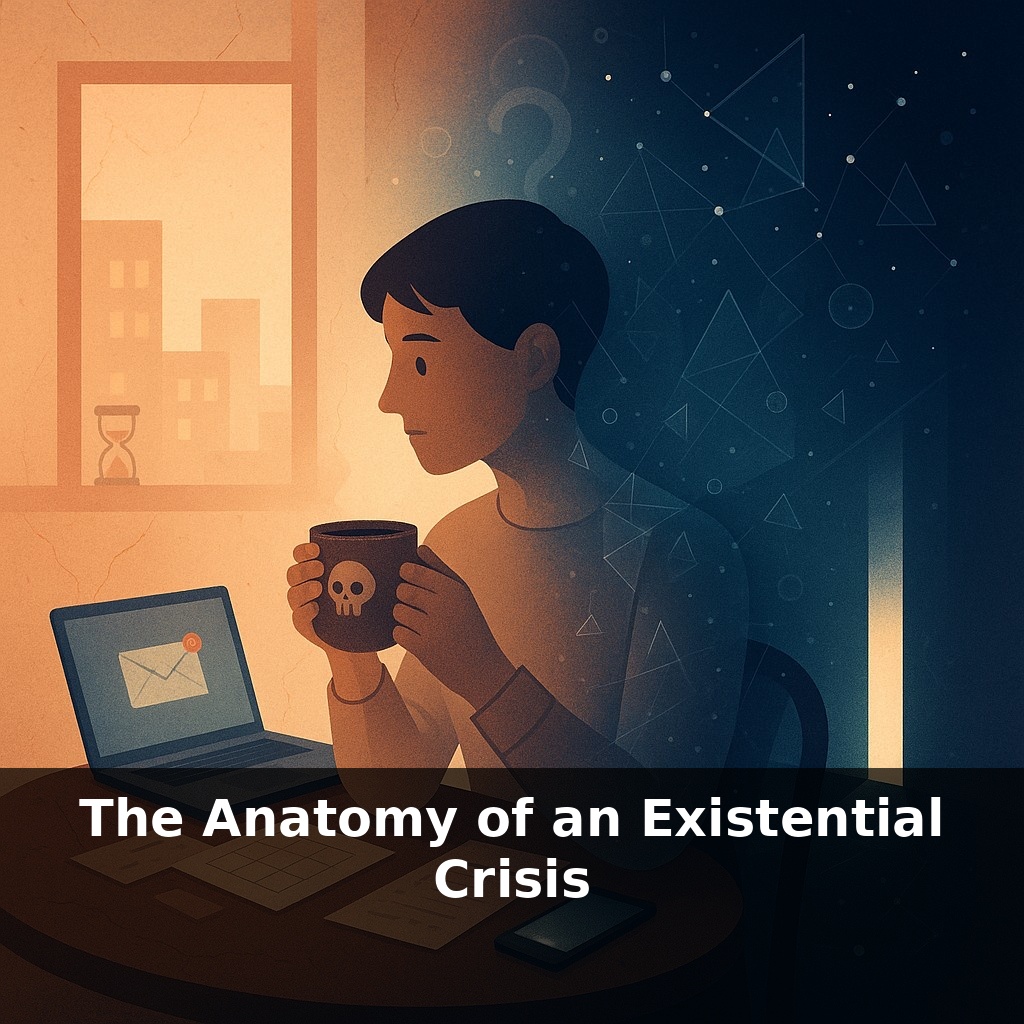
A philosopher once said, “The meaning of life is that it ends.” Now, jump to a quiet Tuesday: coffee in hand, inbox full, life on paper “fine.” Out of nowhere, a question hits: Is this it? In the space after that question, your real story quietly starts to shake.
An existential crisis often doesn’t arrive like a thunderclap; it seeps in quietly. You hit the next milestone everyone said would make you feel “settled” — the degree, the job, the relationship — and instead of satisfaction, you feel a strange emotional static. Tasks get done, small talk flows, but in the pause between notifications, something inside you feels slightly out of tune, like a piano that’s been moved one too many times.
This isn’t simple stress or burnout. It’s the unsettling sense that the script you’ve been performing no longer fits, though you can’t yet see an alternative. You start noticing tiny fractures: a sudden irritation at advice that used to comfort you, a hollow feeling after achievements that were supposed to matter more, a quiet envy of people who seem anchored to something you can’t name.
That’s the anatomy we’ll examine: not just the crisis itself, but what it’s trying to tell you.
Psychologists note that what feels like chaos inside you often follows a pattern. An existential crisis usually starts when three layers grind against each other: the life you’re living, the life you were taught to want, and the life you secretly sense might be possible. That friction shows up in subtle ways: your favorite hobbies feel oddly distant, your beliefs sound different when you repeat them out loud, your calendar is full but your inner life feels strangely underbooked. You may catch yourself asking not “What should I do next?” but “On what basis am I choosing at all?”
Under the surface of that friction, certain questions start organizing the chaos. Yalom called them the “ultimate concerns”: death, freedom, isolation, and meaninglessness. They’re not abstract seminar topics; they’re fault lines running under ordinary days.
Death shows up less as fear of literal dying and more as a sharp awareness of finitude. You scroll past another news story, or watch a parent age, and suddenly time stops feeling endless. Decisions you postponed — career changes, commitments, apologies — begin to glow with urgency. “If I only get one life, is this really how I want to spend it?”
Freedom arrives as its own kind of burden. At first, having options felt empowering. Now it can feel like standing in front of a wall of identical doors, each choice quietly closing off countless others. You may feel a strange mix of resentment (“Why didn’t anyone give me a clear map?”) and vertigo (“What if I ruin everything by choosing wrong?”).
Isolation is less about being alone and more about realizing no one can fully live your life for you. Even surrounded by people, there’s a sense that a crucial piece of your experience is incommunicable. Loved ones can advise, comfort, even decide with you — but they cannot ultimately guarantee that your path is “right.” That responsibility sits with you, whether you like it or not.
Meaninglessness often appears last, as a kind of echo. Once you see that life is finite, that no one else can hand you a guaranteed blueprint, and that you must choose anyway, a quiet question emerges: “Does any of this really matter beyond the stories we tell about it?”
At this point, many people think, “Something must be wrong with me.” Yet research suggests the opposite: these concerns tend to intensify precisely during major developmental shifts. In your twenties, when identity and direction are fluid. In mid-life, when old goals have been checked off or abandoned, and the horizon looks different than you’d imagined.
Rather than a malfunction, the crisis is often your mind’s way of saying: the old organizing story has reached its limits. Your values have evolved; your explanations have not. The dissonance between them is what you feel so acutely now.
Some people first notice this shift in oddly practical places. A software engineer stares at her glowing monitor, commits clean code, hits every sprint target — and feels nothing. Her review is stellar, her raise substantial, yet a quiet question trails her home: “Why does this no longer feel like progress?” A new parent, up at 3 a.m., rocks a restless baby and feels a flicker of guilt: beneath the love is a disorienting thought — “I don’t recognize who I am anymore.”
Others meet it at moments labeled as success. The academic who finally earns tenure and, the next morning, wakes with a strange blankness where the goal used to sit. The entrepreneur who sells the startup, refreshes a swollen bank account, and realizes the scoreboard changed, but the underlying unease did not.
Think of a hiker who leaves the marked trail: the first steps feel thrilling, then comes a tense pause — no clear path, no signs, only landscape and choice. That pause is unsettling, but it’s also where genuine navigation begins.
Existential questions won’t stay confined to late-night thoughts; they’re likely to shape institutions. As people seek purpose, universities may treat “meaning literacy” like basic writing skills. Health systems could prescribe reflection tools the way they prescribe exercise. Workplaces might resemble apprenticeships in values, not just skills — less “climb the ladder,” more “craft a path.” Like gardeners adjusting to new seasons, societies will need to redesign norms to fit longer, many-chaptered lives.
You don’t have to solve everything at once. Think of this season less as a test and more as learning a new instrument: at first, every note sounds wrong, your timing off. Over time, you start noticing which melodies feel honest. Curiosity becomes a compass. Instead of asking, “What’s my grand purpose?” you can start with, “What feels quietly true today?”
Try this experiment: For the next 24 hours, pretend your “old life script” has fully expired and you’re in what the episode called the “liminal hallway” between identities. As you move through your day, consciously pause three times (morning, afternoon, evening) and choose one small decision you’d normally make on autopilot—what to wear, how to answer “How are you?”, what you say yes/no to—and ask, “If I wasn’t trying to be my old self, what would I choose right now?” Do the new choice, then quickly rate (in your head) how it felt on a scale of 1–10 for aliveness vs. numbness. At night, notice which choices gave you even a tiny bump in aliveness—that’s your real-time data on what the “next you” might actually want.
From this course
Existential Dilemmas: Navigating Life's Big Questions
6 episodesUnlock all episodes
Full access to 6 episodes and everything on OwlUp.
Subscribe — $1.99/monthLess than a coffee ☕ · Cancel anytime