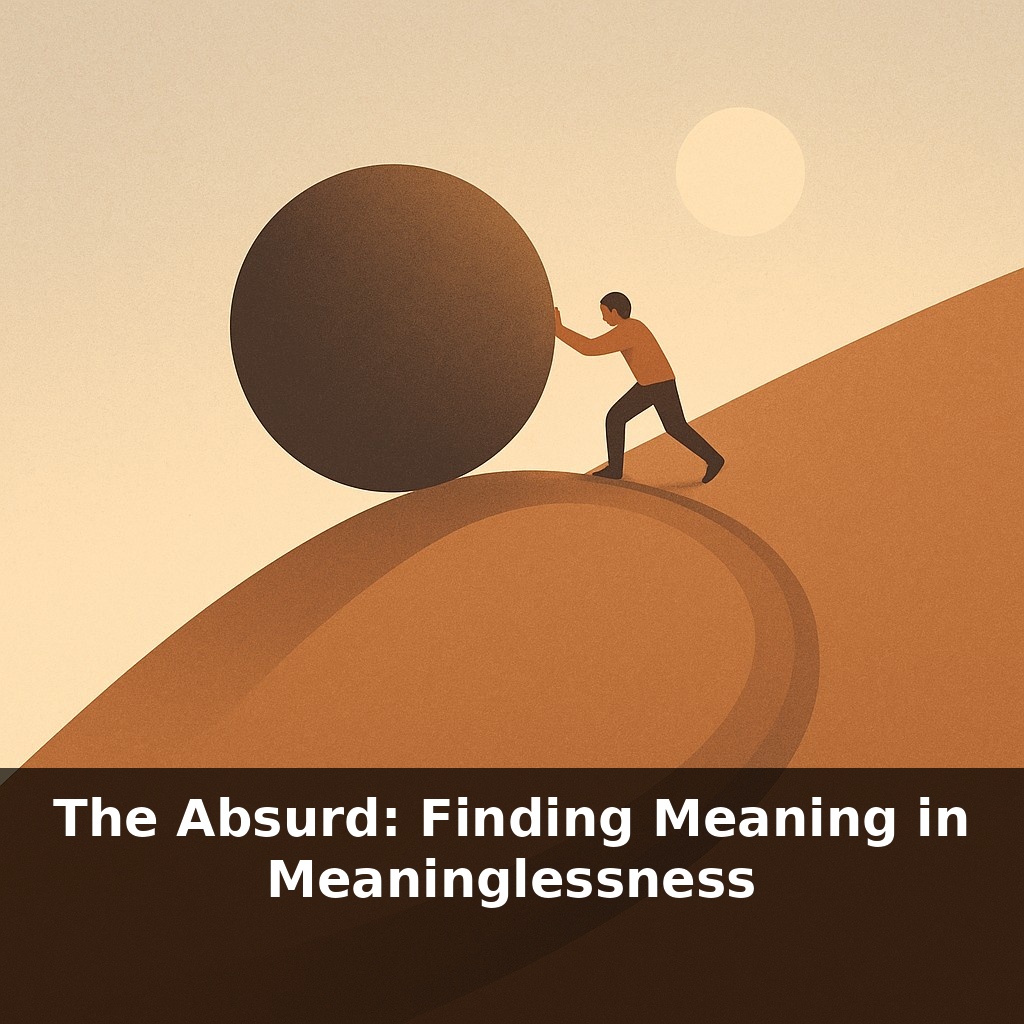
A book about a man pushing a rock up a hill has quietly sold millions of copies. Not a thriller, not a romance—just a man, a rock, and a task that never ends. Yet readers keep turning its pages. Why are we so drawn to a story where nothing, on the surface, ever really changes?
Maybe we keep returning to Sisyphus because his hill looks suspiciously like our own lives. Not in the dramatic moments, but in the quiet, repetitive ones: answering the same emails, calming the same fears, waking to the same alarm. Camus takes that familiar background hum and gives it a name: the absurd—the clash between our hunger for meaning and a world that won’t explain itself. Instead of solving this clash, he stares at it and asks: “Now what?” That “now what?” is where things get interesting. It’s where philosophers, therapists, and even modern psychologists step in—not with a grand cosmic answer, but with tools for living anyway. In this episode, we’ll explore how accepting a silent universe can, strangely, make your own voice louder—and why that might be the start of a more honest, resilient kind of hope.
So here’s the twist: when philosophers and psychologists look closely at this tension, they don’t mainly see a recipe for despair—they see raw material. Kierkegaard talks about a leap of commitment, not because the universe is clear, but precisely because it isn’t. Sartre insists that every “I have no choice” usually hides a choice we don’t want to own. Viktor Frankl, working with people in extreme suffering, noticed that even there, tiny acts of meaning-making mattered. Modern research quietly agrees: people who choose their own “why” tend to cope better, live longer, and stay steadier under pressure.
Camus thinks the first honest move isn’t to fix the absurd, but to stop pretending it isn’t there. Not with grand gestures, but in small, awkward recognitions: telling a friend, “I don’t actually know why I’m doing this job anymore,” or noticing, mid-scroll, that no notification will explain what your life is for. That pause is where his three responses begin to matter.
Revolt, for Camus, is not rebellion for drama’s sake; it’s the decision to keep showing up without inventing a comforting script about how it all adds up. A nurse who knows some patients won’t recover, but still learns their stories; an artist who accepts that most work will be forgotten, but keeps creating anyway—that’s revolt in practical clothes. It’s a refusal to let the lack of a cosmic guarantee turn into personal resignation.
Freedom, in this lens, isn’t “I can do anything”; it’s “I can no longer blame the universe for choosing for me.” Sartre presses this to an almost uncomfortable edge: the person who says “I have no choice but to stay” is usually choosing security, reputation, or someone else’s approval. Kierkegaard’s leap looks different—less about radical autonomy, more about owning a commitment you can’t rationally prove. Both demand that you stop outsourcing responsibility to fate, God, or “the system” and admit: this is my move.
Passion, for Camus, is where these choices stop being abstract. It’s not necessarily intensity or drama; often it looks like Viktor Frankl’s patients who found a reason to endure in caring for a child, finishing a manuscript, or simply wanting to see another sunrise. Modern psychology’s data on purpose, cortisol, and longevity quietly echo this: it’s the lived pursuit of something you treat as worth your limited time.
Here’s where absurdism quietly parts ways with nihilism. If nothing is guaranteed to matter, then everything is available to matter—your friendships, your craft, your causes, even the way you handle boredom. The conflict with a mute universe doesn’t disappear, but it stops being a verdict and starts becoming a backdrop against which your projects stand out more sharply.
A useful way to spot your own response to the absurd is to watch how you treat the “in‑between” moments of your day. Someone stuck on a cramped train might scroll numbly, waiting for time to pass; someone else on that same train might use the commute to practice a language, sketch strangers’ shoes, or send a thoughtful voice note. The external situation doesn’t change—but the stance toward it does. In workplaces, you’ll often see one colleague quietly redesign their role around mentoring juniors or improving a broken process, while another moves through the same tasks on autopilot, counting hours. Both feel the tension of “What’s the point?”; only one experiments with an answer. Even small choices—picking a theme for your year, learning the names of the people who clean your building, tending a tiny balcony garden as if it mattered—become concrete places where your values stop being ideas and start rearranging your calendar. Over time, those tiny, stubborn preferences form a pattern that looks suspiciously like a life.
As AI and schools start teaching “purpose skills,” meaning may feel less like a rare revelation and more like learning an instrument: awkward scales first, then your own songs. Clinical tools could shift from only reducing symptoms to asking, “What will you do with the relief you gain?” Work might shrink as a life-defining story, nudging people to treat care, craft, and curiosity as serious projects. Even space agencies quietly hire psychologists now—preparing crews not just for risk, but for raw, horizonless awe.
So the question quietly shifts from “What is life for?” to “What will I do with this afternoon?” Absurdism isn’t a finish line; it’s closer to learning a new instrument—clumsy at first, then unexpectedly absorbing. You may never get a cosmic answer, but each small, chosen rhythm—a call, a risk, a kindness—becomes another bar in a song only you can play.
Before next week, ask yourself: 1) “Where in my life right now do I feel like Sisyphus—pushing the same boulder up the hill—and how might I consciously ‘rebel’ by choosing *how* I show up in that routine instead of just resenting it?” 2) “When something feels pointless (like answering emails, commuting, or doing chores), what tiny, specific meaning could I choose to give it—such as practicing patience, kindness, or craft—and how would that change my experience of it today?” 3) “If I fully accepted that the universe is indifferent, what is one deliberately ‘absurd’ yet personally meaningful act I could do this week (like writing a thank-you note no one expects, creating art no one will see, or taking a silent walk just to notice the world) purely for its own sake?”