About half of people say they don’t feel like their “real self” in daily life—yet almost everyone claims authenticity is a top value. You’re in a meeting, laughing at a joke you don’t find funny. On a date, nodding along to an opinion you hate. Where, exactly, did you go?
You don’t fake-laugh in meetings or bite your tongue at dinner because you’re a liar; you do it because you’re wired to belong. Our nervous system is constantly scanning: “Will I be accepted if I show *this* part of me?” Sometimes the answer feels like no, so we quietly edit ourselves. Over time, those tiny edits can stack up into a life that “fits” on paper but feels strangely foreign from the inside.
Research shows this isn’t just a vibe problem; it’s a stress problem. Chronic self-suppression keeps your body in a low-grade threat state—tension in your jaw, shallow breathing, that Sunday-night dread. And socially, others can often sense the mismatch, even if they can’t name it, which subtly erodes trust.
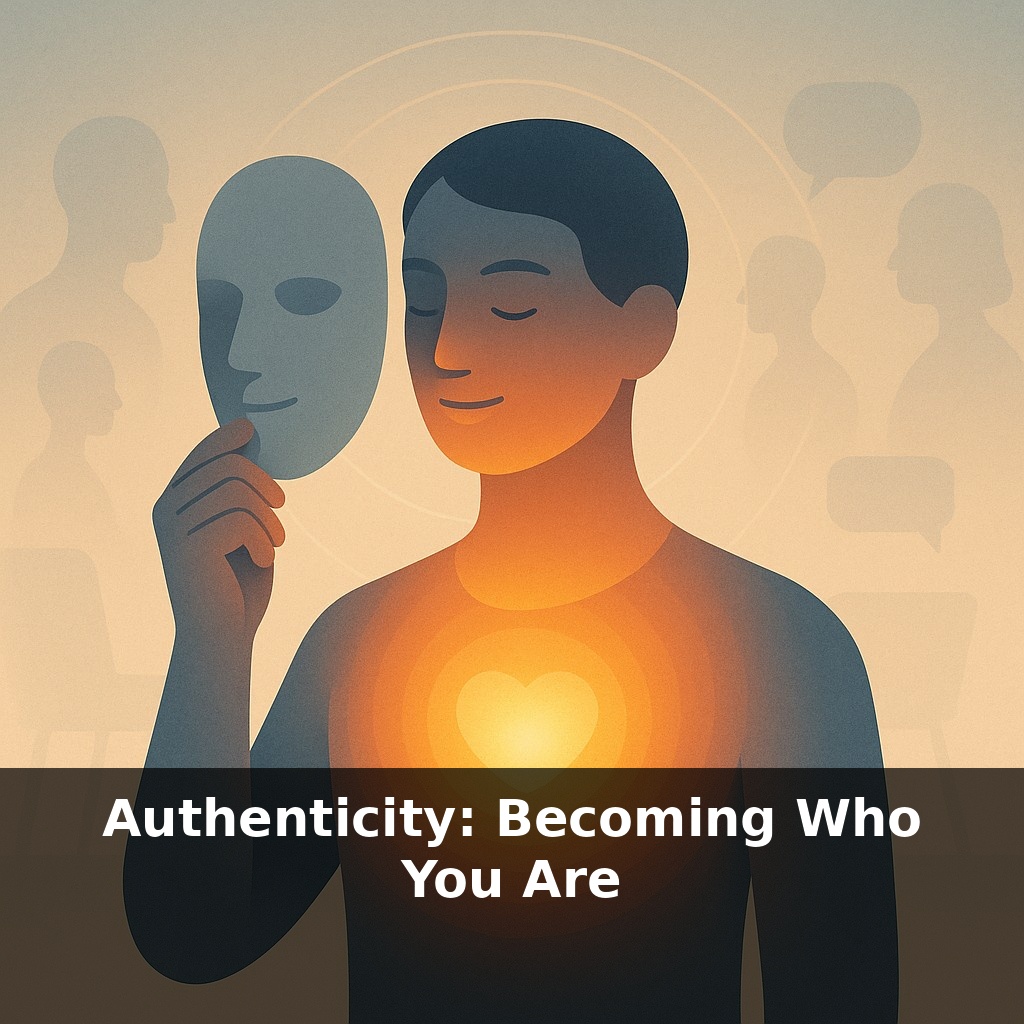
The twist: authenticity isn’t all-or-nothing. It’s less like choosing a mask or no mask, and more like carefully adjusting how much of your inner world you’re willing to let into the room, here and now.
Some people respond by deciding, “Fine, I’ll just be 100% myself, all the time, with everyone.” That sounds noble, but in practice it can feel like emotional streaking—too much, too fast, in unsafe rooms. Others go the opposite way: treating life like a performance review, constantly tweaking their behavior to keep every audience pleased. Both extremes miss a key point from the research: authenticity is relational. Who you are *with* shapes which parts of you can responsibly come forward, without you being fake or betraying yourself.
“People who feel they are living authentically report greater life satisfaction, better relationships, and more resilience,” notes psychologist Michael Kernis. Yet the people who score *highest* on authenticity scales don’t report “finally discovering their true self.” They report being engaged in an *ongoing* process of checking in, adjusting, and sometimes course-correcting when they drift.
This is where the research gets interesting. Studies find that authenticity has three overlapping parts:
1. **Self-awareness in real time** – noticing what you actually think, feel, and want in a given moment. 2. **Honest expression** – letting at least *some* of that inner reality shape what you say and do. 3. **Ethical alignment** – acting in ways that fit your deeper values, not just your moods.
You can be clear on your values but mute in the meeting. You can blurt out your uncensored opinion yet betray a core value of kindness. Authenticity is the *alignment* across those layers, not just “speaking your mind.”
Context complicates this. At work, many people run a quiet cost–benefit analysis: “If I disagree here, does that risk my promotion?” The Harvard Business Review data on engagement doesn’t suggest “be raw at all costs”; it suggests that when environments are safe **enough** for people to share their real perspectives and limits, they invest more energy and creativity.
Companies learned this the hard way. When brands perform “relatability” without backing it up—like publishing glossy inclusion statements while burning out employees—customers and staff pick up the dissonance. Patagonia’s counterintuitive campaign worked not because it was clever, but because it was consistent with years of environmental commitments. The message and the track record matched.
On a personal level, the same pattern applies. People don’t need access to your entire inner monologue to feel you’re real with them. They look for smaller signals: you admit uncertainty, you say “I don’t agree” without theatrics, you apologize when you mess up. Over time, these micro-moments of alignment build a reputation: with others, and in your own mind.
A designer in a big tech firm quietly keeps a folder called “things I actually think.” After major meetings, she jots down what she wished she’d said, then highlights one sentence she’s willing to bring next time. Three months in, she’s not “totally transparent,” but she’s started asking sharper questions and declining impossible timelines. Her work hasn’t changed; her posture has.
A father realizes he’s relaxed and funny with friends, but stiff and critical with his teenager. Instead of vowing to “be more authentic,” he experiments in one tiny zone: endings. For a week, he makes sure every night ends with a genuine, specific appreciation. The dynamic doesn’t transform overnight, yet arguments feel less like court trials and more like rough drafts.
Think of it like walking an unfamiliar trail in low light: each small, honest step shows you just enough ground to take the next one. The path isn’t mapped in advance; it’s made by where you’re willing to place your weight.
As AI deepfakes, curated feeds, and polished “personal brands” multiply, the baseline expectation may quietly shift from “be yourself” to “perform a self.” In that world, signals of grounded humanity—changing your mind in public, admitting mixed motives, updating an old stance—could become rare and therefore powerful. The risk is opting out and going numb; the opportunity is treating each context like a studio, where you’re refining one coherent style rather than painting a new mask every time.
It might help to treat “being yourself” less like a destination and more like editing a draft. Some lines stay, some get cut, some finally say what you meant all along. You won’t please every reader—and that’s the point. Over time, the pages that feel most alive tend to be the ones where your inner voice and the story you live are written in the same ink.
Here’s your challenge this week: choose one situation where you usually “perform” (like your Monday team meeting or a family dinner) and deliberately show up as your unedited self in one concrete way—say the opinion you usually soften, admit one thing you’re actually struggling with, or let your real enthusiasm/nerdiness show instead of toning it down. Before you go in, decide exactly what authentic move you’ll make and who it will be with. Afterward, rate from 1–10 how aligned you felt with your real self in that moment, and what actually happened compared to what you were afraid would happen.