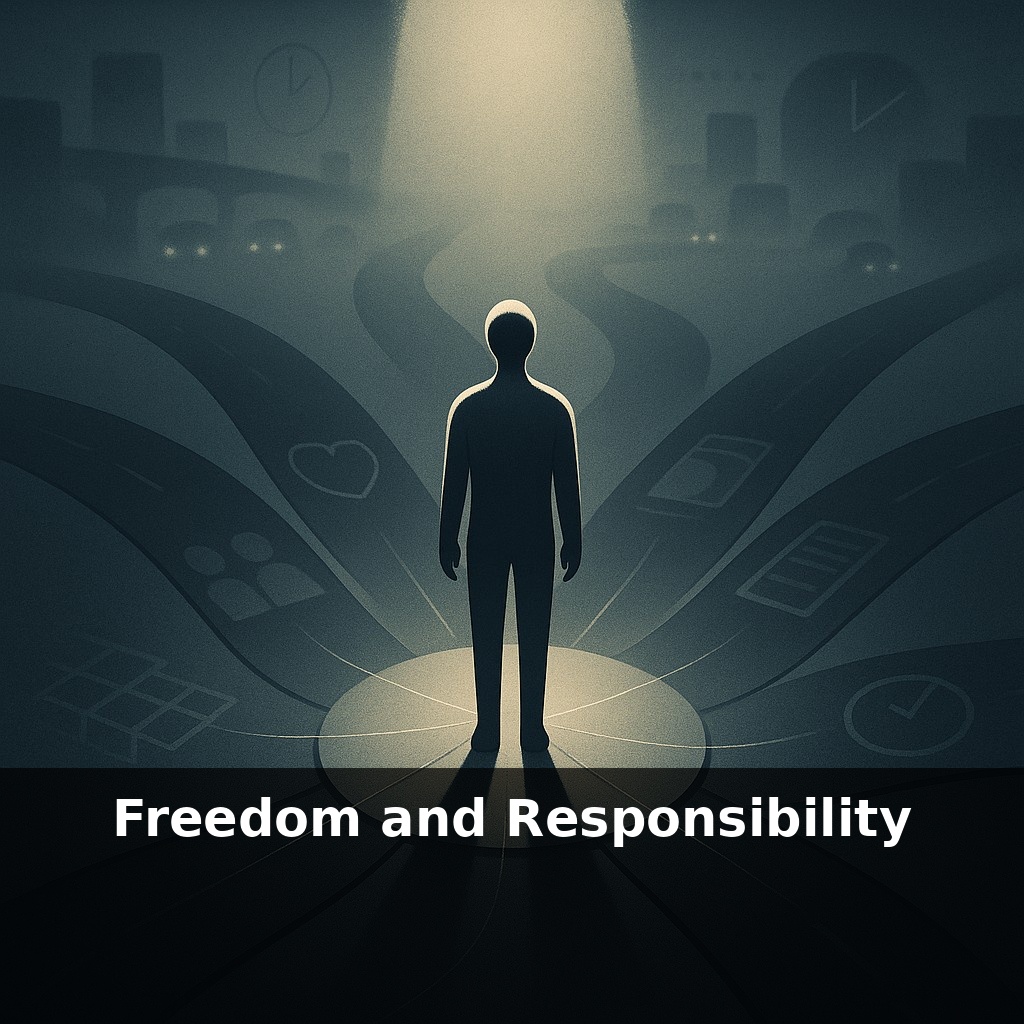
Jean-Paul Sartre once claimed we are “condemned to be free.” On your commute, you choose a lane. In a meeting, you stay silent instead of speaking up. At home, you scroll instead of sleeping. Each tiny decision feels trivial—until you realize none of them were truly neutral.
Sartre’s line sounds dramatic, but it lands in very ordinary places: the career you drift into because it’s “sensible,” the relationship you don’t leave because it’s “not that bad,” the values you inherit but never test. You can refuse to decide, but even refusal tilts your life in a direction. Neuroscience complicates this further. Libet’s experiments suggest your brain “gears up” for action before you’re aware of choosing, raising a disturbing question: if my neurons start first, am *I* really responsible? Yet across cultures, most people still rate freedom of choice as central to a good life, and psychology keeps finding that when we *feel* autonomous, we’re mentally healthier. So we sit in a tension: our choices shape us, yet they’re shaped by forces we didn’t choose—family stories, algorithms, habits, fears. How do we own our lives from inside that web?
Pull back for a moment from big life crossroads and look at the quieter tensions: the job that pays well but leaks your energy, the friend you keep saying yes to though you leave every hangout drained, the news feed you open automatically then close feeling slightly worse. These aren’t dramatic moral crises, yet they quietly edit who you’re becoming. Existential thinkers zoom in on that gap between what you *say* you care about and what your calendar, bank account, and browser history reveal. That gap is where freedom turns into responsibility—or into self-deception. This series lives inside that uncomfortable space.
A strange puzzle sits at the center of all this: most people say they care deeply about shaping their own lives, yet so much of what actually shapes them runs on autopilot. You don’t wake up and consciously decide, “Today I’ll become slightly more impatient, a bit more cynical, and 3% more burnt out.” But patterns of micro‑choices—where your attention goes, what you tolerate, what you avoid—quietly do that work.
Existential thought presses on a simple but uncomfortable question: *Who is the author of those patterns?* Not in some abstract sense, but at the level of: who decided that you check email before you’re fully awake, or that you never bring up money with your partner, or that you always volunteer for extra work and then resent it?
Here the Libet‑style worry about the brain “starting first” can easily become an excuse story: “It’s just how I’m wired.” Yet notice where that logic suddenly evaporates. We still hold people accountable when a surgeon cuts the wrong artery or when a leader lies on their CV. Most legal systems don’t ask, “Did your neurons do this?” They ask whether you could reasonably have anticipated the consequences and chosen differently given what you knew.
This gap—between what’s happening automatically and what you *could* have noticed and redirected—turns out to be where many philosophers and psychologists quietly locate a workable kind of agency. Not supernatural control, but the capacity to *interrogate and revise* your own default scripts over time.
That’s one reason existentialism pushes responsibility beyond private self‑help. Your patterns don’t just sculpt your inner life; they spill outward. The colleague you interrupt, the sibling whose messages you “forget” to answer, the stranger who absorbs your bad mood on public transport—none of those encounters are neutral for them. To say “I couldn’t help it” is often to say, “I chose not to examine the habits driving me.”
This is where the World Values Survey and Self‑Determination Theory quietly converge with existential ethics: feeling like the origin of your actions is psychologically nourishing, *and* it usually demands that you look honestly at the ripple effects of those actions. In practice, that means shifting from “Did I mean well?” to tougher questions like “What am I actually training myself to become?” and “What is it like to be on the receiving end of how I move through the world?”
The challenge is less about suddenly making “perfect” choices and more about no longer pretending they’re weightless.
Think of three ordinary arenas: your calendar, your notifications, and your conversations. Each one quietly records who you’re becoming.
In a calendar, “just this once” late‑night work sessions accumulate. Over months, the pattern whispers a story: *career first, body later*. No single entry looks decisive, yet together they redraw your priorities without asking permission.
On your phone, toggling one app’s alerts to “off” and another’s to “always” gradually shifts which voices get front‑row seats in your day. Headlines, colleagues, or a single group chat can end up curating your mood more than your own long‑term aims do.
In conversation, routinely softening your opinion around one particular person trains a subtle script: “Their comfort outranks my honesty.” The other person learns from that, too—about what they can expect, what they can ignore.
Across these domains, the through‑line isn’t guilt; it’s authorship. You’re not just living in systems—you’re constantly, often silently, co‑designing them.
Laws and technologies won’t wait for us to “feel ready” for heavier responsibility. As tools like CRISPR and AI stretch what a single decision can affect, the moral radius of one person’s choices expands—like upgrading from a bicycle to a high‑speed train while keeping the same reaction time. We’ll likely need civic habits that treat ethical reflection less like a fire extinguisher behind glass and more like a daily exercise routine everyone is expected to maintain.
Maybe the point isn’t to hunt for a single “right” path, but to keep revising how you walk the one you’re on. Like a painter returning to the same canvas, you can layer over old strokes without erasing them, shifting the picture by degrees. The question that lingers is less “What should I choose?” than “Which small, honest edit is possible today?”
Here’s your challenge this week: Pick one “freedom” you value (like flexible work hours, creative autonomy, or saying yes/no to projects) and explicitly define the matching responsibility you’ll own for it (for example: “I own delivering X result by Y time without needing reminders”). Tell one specific person affected by this freedom—your manager, partner, or teammate—exactly what you’re committing to and how they’ll be able to see if you followed through (a metric, deadline, or visible outcome). By Friday, send that same person a short update with the concrete result you produced, even if you fell short, and ask them one question: “Did this level of ownership make your life easier this week?”