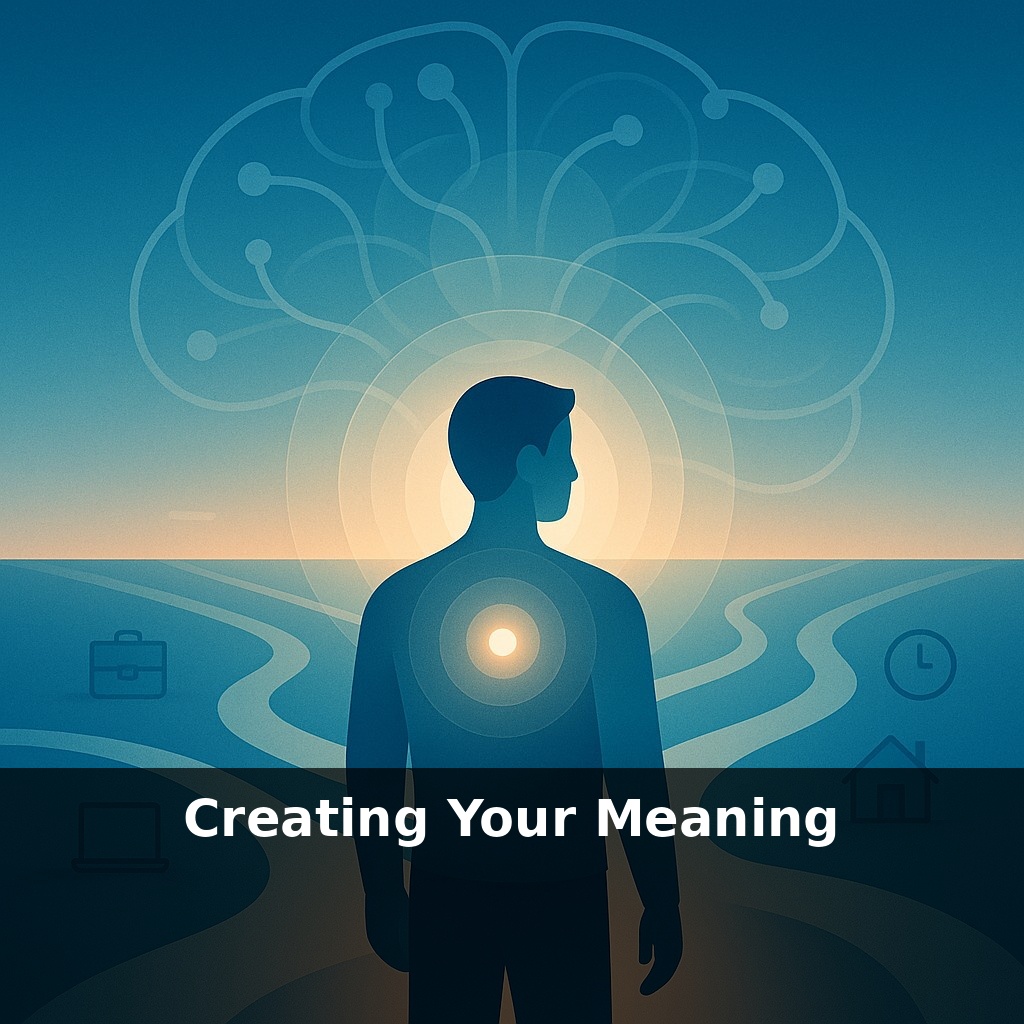
Only about one in five people feels their work is meaningful—yet searches for “life purpose” have exploded in recent years. On your commute, in a late meeting, during dishes at night, a quiet question keeps surfacing: if no one handed you a script, what would your days be for?
Some researchers argue your life already contains enough raw material for meaning—you’re just not organizing it. Neuroscience shows that when your actions line up with what you truly value, your brain’s reward systems respond differently: everyday tasks feel less like random obligations and more like connected steps. That alignment doesn’t happen by accident; it’s more like editing a draft than waiting for a revelation. You notice what feels alive, cut what consistently drains you, and keep revising. This is where reflection matters. Not grand, once-a-year reflection, but brief check-ins: why did that conversation energize me, and that “success” leave me oddly flat? Over time, those small observations become signals: spend more time here, less time there. That’s how ordinary Tuesdays quietly start to cohere into something that feels like it has a direction.
But here’s the catch: clarity rarely arrives while you’re doomscrolling at midnight. It shows up in motion—testing different ways of spending your time, then noticing what happens to your mood, body, and relationships. Studies on self-concordant goals suggest that when what you pursue actually feels like “you,” motivation becomes more sustainable and setbacks less threatening. The same hour can either drain you or quietly anchor you, depending on why you’re doing what you’re doing and who benefits. Meaning, then, starts looking less like a lightning bolt and more like a practice of choosing your “why” before your “what.”
Here’s the uncomfortable twist: your days are already proving what you care about, whether you’ve chosen it or not. Open your calendar and bank statement—those are your current “beliefs,” translated into time and money. Existential psychologists point out that when this unintentional pattern clashes with your stated values, you feel it as a vague restlessness: nothing is exactly wrong, but nothing quite fits.
So how do you shift from default to design? One route is through very small, deliberately chosen commitments that favor depth over drama. Instead of waiting for a single “calling,” you can build what researchers call a *web* of purpose: multiple roles and projects that each connect to something you care about—learning, beauty, justice, family, curiosity, faith. That way, if one strand snaps (a job loss, a breakup, a health scare), the whole structure doesn’t collapse.
Relationships are a powerful part of that web. Longitudinal studies repeatedly find that people who invest in a few close ties—friends, family, mentors, community—report higher life satisfaction and cope better with stress. Not because every conversation is profound, but because showing up for others gives your choices a context. Texting a friend after their exam, making soup for a sick neighbor, mentoring a junior colleague: these are tiny, concrete ways of saying, “My time is also for you.”
Service is another anchor. It doesn’t have to be heroic. Volunteering two hours a month, offering a skill you have, or just being reliably kind in a specific space (the classroom, the group chat, the team meeting) can turn routine environments into places where you know *why* you’re there.
And then there’s your inner story. Values-affirmation research shows that even brief writing about what matters most can buffer you against stress. But you can go further: not just naming values, but rewriting how you interpret your setbacks in light of them. The same failure can be a verdict—“I’m not enough”—or a data point—“This is the kind of risk I’m willing to take for what I care about.” That narrative shift is subtle, but over months and years, it changes which risks you take, whom you approach, and which doors you even notice.
Maya starts with a simple rule: “One hour a week for what I wish more people had.” She joins a language buddy program for immigrants, not because it’s her “destiny,” but because she remembers how lost her parents felt in clinics. That single hour quietly reshapes her week—suddenly her phone scrolling has a rival, and Tuesday evenings have a story she can point to.
Jared, who feels stuck in a corporate role, makes a different kind of move. He chooses *one* meeting each day where he’ll ask a question no one else is asking—about long‑term impact, or who’s affected but not in the room. It’s a tiny intervention, but over months, he becomes the unofficial conscience of the team. His job title hasn’t changed; his stance inside it has.
Creating meaning is like crafting a mosaic—you rarely know what the final image is, only that today’s tile needs to belong *somewhere* that matters, even if the edges are still rough.
As tech, climate, and culture keep shifting, “creating your meaning” may become less like choosing a career and more like tending a rotating garden of projects, roles, and communities. Hospitals might pair checkups with “purpose coaches,” schools could grade not just what you know but how you contribute, and employers may compete on how well your role fits your values—like choosing a city that matches your pace, not just a job that pays the rent.
You don’t need a five‑year blueprint to start; you need one experiment you’re willing to run tomorrow. Treat your day like a draft playlist: keep one activity that felt honest, skip one that felt empty, and add one small act of service or curiosity. Over months, those edits can turn background noise into a soundtrack you’d choose on purpose.
Try this experiment: For the next 7 days, pick one “meaning seed” from the episode (growth, contribution, creativity, or connection) and design a tiny, 15‑minute daily ritual around it—like teaching someone one thing you learned (contribution) or deliberately doing one task 10% better than necessary (growth). Each evening, rate that day from 1–10 on two scales: “felt meaningful” and “felt draining.” At the end of the week, compare which type of ritual gave you the highest “meaning” with the lowest “drain,” and commit to keeping just ONE of those rituals for another week.