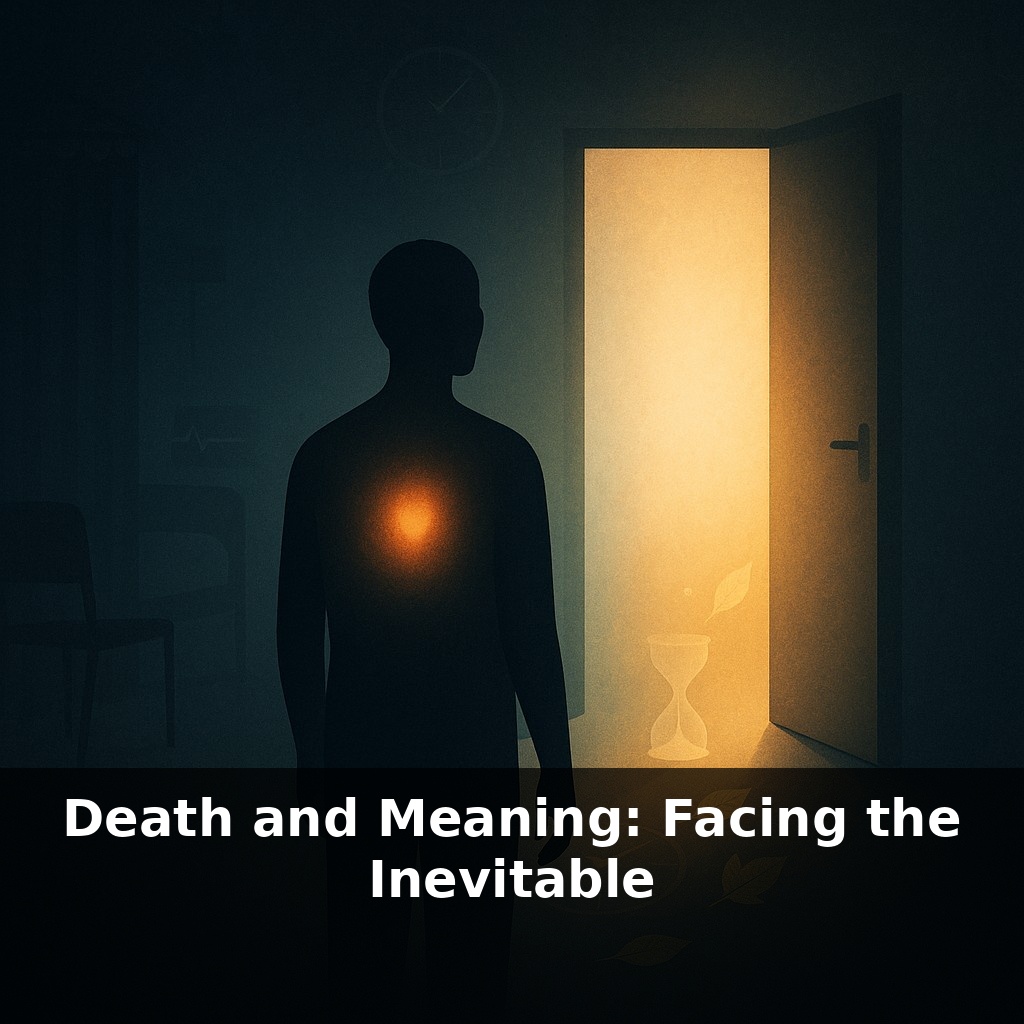
Every second, another person somewhere on Earth takes their last breath. Now zoom into a quiet hospital room, where a family argues about treatment, while the patient just wants to go home. Here’s the twist: facing death clearly can make life feel more vivid, not less.
For most of us, death stays politely offstage—mentioned in insurance forms, skipped over at dinner, sanitized in hospital corridors. Yet it keeps quietly shaping our choices: the careers we chase, the grudges we nurture, the risks we never take. Research shows that when the idea of death sneaks into awareness, we don’t just feel afraid; we also cling harder to our beliefs, our groups, our flags. That’s why the same fact—“you will die”—can fuel compassion in one moment and cruelty in another.
This episode steps into that tension. We’ll look at how cultures try to outwit finitude with legacies, doctrines, and monuments, and how therapies invite people to stop outwitting and start listening. Along the way, we’ll ask a harder question: not “How do I avoid thinking about death?” but “What do my reactions to it quietly reveal about the life I’m building now?”
Some of the clearest insights on mortality don’t come from philosophy books, but from hospital charts and quiet policy shifts. Neuroscience studies show that when people are briefly reminded of their limited time, brain regions linked to self-focus light up first—yet, with repeated exposure, circuits for empathy and long-term planning become more active. Sociologists, meanwhile, track how entire societies reorganize around this fact: from rising hospice use to legal debates about end‑of‑life choices, our systems quietly reveal what we value when the clock is visibly ticking.
When psychologists talk about “mortality salience,” they don’t mean people sitting in graveyards all day. It can be as small as walking past a funeral home, answering two survey questions about death, or hearing that a friend’s parent is ill. Yet those tiny reminders reliably nudge behavior in experiments: people tip more to waiters, punish moral violators more harshly, buy more status goods, and favor leaders who promise security. The same trigger can pull us toward generosity or defensiveness, depending on what stories we’ve already been living inside.
Terror Management Theory helps explain this. When the finiteness of life brushes the edge of attention, most of us reach—often unconsciously—for three buffers: our worldview (“how things are”), our sense of personal value (“that I matter”), and our hope for continuity beyond our individual lifespan (through children, work, faith, or memory). Strengthen those, and death-thoughts tend to recede into the background noise.
But there’s another path that isn’t just distraction or denial. Long-term studies of people who regularly confront finitude—palliative care workers, certain contemplative practitioners, some trauma survivors—find a pattern: initial spikes in anxiety followed, over time, by greater clarity about what is “worth it” and what is not. Goals shrink from “everything I could possibly do” to “what I can stand behind if time is short.” Relationships get edited: fewer obligatory social ties, more deliberate commitment to a smaller circle.
That’s part of why hospice has quietly reshaped the last chapter of life in countries where it’s accessible. When the medical default shifts from “fight on at all costs” to “what matters most in the time left,” people often choose differently: pain control over invasive procedures, reconciliation over litigation, presence over productivity. In a strange way, policy choices about reimbursement codes and hospital incentives end up scripting our last conversations.
This isn’t only about the final months. Brief mortality prompts have been shown to increase gratitude, environmental concern, and willingness to help strangers—if people already value those things. Death doesn’t invent our priorities; it sharpens the contrast on what was faintly there all along.
A man in his 40s gets a routine health scare: a shadow on a scan, more tests needed. For two weeks, his calendar quietly rearranges itself. The side project he’s been postponing suddenly gets his best hours; the networking calls evaporate. When the follow‑up shows he’s fine, he doesn’t fully go back—because he’s now seen which parts of his schedule felt absurd under a tighter clock.
A nurse in oncology keeps a small notebook, not of symptoms, but of last requests she overhears: “I wish I’d taken that train trip,” “I want to hear my brother’s voice,” “I hope my kids know I was trying.” Patterns emerge. They begin to use those patterns as a compass for their own choices long before their own chart is ever written.
Contemplating death is like pruning a garden: removing what’s bound to wither lets sunlight reach what you truly want to flourish.
Even public debates shift: cities that publicly discuss end‑of‑life care often see more advanced directives filed and fewer unwanted interventions, as if naming the inevitable makes room for gentler endings.
Mortality will soon meet technology in ways previous generations never faced. Your data may outlive your body, letting descendants “visit” you through posts, messages, even AI-trained avatars. Schoolkids might one day draft end‑of‑life plans alongside career goals, treating both as normal. Climate disasters could make loss feel less abstract, nudging nations either toward shared responsibility or harder borders. How we design these systems will quietly answer what we think a life is “for” once it’s over.
So maybe the question isn’t how to outsmart the ending, but how to revise the middle. Futures shrink and stretch in strange ways: a year can feel like a hallway or a keyhole. Relationships, projects, even grudges start to look like books on a short shelf—there’s only room for a few you’ll actually finish reading twice.
Start with this tiny habit: When you turn off a light at night, gently say to yourself, “I will die, and that makes this moment precious,” then notice one specific thing you’re grateful for from today (a person, a smell, a sound). When you brush your teeth in the morning, take one slow breath and silently ask, “If today were my last ordinary day, what’s one small kind thing I could do?” When you touch your phone for the first time each day, pause for just three seconds and picture one person you’d miss if you were gone, then silently wish them well.