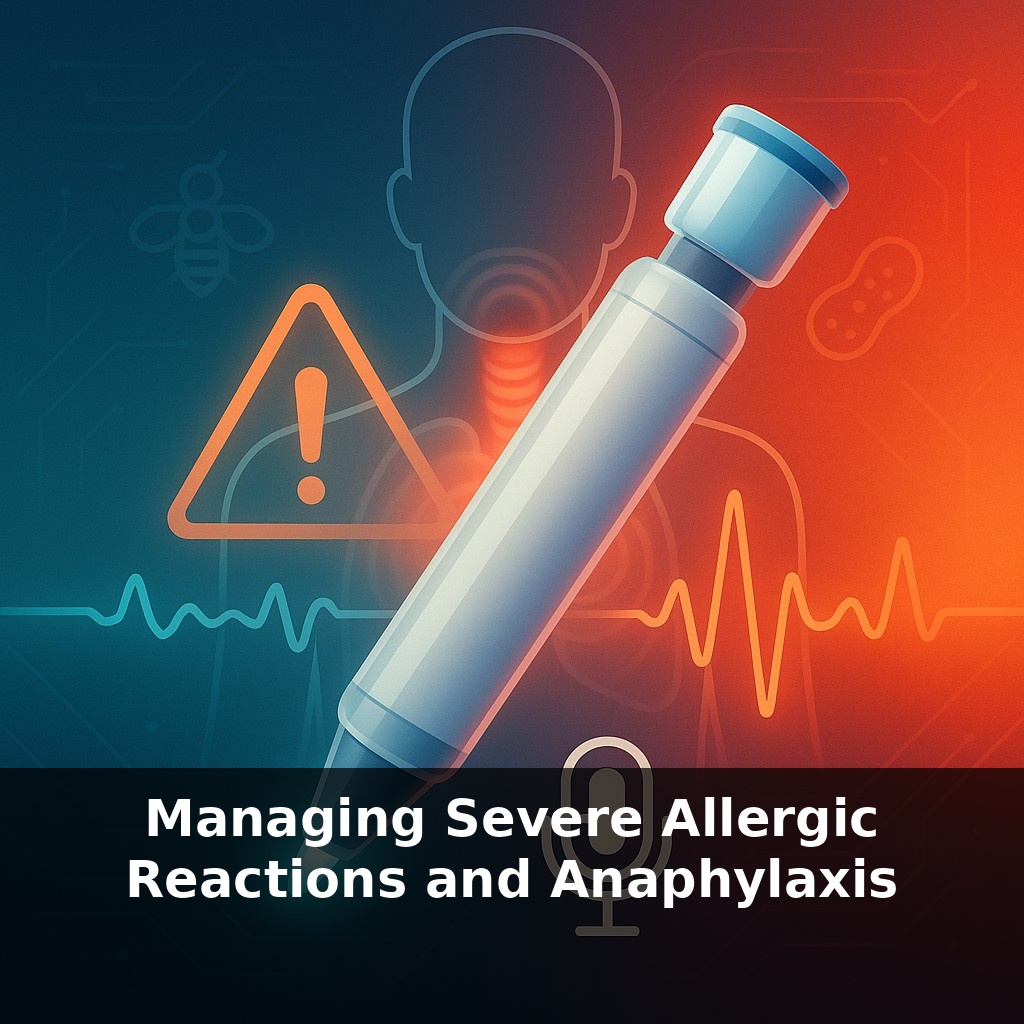
A severe allergy can push someone from “I feel strange” to cardiac arrest in under five minutes. A child bites a cookie, a nurse starts an IV, a teen gets stung at practice—breathing tightens, lips swell, voice changes. Which clue tells you this isn’t “just” an allergy anymore?
That turning point—the moment when “this feels off” becomes “this is an emergency”—is where most people freeze. Not because they don’t care, but because they’re afraid of “overreacting,” of using an EpiPen “too soon,” of “bothering” emergency services. In real life, that hesitation is what kills, not the medicine. Some reactions start with hives or stomach cramps, others jump straight to a sense of doom, sudden weakness, or a strange, restless agitation. A person might insist they’re fine even as they’re subtly pulling at their collar, switching positions, or pausing mid‑sentence to catch a breath. In this episode, you’ll learn how to spot that tipping point, why epinephrine is safer than most people think, and how to build a simple plan so your response is almost automatic when seconds matter.
The tricky part is that early anaphylaxis doesn’t always look dramatic. It might be a sudden wave of nausea in a classmate after a snack swap, or a teammate who abruptly feels “really off” and light‑headed after a sting, or a patient who becomes unusually quiet and distant after a new medication. Some people feel gut cramps, others get a racing pulse and restless pacing, others feel chest tightness or a “lump” in the throat with no visible swelling yet. In real time, these clues show up like scattered brushstrokes; your job is to notice the pattern fast enough to act, even before it looks textbook.
The fastest way to cut through the uncertainty is to focus on *clusters* and *change over time*, not any single symptom.
Think in pairs: two or more body systems misbehaving at once after a likely trigger. For example: - Skin: new hives, flushing, or sudden itchiness - Lungs: new cough, wheeze, or feeling “can’t get a deep breath” - Heart/circulation: faint, dizzy, weak, or unusually rapid pulse - Gut: crampy pain, vomiting, or repeated loose stools - Brain: intense anxiety, confusion, or “something terrible is happening”
One system grumbling might be a mild reaction; two or more changing quickly—especially within minutes of a sting, food, or medicine—should ring loud alarm bells. Timing matters: symptoms that appear abruptly and escalate beat out “I’ve had a mild itch all day” in terms of concern.
Next, watch the direction of travel. Are symptoms: - Spreading (itchy patch to full‑body hives)? - Moving inward (mouth tingling to throat tightness)? - Deepening (lightheaded to “I’m going to pass out”)?
Worsening equals acting, not watching.
Now layer in the trigger. High‑risk: - Known allergen exposure (even a “tiny bite” or trace) - Injections/IV meds - Stings to face, neck, or inside the mouth - Exercise or alcohol on top of a usual food trigger
If a high‑risk trigger and a fast cluster of changes show up together, that crosses the line from “monitor” to “treat”.
A counterintuitive twist: the *calm* person can be the one you worry most about. Someone who suddenly goes quiet, slumps, or stops participating right after exposure may be losing blood pressure or fighting for air without drama.
Concrete red‑flag combinations that should push you straight to using an auto‑injector and calling emergency services: - Hives plus any trouble talking in full sentences - Mouth, tongue, or throat symptoms plus lightheadedness - Vomiting plus chest tightness after a known trigger - Sudden collapse at any point after exposure—even if skin looks normal
In sports terms, you’re not the video referee analyzing slow‑motion replays; you’re the on‑field official who must call it in real time. When in doubt, you act on the pattern you see, not the one you hope it is.
Think of three short “micro‑scenes,” each with slightly different clues. Scene one: at a school lunch table, a student with a peanut allergy says her tongue feels odd and her stomach “drops,” but her skin looks normal. A friend notices she’s gone pale, fumbling her water bottle, and flags a teacher. They don’t wait for hives; they move her away from the food, grab the action plan, and prepare the auto‑injector while calling parents and EMS.
Scene two: an adult at a work event eats shrimp “just this once.” He laughs off mild throat scratchiness, but a coworker spots that he’s now leaning on a chair, breathing a bit faster, and asking someone else to finish his presentation. The team leads him to a quiet space, has him lie flat with legs elevated, and someone retrieves his bag to check for an auto‑injector.
Scene three: on a hike, a sting leads to a teen saying, “I just feel weird.” No rash yet, but they’re walking slower, pausing more, and needing a hand to steady themselves. The group turns back immediately, assigns roles—caller, watcher, navigator—and stays ready to treat on the trail.
Training for anaphylaxis may soon look more like a team sport than a solo emergency. Community drills in schools, gyms, and airports could turn bystanders into rapid responders, rehearsing roles the way teammates practice set plays. Digital tools might replay each real event like game footage, helping refine timing and decisions. As tech improves alerts and delivery, the human side—shared language, calm coordination, and practiced trust—will still decide how fast help truly arrives.
Your challenge this week: pick one place you spend time—a gym, café, or classroom—and quietly map out how an anaphylaxis response *would* unfold there. Where’s the phone, who can grab an auto‑injector, who guides EMS in? Treat it like sketching stage directions; next time you enter a new space, see how fast you can map that script.