The Chains of the Past: Understanding Dictatorship
📝 Transcript
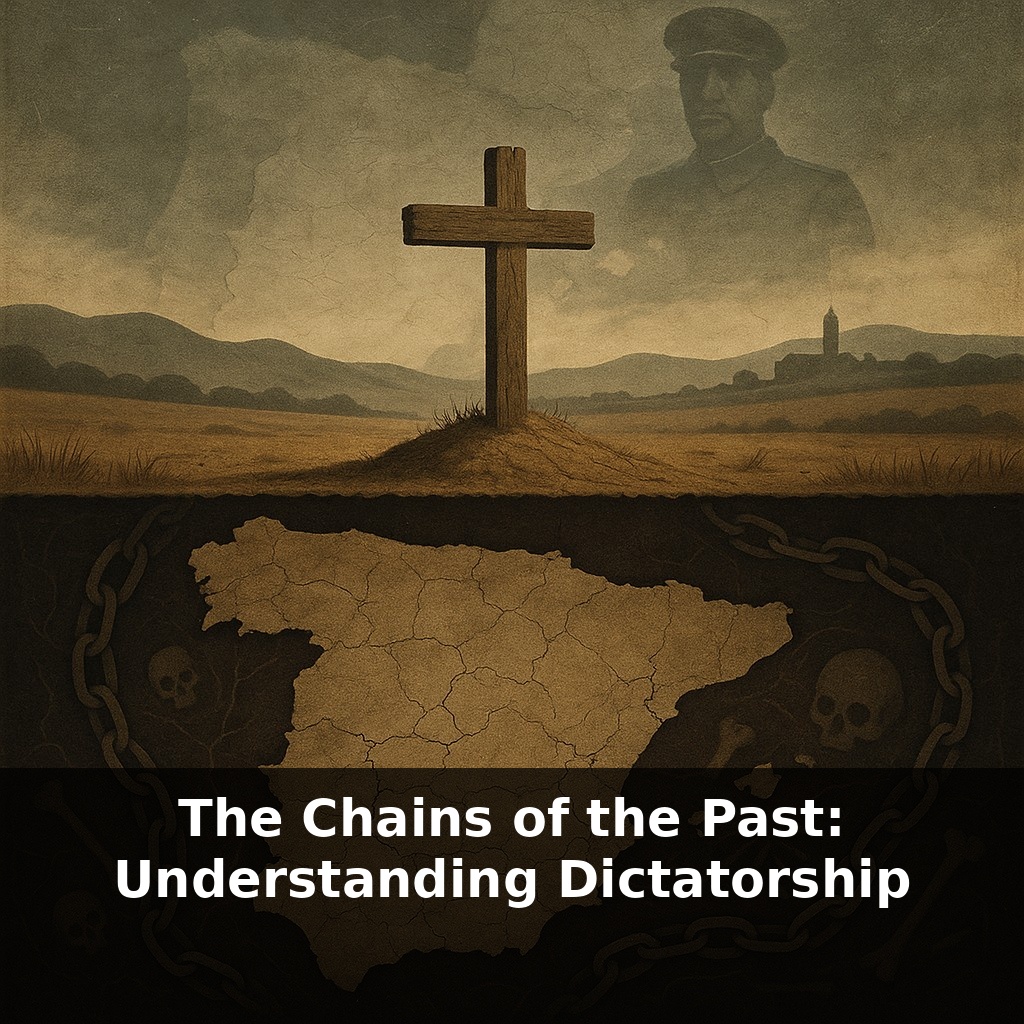
A man dies in Spain today, and his grandchildren still don’t know where his body is buried. Somewhere in the countryside, one of over a hundred thousand unmarked graves lies hidden. Yet for decades, the official story insisted nothing was wrong—only order, peace, and “national unity.”
Those missing bodies are not just a legacy of violence; they are a map of how a dictatorship rewires a whole society. Franco’s Spain did not feel like a war zone every day. For many, it felt more like living in a house where one room is always locked, and everyone pretends not to notice. Schools, courts, newspapers, even dinner-table conversations learned to curve around that locked door.
To understand dictatorship, we have to watch how power seeps into ordinary routines. A history textbook turned into a loyalty test. A neighbor’s silence becoming more valuable than friendship. A priest’s sermon doubling as a political briefing. Francoism shows that authoritarianism is not only about tanks and prisons; it is about narrowing the range of what seems sayable, thinkable, even imaginable. In this episode, we’ll trace how that narrowing happened—and why its patterns still matter.
Franco’s rule did not begin with a constitutional debate; it began with a military victory, and then a legal clean‑up operation to make that victory look permanent and natural. New laws did quiet work in the background, redrawing who counted as a “good Spaniard.” The Law of Political Responsibilities reached backward in time, turning yesterday’s opinions into today’s crimes. Courts, newspapers, and classrooms adjusted like apps after a software update—same icons, different rules underneath. To see how chains are forged, we need to watch these slow edits to everyday life, not just the dramatic moments of conquest.
Censorship came first, not as a blackout, but as a dimmer switch. Newspapers stayed on the stands, radio kept broadcasting, but a new set of invisible tripwires ran through every sentence. Editors learned which topics “caused problems,” which adjectives drew phone calls from censors, which photos mysteriously never made it to print. Self‑censorship soon did more work than official bans. Why risk a visit from the authorities when you could quietly trim a headline, soften a criticism, or simply decide that some stories were “not worth the trouble”?
Schools followed the same pattern. The buildings, desks, and timetables looked familiar, but the content shifted. History classes turned into narratives of heroic “crusades” and providential victories. Teachers who had sympathized with the Republic were purged, suspended, or reassigned. Those who stayed often taught with one eye on the classroom door. Students learned early that certain questions—about the recent past, about missing relatives, about banned languages—were dangerous curiosities rather than normal parts of learning.
Inside families, the line between private and public space grew thin. Children were warned not to repeat at school what they heard at home. A careless joke about “the Chief” could reach the wrong ears through a neighbor, a shopkeeper, even a classmate’s parent. The regime did not need microphones in every living room when everyday gossip could be weaponized. Informants were rewarded, but more powerful than rewards was the quiet fear that anyone might be one.
Religion was woven into this fabric of control. Being seen at Mass, joining certain Catholic associations, or marching in religious processions acted as public proofs of “good behavior.” Parish priests sometimes doubled as community gatekeepers: recommending jobs, vouching for loyalty, or signaling doubts about someone’s “reliability.” Spiritual conformity and political conformity blurred.
Over time, all these adjustments—edited headlines, careful lessons, guarded conversations, conspicuous piety—hardened into habit. The chains that mattered most were not only those of law or police, but the routines people adopted to stay safe, get by, or quietly advance.
Think of a newsroom under the regime as a software team working on an app where the operating system can silently reject any update. Developers keep coding, but they start avoiding features they suspect will crash the system. Maybe they remove a “share” button, or never propose a new security layer because it might conflict with hidden rules. Over months, no one even sketches those features on the whiteboard; the app simply grows up lopsided.
Now shift from code to concrete. City planners in Spain still drew boulevards and plazas, but names and monuments sent clear signals. A street honoring a Republican teacher became Avenida del Generalísimo. Public space worked like default settings: you could technically rename a file on your desktop, but the wallpaper, icons, and notifications all nudged you back toward the approved layout.
Workplaces, too, absorbed the script. A bank manager didn’t need a written order to favor job applicants with certain associations or family histories. Hiring decisions, promotions, even office gossip started to align with what felt “safer,” building an invisible architecture of obedience around everyday careers.
Eerie lesson: systems don’t forget as quickly as leaders fall. Habits born from fear—staying quiet at meetings, avoiding “sensitive” topics, trusting only your inner circle—can outlive any regime. Today, algorithms can play the role once held by paper files: quietly sorting, flagging, excluding. Your challenge this week: notice each time you hold back a question or opinion because “it’s safer.” Ask yourself: safer for whom—and at what long‑term cost?
Democracy, then, isn’t a switch we flip once; it’s closer to a language we can forget if we stop speaking it aloud. Each honest question in class, each local archive opened, each dinner where the “off‑limits” topic finally gets a name—these are small grammar lessons. In future episodes, we’ll follow how people slowly rebuilt that vocabulary.
Try this experiment: For one day, treat a familiar institution in your life (your workplace, school, HOA, or even a group chat) as a “mini-dictatorship lab” and track every moment when decisions are made without open input—note who decides, how they justify it, and how others react (silence, joking compliance, subtle resistance). Then, in one of those situations tomorrow, gently disrupt the pattern by asking a curious, non-threatening question like, “Could we hear a couple of other ideas before we decide?” and observe what actually changes: who speaks up, who looks uncomfortable, who steps in to shut it down. Compare the two days and see whether that tiny challenge to “automatic obedience” reveals any invisible chains—unspoken rules, fears, or habits—that mirror the dynamics the episode described in larger dictatorships.
Unlock all episodes
Full access to 5 episodes and everything on OwlUp.
Subscribe — $1.99/monthLess than a coffee ☕ · Cancel anytime