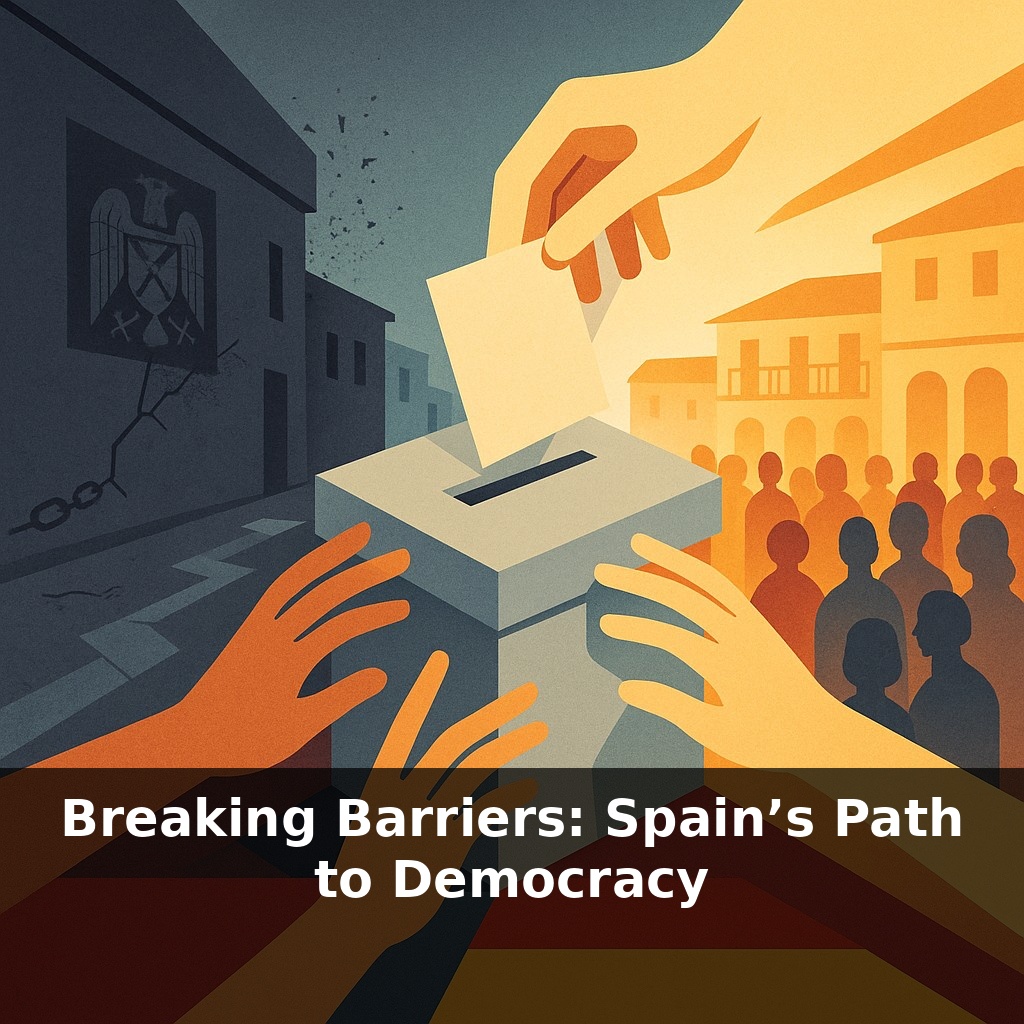
Crowds pour into Spanish streets, not to start a revolution—but to approve it. In a country ruled by a dictator for nearly four decades, most voters suddenly choose reform from within the very system that oppressed them. How does a regime vote itself out of power?
The twist in Spain’s story is that almost no one got exactly what they wanted—yet most people decided that was good enough. Franco’s loyalists feared chaos if power shifted too quickly. The democratic opposition feared betrayal if it shifted too slowly. Workers wanted higher wages and rights; business elites wanted stability and lower inflation; regional movements wanted autonomy without breaking the country apart. Each group held a different piece of the future, and none could win alone.
So the question quietly became: How much are you willing to give up now to avoid losing everything later? Instead of a single dramatic showdown, Spain moved through a series of controlled tests—referendums, elections, national agreements—each one slightly riskier than the last, each one probing whether trust could stretch a little further without snapping.
To make that stretching possible, Spain’s rulers did something unexpected: they kept using Franco-era legal tools—but pointed them in a new direction. Reformers didn’t storm the courthouse; they rewrote the script inside it. Old laws became stepping stones for new rules, so each change looked less like a rupture and more like an update. Crucially, the army, the Church, and big employers were reassured they wouldn’t be publicly humiliated or instantly dismantled. Like updating critical software on a live server, leaders scheduled changes so the system never crashed, even when key files—like censorship and single-party control—were finally deleted.
The first big test came with the 1976 Law for Political Reform. Drafted by Adolfo Suárez’s government and passed by Francoist parliament, it quietly did something radical: it promised free elections and a new constitution—while asking the old system to sign its own redundancy notice. That law went to a referendum, and the “yes” vote was overwhelming. But behind that simple outcome was a complex bargain: legal continuity for the outgoing elite in exchange for opening the door to real competition for power.
Once the door was cracked, timing became everything. Suárez moved fast enough that hardliners couldn’t regroup, but not so fast that the army felt cornered. Legalizing political parties in 1977—especially the Communist Party (PCE)—was a high‑risk move. It signaled to the left that they would not be excluded from the new order, but it unnerved many officers who still saw the PCE as an existential threat. Suárez announced the PCE’s legalization on Holy Saturday, when political temperature and media cycle were both relatively low, to limit immediate backlash.
The first free elections in June 1977 didn’t just pick a government; they chose the people who would write the new rules. No bloc won an absolute majority, so negotiation shifted into parliament itself. Out of that fragile balance came the Moncloa Pacts later that year: parties, unions, and business groups agreed to wage restraints, tax reforms, and social protections to pull inflation down from crisis levels. In return, the government committed more firmly to political opening and social rights.
Drafting the 1978 Constitution turned that fluid understanding into a binding framework. Here the central question was: how do you embed disagreement without breaking the state? Title VIII created a pathway for Autonomous Communities, especially for Catalonia and the Basque Country, defusing immediate separatist pressures by offering self‑government within a shared state. At the same time, rights and freedoms were written tightly enough that even reluctant institutions could accept them as the new baseline.
Not everyone accepted this recalibration. Violence from both ETA and far‑right groups tried to derail the process, keeping fear in the background of every decision. That fear crystallized in the 23‑F coup attempt in 1981, when armed officers stormed parliament and held deputies hostage. Yet the failure of that coup, and King Juan Carlos’s televised backing of the constitutional order, flipped the script: the army’s political leverage was visibly broken, and civilian rule came out stronger than before.
By the mid‑1980s, alternation in power—especially the 1982 victory of the Socialist Party—confirmed that the new rules worked even when incumbents lost. Democracy was no longer a promise; it was a routine. The same gradualism that had once protected cautious reformers now protected the system itself: changing governments no longer felt like risking the country, just changing the team running it.
Your challenge this week: Pick one current country facing political strain—polarization, authoritarian drift, or a stalled peace process. Map three elements from Spain’s pacted transition onto that case: a potential “low‑risk” first test (like a tightly defined referendum or local election), a credible bargain between rival elites, and one concrete guarantee that could reassure a powerful veto player (like the military, courts, or major economic groups). Don’t aim for a full blueprint—just sketch where incremental, negotiated steps might realistically start, and where they would likely run into resistance.
Think of Spain’s transition more like redesigning the rules of a high‑stakes tournament while the season is already underway. No one cancels the league; instead, coaches, owners, and referees meet in quiet rooms to tweak how points are scored, who can appeal a call, and what counts as a foul—always careful not to invalidate yesterday’s results. The Moncloa Pacts worked this way: economic “rules of the game” were adjusted so inflation stopped punishing everyone, while parties and unions gained a say in future calls.
You can see echoes elsewhere. In South Africa, negotiations used interim arrangements and sunset clauses to calm security forces and white business leaders while opening space for the ANC. In Chile, plebiscites and constitutional reforms gradually chipped away at Pinochet‑era safeguards. In each case, the real leverage wasn’t just street pressure or elite fear; it was the credible promise that today’s compromise wouldn’t be used tomorrow as a weapon of revenge.
Spain’s path hints at a broader pattern: deep change often rides on “good enough for now” deals, not perfect justice or perfect blueprints. That raises a live question for today’s crises: how much compromise is acceptable to unlock movement without freezing unfair structures in place? Think of a software beta: you ship with bugs, but you build in update channels. Durable transitions may depend less on heroic moments than on whether those update channels stay open when pressure spikes again.
Spain’s story suggests that the real fault line isn’t just between dictatorship and elections, but between systems that can learn and those that can’t. States that survive shocks act more like adaptive ecosystems than marble statues: rules evolve, alliances reshuffle, and even old watchdogs find new roles. The question is whether today’s strained democracies still have that adaptive edge.
Start with this tiny habit: When you scroll past a political headline about Spain or Europe, pause and whisper to yourself one sentence about Spain’s transition to democracy (for example: “Franco died in 1975 and Spain chose reforms over revenge”). Then, still holding your phone, tap open a map app and zoom in on one Spanish city mentioned in the episode (like Madrid or Barcelona) for just 10 seconds to picture where these changes unfolded. If you have 30 extra seconds, type the name of one key figure from the episode into your browser search bar and read only the first line of their bio—then you’re done.