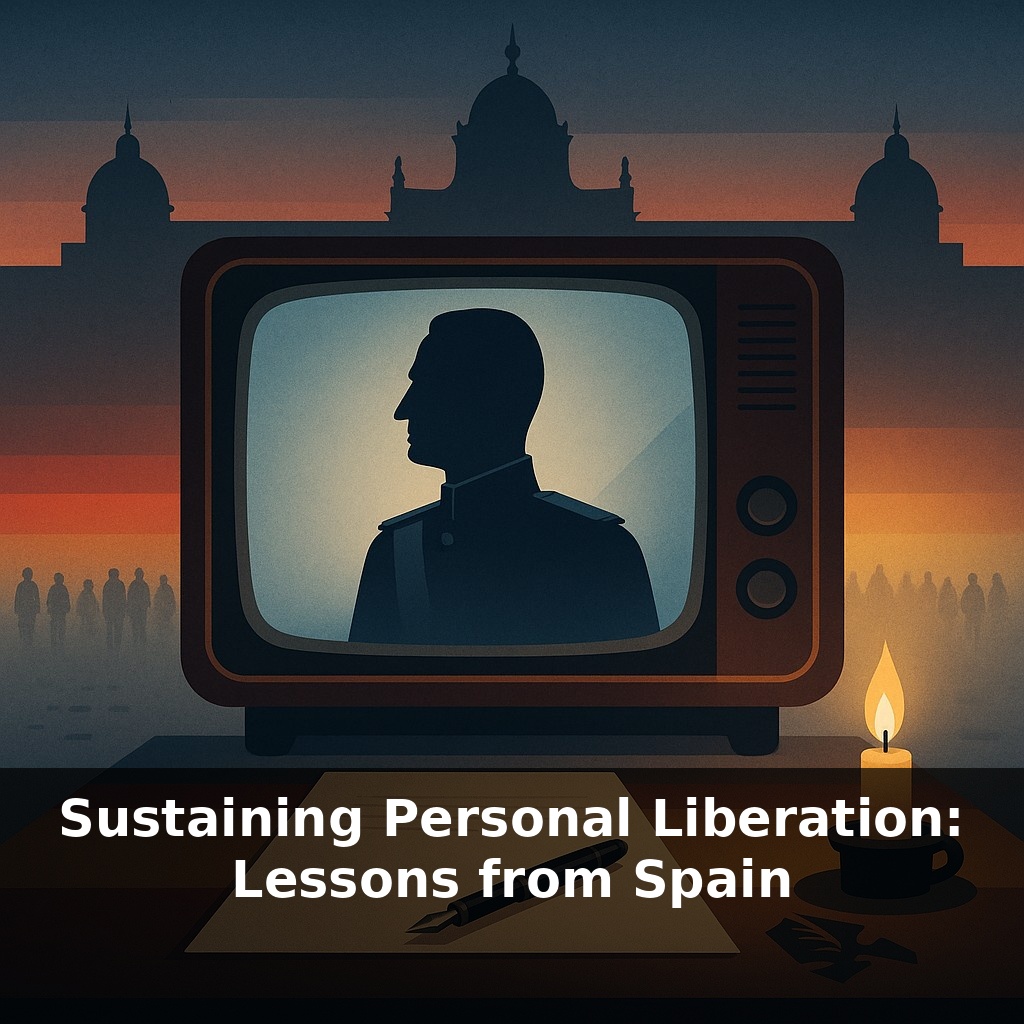
In Spain, a king stopped a coup live on television—yet the real drama came after the gunfire. In this episode, we’re stepping into that uneasy calm, where the dictator is gone, the crowds go home, and the question quietly appears: how do you keep freedom alive tomorrow?
In 1977, sixteen rival leaders in Spain sat down, signed the Pactos de la Moncloa—and then had to wake up the next morning and actually live with what they’d agreed. That’s the awkward, quiet part of any turning point: you need a way to make yesterday’s courage repeatable.
This episode is about that repetition.
Spain shows that what happens *after* the breakthrough matters most. The Transición wasn’t just a big national “yes” to change; it was thousands of small, written “yeses” that followed: parties accepting rules they disliked, unions tolerating painful wage limits, citizens voting for a constitution that would also restrain their own side.
We’ll use that to zoom in on you. How do you encode your values so they survive your moods, your stress, your next crisis? How do you build habits and relationships that keep you from quietly drifting back into old patterns when no one’s watching?
Spain’s story after Franco is basically a stress-test lab for change. New rules were written, but then inflation, terrorism, and that 23‑F gunfire all pushed those rules to the edge. The interesting part is not that the system was fragile—it’s that it bent instead of snapping. Think of a well-designed bridge: it sways in the wind, but the bolts don’t pop.
In this episode, we’ll look at three things Spain quietly got right—law, culture, and institutions—and translate each into something very small and very practical you can build into your own daily life.
Here’s the quiet trick Spain used after Franco: they stopped treating “change” as a mood and started treating it as paperwork.
First, they wrote things down—even when it was uncomfortable. The 1978 Constitution didn’t just say “democracy is good”; it nailed down details: how judges are appointed, how regions share power, how rights can and cannot be limited. Eighty‑seven point nine percent of voters said yes, knowing that, from then on, arguments had to go through that text. In software terms, they moved from improvising in the command line to agreeing on a shared codebase—with version control.
On a personal level, that’s the difference between “I want more freedom” and “these are the three rules I don’t break, even when I’m tired or scared.” It might be as blunt as: “I don’t cancel therapy for work,” or “I never check my boss’s messages after 9 p.m.” Vague intentions are like verbal agreements in a crisis meeting: everyone walks out with a different memory. Written rules survive your next bad day.
Second, Spain didn’t wait for politics to carry all the weight. Pluralism seeped into music, TV, neighbourhood bars, universities. Censorship fell, and suddenly people could read communist papers, conservative papers, Catalan poetry, punk lyrics. Disagreement moved from the shadows to the living room. Over time, having friends who voted differently stopped being a scandal and became normal social friction.
Your equivalent isn’t to consume “both sides” mechanically; it’s to diversify your everyday inputs. Follow people whose life choices unsettle you a bit. Have one regular space—a class, a hobby group, an online forum—where you’re not the majority. Spain’s later leap on same‑sex marriage in 2005, and thousands of couples marrying within a year, rested on that slow, prior stretch in what counted as thinkable.
Third, they built alarms. When 200 Civil Guard officers stormed parliament on 23‑F, the system didn’t improvise from zero. Broadcasters chose to keep cameras rolling. Judges, party leaders, and especially the king used their institutional roles to send a unified signal: the line is here. Today, press freedom monitors, activist networks, and courts keep nudging when that line blurs; Spain’s strong ranking on press freedom isn’t an accident, it’s the result of that constant, slightly irritating nudging.
Personally, you need your own alarms: people who text, “You haven’t sounded like yourself lately”; recurring check‑ins where you ask, “What am I tolerating now that I would’ve refused two years ago?” Liberation erodes slowly, through small exceptions. The work is setting up systems that notice those exceptions before they become your new normal.
A practical way to copy Spain’s move from vague hopes to durable practice is to treat your life like a small experimental city. Start with your “personal constitution”: one page, no poetry—just concrete clauses. For example, limit how many weekends you give away to other people’s priorities each month, or cap how many nights in a row you’ll work late. Then, add a “cultural layer”: choose three recurring spaces that expose you to different temperaments—maybe a sports club, a reading group, and a volunteer gig. You’re not hunting for disagreement; you’re normalising coexistence. Finally, design your “adaptive institutions.” Pick two or three people and give each a specific role: one person authorised to call you out when you shrink your ambitions, one who checks whether your money choices match your stated priorities, one who asks every quarter, “What rule have you quietly stopped following?” Treat their feedback like early-warning dashboards, not personal attacks.
Data trails are becoming like shadow biographies: written about you, not by you. Spain’s story hints that the next frontier of autonomy is editing that biography in real time. Instead of treating app settings as admin chores, treat them like zoning laws for your attention. As civic tech tools spread—browser extensions, consent dashboards, AI auditors—think of them as seatbelts: slightly annoying, until the day they’re the only reason you walk away intact.
So the question isn’t whether you’ve “arrived,” but what you’re quietly normalising next. Spain’s arc hints that renewal comes from small, repeatable moves: tweaking one clause of your personal code, adding one unconventional voice to your circle, installing one new alarm. Think of it less as guarding a fortress and more as tuning an instrument you plan to keep playing.
To go deeper, here are 3 next steps:
1) Watch *The Spanish Earth* (1937, free on YouTube or Archive.org) and, right after, listen to the episode “The Spanish Civil War” from the *Revolutions* podcast (Mike Duncan) to connect Spain’s liberation history with the personal freedom themes from the episode. 2) Read the chapter on Spain in George Orwell’s *Homage to Catalonia* (grab the free PDF or cheap e-book) and then compare it with your own “front lines” by mapping which institutions, routines, or beliefs in your life function like the old authoritarian structures he describes. 3) Explore the online archive of the CNT-FAI (Confederación Nacional del Trabajo) at memoria.cnt.es and pick one concrete historical practice of mutual aid (e.g., collectivized workplaces or neighborhood committees), then replicate it in mini-form by organizing a small, shared-resource experiment this week—like a neighborhood tool library or skills-swap circle.