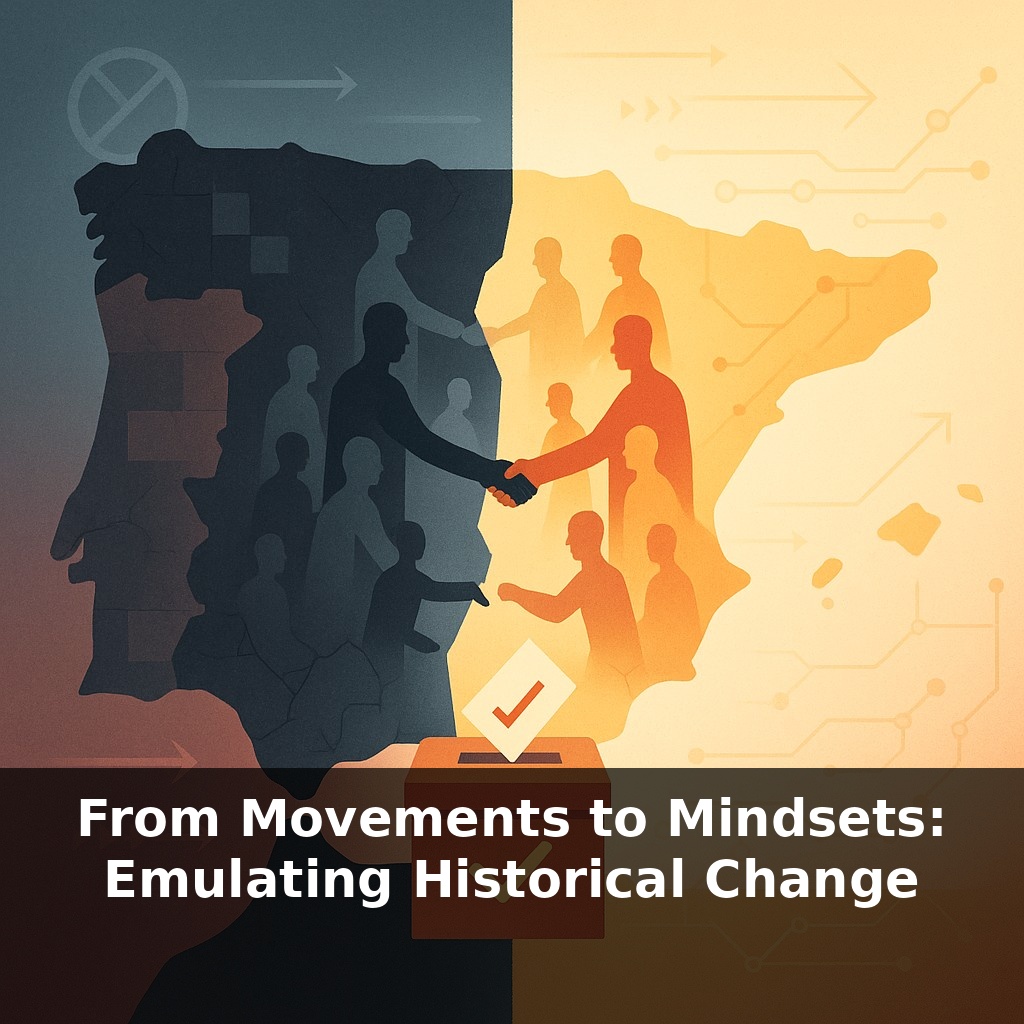
Ninety out of a hundred Spaniards voted to erase a dictatorship… by saying “yes” to living with their former enemies. In this episode, we step into that mindset shift, and ask: what happens when a whole country decides to update its inner operating system at once?
Most of us treat history like a museum: glass cases, distant dates, “do not touch” signs. But the Spanish Transition only makes sense when you treat it more like an open-source project: a messy collaboration where enemies debugged a broken system together, in real time.
Here’s the twist: those same “collaboration protocols” scale down to one person—your conflicts, your career, your family. During Spain’s shift, former hardliners learned to sit at the same table, trade certainty for curiosity, and prioritize a livable tomorrow over a perfect victory today. That wasn’t just politics; it was psychological risk-taking.
In this episode, we’ll zoom in on three attitudes from that period—coalition-building, calibrated courage, and reconciliation-first—and translate them into concrete moves you can test this week in your own life.
Spain’s 1978 referendum didn’t pass just because people hoped for change; it passed because millions quietly updated how they saw themselves: not as passive subjects, but as co-authors of a shared future. That’s the deeper layer we’re going to mine.
Psychologists call this “narrative identity”—the story you tell about who you are and what you’re capable of. When that story shifts from “things happen to me” to “I help shape what happens next,” your options multiply. It’s less like waiting for a plot twist, more like joining the writers’ room of your own life.
Start with the numbers, not the romance: in 1977, over 40% of Spain’s new parliament had either served the old regime or been pushed out by it. On paper, that’s a recipe for paralysis or revenge. Instead, 16 parties signed the Moncloa Pacts—budgets were slashed, wages restrained, political taboos broken—because enough people chose “imperfect progress together” over “perfect justice alone.”
That choice wasn’t automatic. It rested on three transferable attitudes you can repurpose.
First, “coalition” meant more than sitting in the same room. It meant asking: *What outcome am I protecting more than my pride?* Spanish negotiators ranked goals—no civil war, basic freedoms, economic stability—and let those priorities discipline their egos. Individually, this looks like entering a hard conversation having already decided your top non‑negotiable (e.g., “preserve the relationship”) and treating everything else as flexible. You’re not surrendering; you’re budgeting your stubbornness.
Second, courage was staged, not all‑or‑nothing. Leaders didn’t jump straight from censorship to full free speech; they tested amnesties, legalized parties stepwise, and watched for backlash. That’s where Bandura’s self‑efficacy research syncs up: people persist when they experience small wins that confirm “I can handle this.” In practice, the scary career move isn’t “quit tomorrow,” it’s one concrete exposure: send the email to a potential mentor, volunteer for a visible project, say the uncomfortable truth once this week and observe that the world doesn’t end.
Third, reconciliation worked because it was procedural, not sentimental. The goal wasn’t to feel warm toward former enemies; it was to make future cooperation *possible*. Spaniards built structures—amnesty laws, party legalization, constitutional guarantees—that forced repeated, rules‑based interaction. In your world, that might mean agreeing on check‑in rituals with a difficult colleague, or setting a “48‑hour rule” in your relationships: bring up grievances within two days, or let them go without silent punishment.
Across all three, the through‑line is this: attitudes became visible in concrete behaviors that were small enough to attempt, but meaningful enough to change expectations. That’s the scale where your own “transition” actually lives.
Think of a manager in a struggling team, staring at quarterly targets everyone secretly believes are impossible. Instead of cracking down, she borrows from Spain’s “imperfect progress together” playbook: she publicly ranks priorities—team trust first, learning second, numbers third—and invites the most skeptical voices into a weekly “red flag” huddle. They don’t try to fix everything; they agree on one shared experiment per week, and she tracks only two things: *Did we try it? What did we learn?* That’s how a Microsoft‑style “learn‑it‑all” culture starts—by ritualizing tiny, low‑ego tests.
Now shrink the scale again. A friend group stuck in the same arguments sets a simple rule: once a month, one person hosts a “future dinner” where the only topic is, “What would we regret not attempting this year?” No debates about the past, just co‑designing small risks. Over a few months, social gravity tilts from complaint to joint exploration.
Your challenge this week: pick one arena—work, family, or a side project—where you feel stuck in “all or nothing.” For seven days:
- **Day 1–2: Name the shared future.** Not the grievance. One sentence, out loud, with the other person or people if possible. Example: “I want us to be able to plan things together without dread.”
- **Day 3–4: Propose one micro‑risk.** It must be small enough that no one’s safety or livelihood is on the line, but real enough that you’d notice if it failed. Example: “At our next meeting, we each admit one thing we’re worried about before talking solutions.”
- **Day 5–6: Install one simple guardrail.** A rule that protects the relationship while you experiment. Example: “No interrupting during worries; questions only after everyone’s spoken once.”
- **Day 7: Debrief like a Moncloa‑style pact.** Ask: “What surprised us? What felt easier than expected? What’s the smallest next step that now seems possible?” Capture answers in writing, however rough.
You’re not fixing the whole system; you’re testing whether a different way of relating is *possible*.
If schools, teams, and platforms started training “Transición‑style” habits the way we train software skills, history class would feel less like a museum and more like a simulator. You’d practice reframing setbacks like a strategist, not just a student; role‑play tense negotiations as routinely as language drills. Careers with 5–7 reinventions would feel less like cliff jumps and more like changing lanes on a highway: risky, but practiced, signaled, and expected.
Treat this like learning a new instrument: at first the notes are clumsy, then your hands find them automatically while you focus on the song. As you practice these small civic habits in your own life, notice which ones feel oddly energizing. Those are clues: they point toward the kind of citizen—and architect of change—you’re becoming.
Before next week, ask yourself: “If I treated my everyday environment like the ‘ground game’ of a historical movement, where could I start quietly shifting norms—at work, in my group chat, or in my neighborhood—by changing just one recurring conversation or habit?” “Looking at a movement I admire (civil rights, environmental justice, women’s suffrage, etc.), what is one principle they lived by—like disciplined nonviolence, mutual aid, or strategic patience—that I’m willing to experiment with in how I respond to conflict or disagreement this week?” “If someone studied my life 30 years from now the way we study past organizers, what consistent mindset or practice—however small—would I want them to see starting this week, and how will I deliberately show up that way in a real interaction tomorrow?”