Your Genes and You
📝 Transcript
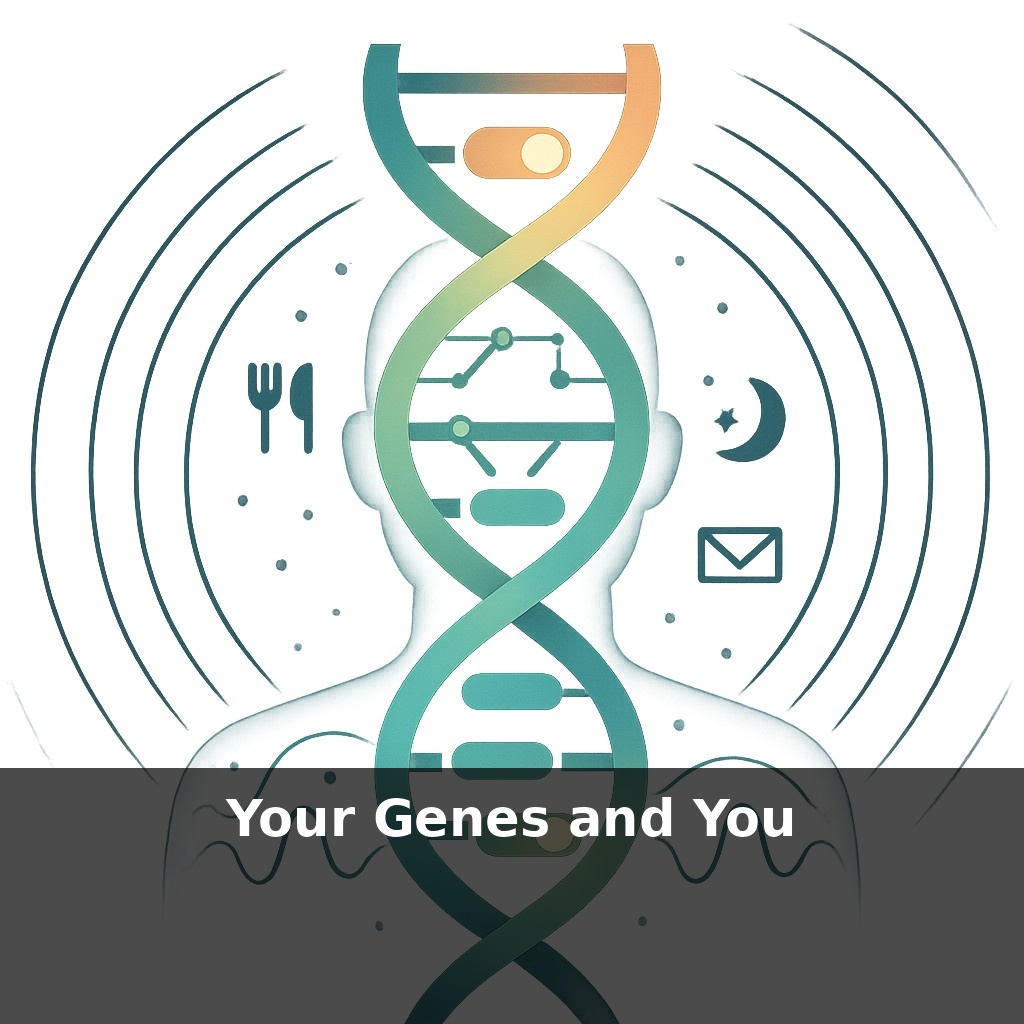
Your genes haven't changed since birth, but what if I told you that just knowing this isn't the full story? Right now, as you listen, billions of tiny switches in your body are turning genes on and off—responding to what you eat, how you sleep, even the stress in your inbox. Your DNA hasn’t changed since birth, but those switches? They’re quietly rewriting your story every day.
Those switches don’t flip in isolation—they’re responding to a genetic script that’s both surprisingly shared and surprisingly personal. Genetically, you’re almost a clone of any stranger on the street: about 99.9 % of your DNA is the same. But the remaining 0.1 % helps tilt the odds on things that feel very “you”: how tall you tend to grow, how your body handles stress, how easily you gain muscle, or how likely you are to develop certain illnesses.
That tiny fraction isn’t a single “talent gene” or “anxiety gene.” It’s thousands of small nudges scattered across your genome, layering their effects. Some nudges are strong, many are subtle, and their impact depends on what life throws at you—your nutrition, your relationships, your sleep, even your culture. In this series, we’ll unpack how those genetic nudges and your daily choices negotiate who you become.
Those nudges also don’t act one‑by‑one. Most traits you care about—your focus at work, your response to caffeine, how drained or energized you feel after conflict—are shaped by networks of genes working together. Meanwhile, your environment is constantly “sampling” those networks: a tough semester, a new exercise habit, a cross‑country move, or becoming a parent can all pull different genetic tendencies into the spotlight. Across this series, we’ll treat your biology less like a fixed label and more like a landscape you can learn to navigate with increasing skill.
Think of what scientists call “heritability” as a way of asking: if we rewound and replayed the lives of many people born into the same population, how much of the differences we’d see in a trait would come down to their DNA differences? For height, the answer is “quite a lot”—around 80 %. For major depression, it’s closer to 30–40 %. That doesn’t mean “your height is 80 % genetic” or “your depression is 40 % inevitable.” It means that, in a given place and time, genes explain that proportion of variation between people.
Change the place and time, and the number can shift. When nutrition improves across a society, average height can climb even though genes haven’t changed much. The same genetic tendencies are now playing out in a richer nutritional context, so more people reach their “built‑in” potential. In contrast, when environments become more stressful or unequal, genetic differences in mental‑health vulnerability may show up more starkly.
Zoom in further and you find that most traits you care about aren’t shaped by a single standout DNA change but by many tiny ones adding up—each more like a raindrop than a thunderbolt. Researchers can now bundle thousands of these small effects into what’s called a polygenic score: a rough indicator of how your genetic lottery ticket leans for a given trait or disease risk. Even then, scores describe probabilities, not certainties. Two people with similar scores for heart disease can land in very different places depending on sleep, movement, food, and long‑term stress.
Epigenetic marks add another layer of nuance. Early studies suggest that exposures like maternal smoking can leave chemical traces on DNA that persist into children and even grandchildren. The science here is still evolving and sometimes controversial, but it’s nudging us to think beyond “my body” and “my choices” in isolation and toward a longer, intergenerational view.
Your challenge this week: pick one trait you’ve long labeled as “just how I am”—being “bad at math,” “always anxious,” “naturally strong,” “never athletic,” anything. Each day, run a small experiment that tweaks the context around that trait: change the time of day you attempt the task, your sleep the night before, your caffeine or meal pattern, or the social setting you’re in. At the end of the week, don’t judge improvement; instead, map when that trait shifts even slightly. You’re looking for cracks in the story of fixedness—places where your genome’s tendencies clearly respond to real‑world conditions.
You can see this play out in real lives. Two people might both carry variants linked to higher blood pressure; one becomes a long‑distance cyclist with normal readings, the other works nights, eats on the run, and watches their numbers climb. Same underlying tilt, different outcome. Or consider identical twins with similar genetic vulnerability to depression: one lands in a supportive college environment with good mentoring; the other faces isolation and financial stress. Their paths can diverge for years—until a change in circumstances shifts the balance again.
A single choice can also “unlock” hidden capacity. A person who always felt “socially awkward” may discover that in structured volunteer roles—reading to kids, leading hikes—they feel unexpectedly confident, suggesting that what looked like a fixed social trait was partly context‑sensitive skill.
Your genes set ranges and sensitivities, but your routines, relationships, and risks decide which possibilities get the most airtime.
Genes will soon matter less as destiny and more as data. Within your lifetime, a cheek swab could help tune your diet, training, or even study schedule, like customizing the difficulty in a game. But the same tools that tailoBuilding on the discussion about genetic information's impact, consider how our care might tempt employers or schools to sort people early, mistaking probabilities for limits. Think of this moment as standing at a trail fork: one path uses genomics to widen options, the other to fence them in. Laws, norms, and your choices will help decide which route we take.
Your genome doesn’t hand you a finished portrait; it hands you a sketch. How you sleep, move, relate, and cope keeps adding brushstrokes, sometimes softening outlines you thought were permanent. As genetic tools spread—from ancestry kits to medical panels—the real opportunity is learning to read this sketch well enough to revise it with intention.
Before next week, ask yourself: 1) “Looking at my family health patterns (like heart disease, diabetes, or Alzheimer’s), which 1–2 lifestyle habits from the episode—such as sleep quality, daily movement, or blood-sugar-friendly meals—would most powerfully ‘turn down’ those genetic risks for me, starting this week?” 2) “If I treated my genes as a set of ‘dials’ instead of a fixed destiny, what’s one concrete experiment I can run for 7 days (for example, a 10-minute evening walk, a consistent bedtime, or swapping my usual breakfast for a higher-protein one) to see how my body and mood respond?” 3) “When I feel tempted to think ‘it’s just my genes,’ what specific reminder from the episode (like epigenetics, gene expression, or how quickly habits can shift biomarkers) can I repeat to myself to stay in the mindset that my daily choices still matter?”
Unlock all episodes
Full access to 5 episodes and everything on OwlUp.
Subscribe — $1.99/monthLess than a coffee ☕ · Cancel anytime