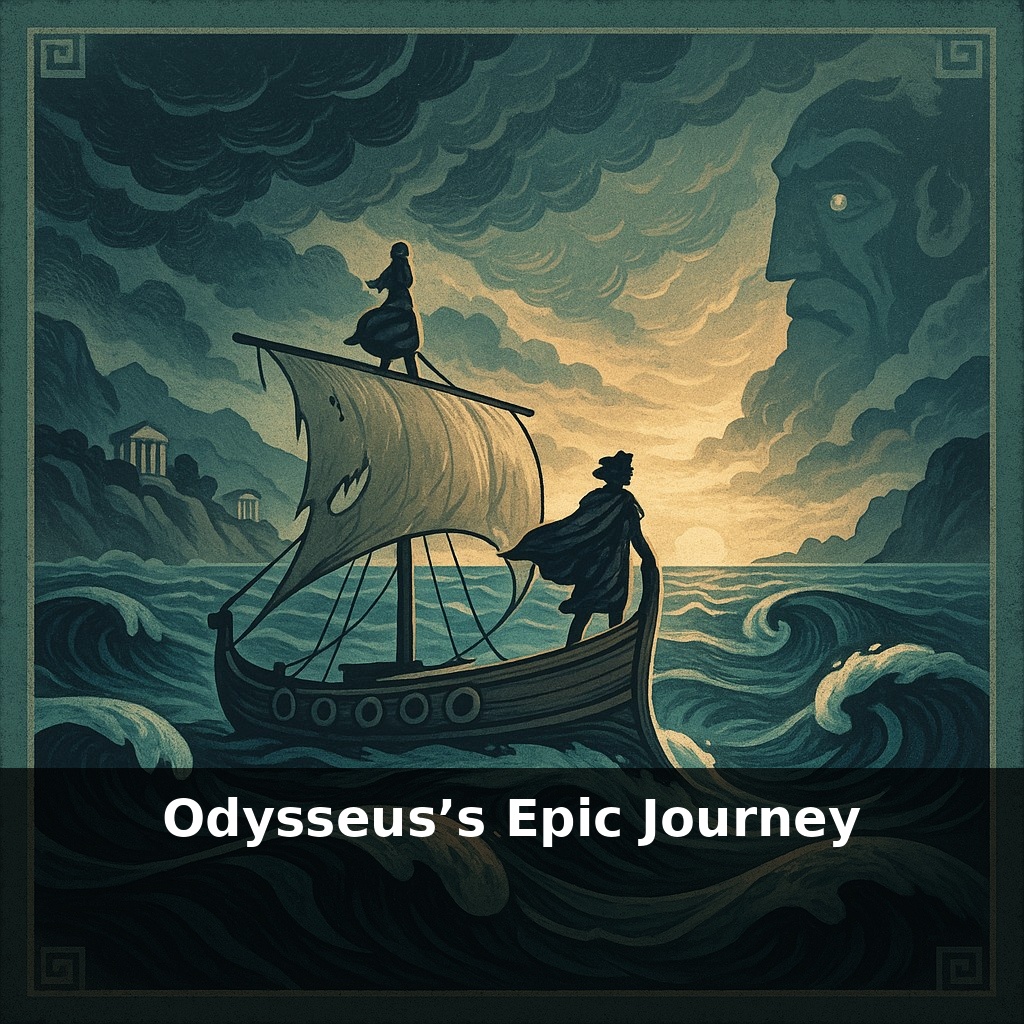
For about twenty years, one man is missing: no texts, no letters, no proof he’s alive. Yet every tavern across the Mediterranean buzzes with tales of his tricks. Some say he outwitted a giant; others, that he angered a god. All agree on one thing: Odysseus is never boring.
Bards don’t just swap stories about him for fun; they treat his journey like a masterclass in how to live through chaos and come back changed. The Odyssey isn’t only about getting from Troy to Ithaca—it’s about what happens to a person when every familiar landmark disappears. Each stop on his route is like a different “stress test” for the same mind: temptation on one island, despair on another, raw survival somewhere else. Layered under sea monsters and divine grudges is a quiet question: how much of yourself can you lose and still be “you”? Ancient audiences heard more than entertainment; they heard a roadmap for navigating uncertainty, reputation, and responsibility. In this series, we’ll trace his wandering path the way you might trace transactions in a complex budget—tracking costs, hidden risks, and the final balance he brings home.
Odysseus’s story unfolds in a world where maps are more rumor than science, and “weather forecast” means reading the moods of gods. Bronze-Age crews steer by stars, coastline shapes, and half-remembered sailors’ yarns—more like following a messy group chat than a clear GPS route. Every harbor has its own rules about guests, gifts, and revenge, so a wrong greeting can be as dangerous as a storm. Meanwhile, professional storytellers treat each episode of his journey like modular code: reusable tales they can remix, reorder, and upgrade for every new audience.
Odysseus first enters the poem not as a swaggering victor, but as a man stuck on a small, inescapable island with a goddess who won’t let him leave. That’s already a warning: the “hero” we’re about to follow is introduced at his most powerless, far from the battlefield glory that made his name. Homer withholds him for four entire “books,” letting other characters talk about him first—like hearing about a controversial CEO from board members before you ever see him in a meeting. By the time we finally meet him, we’re primed to notice not just his courage, but his impact on everyone who has waited in his absence.
The Odyssey also bends time in a way that would feel familiar to fans of intricate TV series. We begin near the end of the journey; many of the famous adventures are told later as Odysseus’s own flashbacks at a royal feast. That structure quietly shifts our trust. We don’t get a neutral camera view of events—much of what we “know” about the wanderings comes from the mouth of a man whose talent for shaping stories is legendary. The text invites us to ask: are we hearing the full cost of his decisions, or only what plays well in a banquet hall?
Before we ever hear those tales, the poem takes us somewhere unexpected: home, without him. In Ithaca, his son Telemachus grows up in a house that’s been half-taken over by opportunistic nobles eating through the family’s wealth. This “prequel” thread is crucial. We see a kingdom drifting, a queen constantly managing threat with politeness, and a young heir learning that missing information is itself a kind of danger. News of Odysseus becomes a currency people trade for influence.
If you map the early books, they read less like a travel guide and more like a balance sheet of costs nobody planned for: emotional interest piling up on Penelope’s patience, political debt accruing with every insult the suitors deliver, reputational risk in every rumor that he died cowardly or died bravely somewhere far away. The stage is set not just for a homecoming, but for an audit. When he finally walks back into his own hall, the question won’t only be “Can he survive?” but “Can he settle everything that has accumulated in his name while he was gone?”
Think of each episode in this poem the way a good engineer thinks about a system under load. The Cyclops encounter isn’t just “monster vs. hero”; it’s what happens when a leader’s quick fix (escape now, taunt later) introduces long-term instability into the whole network of his voyage. The Sirens’ song looks less like “magic hypnosis” and more like a test case for process design: he doesn’t trust willpower, so he builds a workaround—wax, ropes, clear roles—that lets curiosity and safety coexist.
Even the palace scenes work like a slow, risky investment portfolio. Penelope diversifies her defenses: weaving by day, unweaving by night, polite speech in public, private signals to loyal servants. Telemachus experiments with alliances abroad, gathering data from veterans of the war the way a startup founder gathers advice from later-stage companies. Across all of this, the poem keeps asking: when circumstances keep rewriting your plan, which parts of your character are configuration settings—and which are hard-coded?
Scholars treat this poem like a living lab notebook for how humans handle long disruption. Its patterns shape everything from space-psychology studies to leadership workshops, where “homecoming” becomes a way to ask what happens after burnout, layoffs, or migration. Digital tools now trace which phrases cluster around risk, trust, and grief—almost like heat maps on a trading screen—revealing how ancient audiences priced the emotional cost of every daring choice.
Your challenge this week: treat your daily routine like a mini‑voyage. For seven days, note one moment when sticking to “the plan” clearly clashes with new information—traffic ruining your schedule, a meeting derailed by unexpected news, a family obligation reshaping your evening. Instead of forcing the original route, design a small “course correction” on the spot, then briefly rNow that we've explored Odysseus's knack for adaptability, let's put his lessons into practice. Record the result, and after a week, review: where did adaptation create better outcomes than stubbornness, and what does that suggest about the kind of navigator you actually are right now?
Each new reader becomes a kind of quiet co‑captain, steering the poem through their own era’s storms. Leadership coaches mine its choices like game tape; therapists see long absences and fragile reunions that echo deployments or immigration. As we keep rereading, the route shifts slightly—like a GPS recalc—revealing fresh side roads in a map we thought we knew.
To go deeper, here are 3 next steps: 1) Read Emily Wilson’s translation of *The Odyssey* (Books 5–12) and, while you read, keep this interactive map of Odysseus’s route from the Perseus Digital Library open in a browser tab so you can visually track each stop of his journey. 2) Watch the CrashCourse World Mythology episodes on “The Odyssey” and “The Hero’s Journey,” then compare their hero-journey stages with three key moments from the episode (e.g., the Cyclops cave, Circe’s island, and the return to Ithaca) using the downloadable hero’s journey wheel from the Joseph Campbell Foundation site. 3) Open the “Classics for All” or “Loeb Classical Library” website and pick one short scholarly article or commentary note on Odysseus’s character (e.g., his “polytropos” nature) and contrast what the scholar says with how the podcast framed his cleverness versus his flaws, jotting down where you now see him differently in specific scenes.