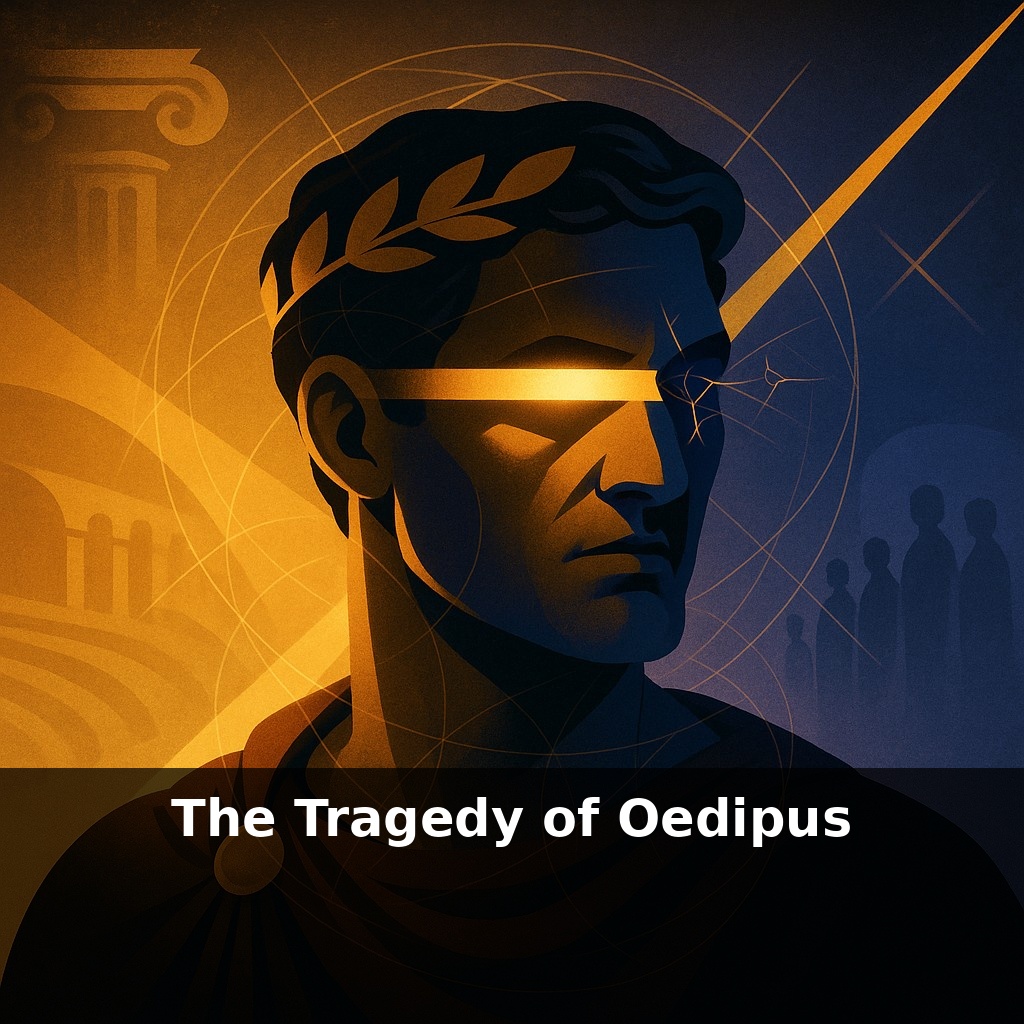
A king walks onstage already cursed, and he’s the only one who doesn’t know it. The audience does. The gods do. Even the chorus suspects. But Oedipus? He believes he’s in control. That gap—between what he knows and what we know—is where the tragedy sharpens its knife.
Aristotle later pointed to this play and essentially said, “That. That’s how you do tragedy.” Yet on the surface, Oedipus doesn’t look like a doomed victim—he looks like a success story. He’s the brilliant problem-solver who once saved Thebes by defeating the Sphinx, a respected ruler, a man who trusts reason, evidence, and his own intelligence. In modern terms, he’s the overconfident CEO who’s sure every crisis is just another puzzle to crack. That confidence drives the story forward: when a plague strikes the city, Oedipus refuses to wait for the gods to fix it. He launches an investigation, interrogates witnesses, presses the chorus, and pushes his allies until they break. The tragedy unfolds not because he is passive, but because he is relentless.
Sophocles drops this driven king into a world where oracles, rituals, and unwritten divine laws still shape every political decision. Thebes isn’t just a city with a health crisis; it’s a community terrified that some hidden religious pollution is angering the gods. Oedipus treats the situation like a solvable crime, but everyone around him half-expects the answer to come from Apollo’s shrine, not human inquiry. That tension between sacred authority and rational investigation turns his search into something riskier than a bold policy move—it becomes a confrontation with the very structure of his universe.
When Oedipus starts asking who killed the old king Laius, it sounds like a straightforward murder case. But Sophocles structures the inquiry so every answer Oedipus drags into the light tightens the net around him. The questions he asks are rational, even admirable; the pattern they form is lethal. Each witness—Teiresias, Jocasta, the Corinthian messenger, the Theban shepherd—arrives like a new piece of evidence. None of them alone is conclusive. Together, they assemble a story Oedipus thinks he’s outside of, until he realizes he’s been reconstructing his own biography.
This is where hamartia matters. It’s not that Oedipus is simply “too proud” in some vague moral sense. His crucial error is intellectual: he trusts that more data and sharper reasoning will necessarily protect him. He underestimates the possibility that the truth he’s chasing could destroy the very identity he’s using to chase it. Sophocles is probing a discomforting idea: knowledge is not automatically therapeutic or liberating; some truths arrive like a verdict.
Fate in the play isn’t a puppet string jerking Oedipus around scene by scene. The prophecy—that he will kill his father and marry his mother—sets boundary conditions. Within those limits, he makes recognizably human choices: fleeing Corinth to protect the parents he thinks he has, lashing out at an aggressive stranger on the road, seizing power in a vulnerable city, insisting on transparency when his advisers beg him to stop. The nightmare is that these responsible-seeming decisions line up perfectly with the oracle’s outline.
The chorus of fifteen doesn’t function as a moral megaphone so much as a shifting barometer of public anxiety. They want Oedipus to be right, to stay innocent, to keep being the man who once saved them. Their songs oscillate between loyalty to their king and fear that the old religious order might crush him. Through them, Sophocles stages the audience’s own divided response: we admire Oedipus’ refusal to live by superstition, even as we watch that refusal collide with a cosmos that will not bend.
When the truth finally clicks into place, the play doesn’t end with the revelation. It lingers on response: Jocasta’s suicide, Oedipus’ self-blinding, his request for exile. That sequence matters because it shifts the question from “Was he free?” to “Given this framework of fate, how free is he now to interpret and bear what’s happened?” His self-punishment is not required by the oracle; it’s his own attempt to reclaim agency inside a script he couldn’t avoid. In that sense, the play’s darkest turn is also its most human: Oedipus can’t edit his past, but he can decide how to inhabit his ruin.
Think about how this pattern shows up offstage. In psychology, Freud seizes on Oedipus not for the plot’s shock value but for its familiarity: his Oedipus complex claims that early desires and rivalries with parents quietly script later relationships, even when we believe we’ve outgrown childhood. In a very different register, legal dramas echo the play’s structure whenever a prosecutor discovers that the fingerprints on the case don’t just belong to a suspect, but to a colleague—or themselves. And in politics, leaders who rise on a wave of popular trust sometimes end up exposed by the very transparency they once championed: anti-corruption reformers whose audits uncover their own past deals, or tech founders whose platforms for “radical openness” leak messages that force their resignation. Just as tech founders might find their transparency platforms instigating their fall, the ambitions of discovering truth can come at unforeseen personal costs.
Oedipus keeps haunting modern questions about control. Algorithms now “predict” our tastes, creditworthiness, even our likelihood of reoffending, and we often accept their verdicts the way Thebes accepts divine pronouncements. Yet, like Oedipus, we still make choices inside those forecasts—switching careers, challenging a medical prognosis, rejecting a recommendation feed. The more precisely systems anticipate us, the harder it becomes to tell where guidance ends and quiet coercion begins.
So Oedipus leaves us with a question less about gods than about self-auditing: when we chase “the truth” about ourselves—through therapy, journaling, data trackers—what verdict are we secretly prepared to hear? Your challenge this week: notice one moment when a new piece of information about you nudges your story of who you are, even slightly.