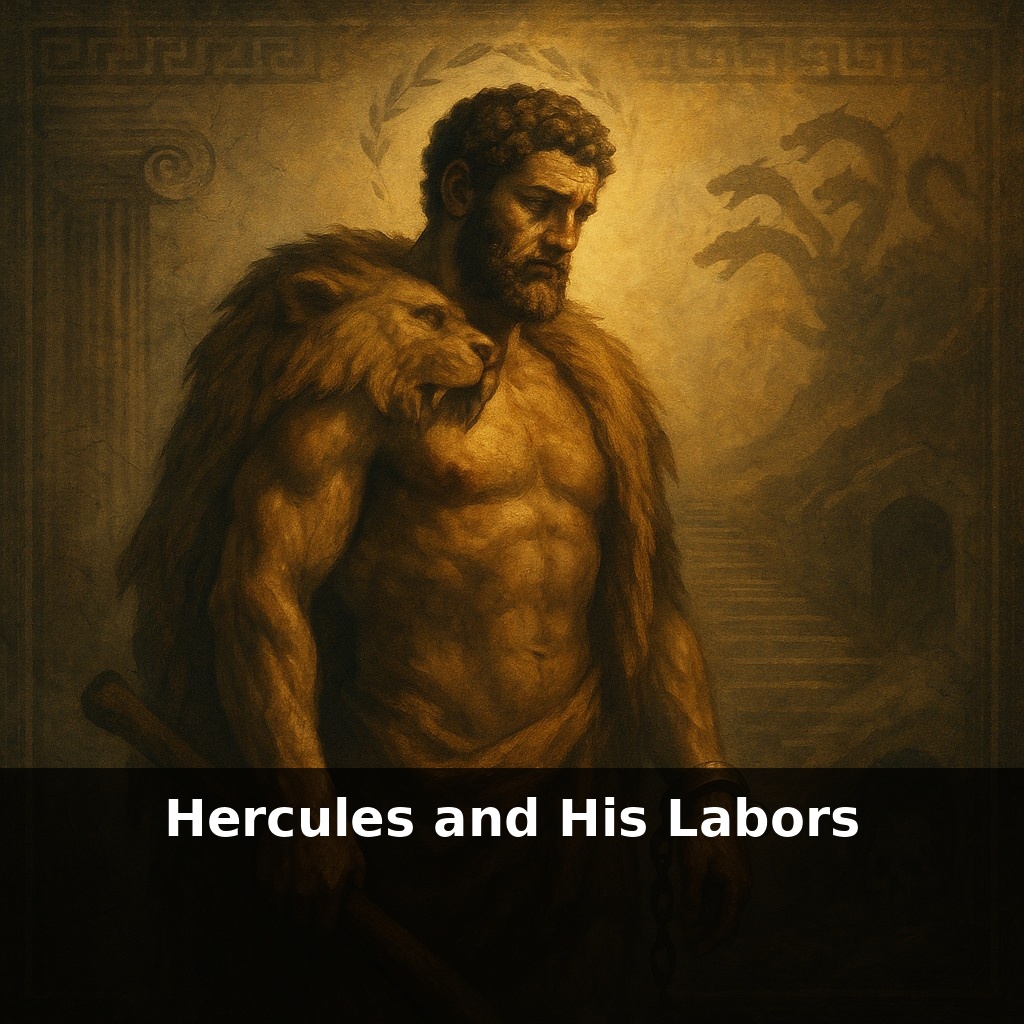
A hero becomes a god not by staying noble, but by committing the worst crime a person can—and then being sent on “impossible” errands to make up for it. Tonight, we drop straight into those punishments: monsters, tyrants, even death itself standing in his path.
Before diving into the tales of his renowned labors, it's crucial to understand that Hercules doesn't start his story as a clean-slate champion; he arrives already carrying a reputation, and not always a flattering one. The Greeks told his life almost like a series of escalating dares from the universe: survive this, endure that, and see what’s left of you at the end. Beneath the monsters and mayhem sits a quieter question: when your rage, grief, or stupidity has wrecked everything, is there a way back that isn’t just pretending it never happened? Each Labor becomes less about showing off strength and more about learning where brute force fails—outwitting a king here, bargaining with a goddess there, arguing with the very rules of the cosmos somewhere else. It’s a bit like debugging a stubborn piece of software: every time Hercules “fixes” one catastrophic problem, a deeper flaw in the system of his world—and in himself—gets exposed.
The catch is that these trials weren’t written down as one neat checklist from the start. Different cities bragged, “Our shrine is where he fought this monster,” or, “Our king hired him for that impossible job,” and poets stitched those claims into a sequence that later solidified into “the Twelve.” Some deeds were even demoted or upgraded over time, like a playlist constantly reordered to suit new audiences. Religion, local politics, and campfire drama all tugged on the same stories, turning one man’s atonement arc into a shared map of how to confront fear, filth, injustice, and the unknown.
Most lists of the Labors open with the Nemean Lion, but the ancient storytellers cared less about chronology than escalation. What matters is the pattern you start to see when you zoom out: each task attacks a different “stuck point” in human life.
First come the beasts—the Lion, the Hydra, the Boar, the Birds. They aren’t just jump-scares in animal form. Each one is anchored to a specific landscape: a valley no one can cross, a swamp choking a trade route, mountains terrorized by a boar that shreds vineyards. Listeners didn’t need footnotes; they knew which passes had bandits, which marshes bred disease. A monster on the map is a way of admitting, “Everyone knows this place is dangerous, but we don’t have a clean explanation.” Kill the beast and, symbolically, you’ve reopened the road.
Then there are the “civilization” Labors, where the enemy isn’t fangs but humiliation. The Augean Stables are a good example: decades of royal manure piling up in public view. Hercules’ solution—rerouting two rivers—isn’t noble in a knightly sense; it’s infrastructure. For a Greek audience used to cities competing over irrigated fields and clean harbors, that story quietly flatters the idea that engineering can redeem long-term neglect. In a way, it’s like a messy ledger in finance: the numbers aren’t evil, they’re just proof no one has faced the accumulated debt. Flush the system, and other reforms become thinkable.
Political anxiety seeps in too. Kings like Eurystheus outsource their problems to Hercules and then move the goalposts, declaring some victories invalid. That’s a recognizable rhythm in any bureaucracy: assign a “fixer,” disown them when the fix is ugly. Several Labors take Hercules far from home—Crete, Thrace, the edge of the western sea—mirroring the Greek world’s own expansion. Cities could point to a local rock, spring, or shrine and claim, “Here is where he passed through,” folding their identity into a pan-Hellenic hero’s itinerary.
The last Labors tilt into the cosmic: guarding apples at the world’s rim, a hound in the Underworld. By the time Hercules reaches these, audiences have watched him wrestle nature, filth, foreign rulers, and divine whims. The stakes aren’t bigger in a simple “harder boss” sense; they’re broader. The stories start asking whether strength can negotiate with beings who don’t age or die, and whether a mortal can borrow that power without breaking.
Think of how audiences met these tales: not as a fixed list on a page, but as traveling “case studies” in surviving the overwhelming. One singer might linger on the filth of the stables; another might spotlight the birds as a nightmare of sudden, random danger. Both are really asking, “What do you do when the problem is so large that normal tools feel silly?” You can’t shovel a lifetime of waste; you can’t swat metal-feathered flocks.
Here’s where the stories become almost shockingly practical. Hercules keeps breaking the expectation that a strong man just hits harder. He experiments. He trades, bargains, borrows, diverts. He gets help from a nephew, a centaur, a river, even from the very landscape. The “heroic” move isn’t pure muscle; it’s refusing to treat a new problem with the same blunt answer.
Modern retellings often smooth this out, turning each Labor into a solo flex. The older versions are messier and more interesting: they quietly insist that needing allies, tools, or loopholes doesn’t cancel your courage—it proves you understood the scale of what you were facing.
Statues and films freeze Herakles mid-swing, yet the Labors’ afterlife is quieter: planners talk about “Herculean cleanups,” therapists borrow his name for programs on anger, even sports teams brand grueling seasons as modern Labors. The pattern isn’t about brute force; it’s about staying in dialogue with the impossible. Your challenge this week: notice one “too big” task in your world and list three non-obvious allies or tools you’ve been ignoring.
Maybe that’s why Herakles keeps resurfacing whenever people talk about burnout projects or broken systems: his arc quietly asks how much of you survives doing “whatever it takes.” The myths don’t hand out blueprints; they hand you tension. Push harder or walk away? Hack the rules or honor them? Like an unresolved chord, his story leaves the next move to you.
Here’s your challenge this week: Pick one of Hercules’ labors (like slaying the Nemean Lion or cleaning the Augean Stables) and, today, block off 25 minutes to tackle your own “modern version” of it in a single focused sprint—no multitasking, no phone. Before you start, say out loud what your “monster” is (e.g., an avoided email, messy room, overdue task) and what your “weapon” will be (e.g., timer, checklist, trash bag). When the 25 minutes are up, stop, note exactly what you completed, and choose tomorrow’s “labor” so you’ve got a mini 7-labors week lined up.