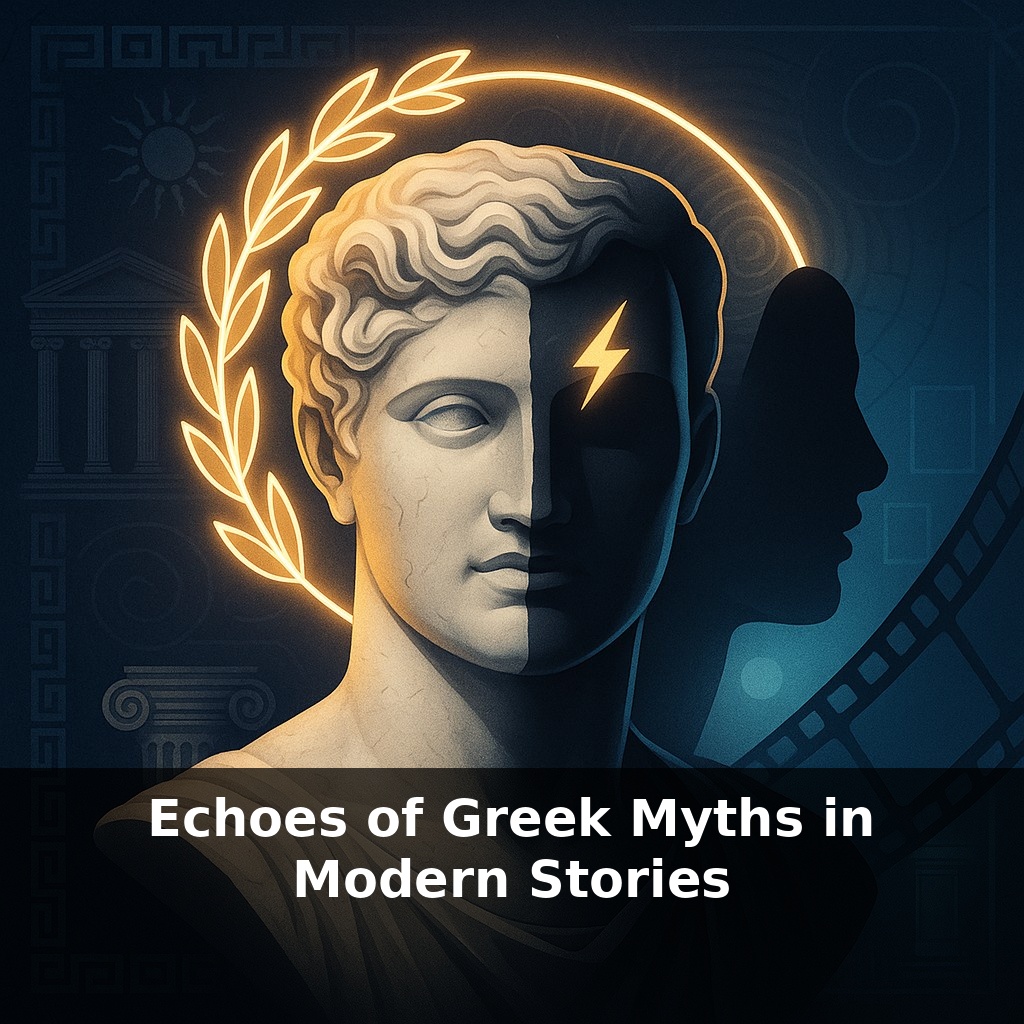
One in two adults can name a Greek god without ever opening a myth book. A superhero movie, a Broadway musical, a viral YA novel—three totally different stories, all secretly powered by the same ancient characters. Today, we follow those hidden mythic fingerprints.
Hollywood trailers, comic-book panels, even perfume ads quietly raid the same old story vault. A brooding hero haunted by a tragic flaw, a love that literally stops time, a villain punished for “flying too close to the sun” — these patterns don’t appear by accident. They’re borrowed, bent, and remixed because they still work.
Modern creators treat those old plotlines the way DJs treat classic tracks: they sample a recognizable hook, then layer new beats on top — gender flips, queerer relationships, climate anxiety, AI ethics. A war god becomes a CEO in a prestige drama; a sea deity turns into the sentient ocean in a sci‑fi epic.
In this episode, we’ll zoom in on how these echoes shape the stories you already consume — and why your favorite “original” series might secretly be on its second, or twentieth, mythic life.
Writers, directors, and game designers don’t just sprinkle in a Zeus reference for fun; they’re tapping into a shared mental library their audience already carries around. You don’t need to remember the *Iliad* to “get” a prideful tech genius whose empire falls apart, or a heroine torn between duty and forbidden love. Those emotional blueprints are so ingrained that a single line—“He flew too close to the sun”—can do the work of three pages of backstory. That’s why marketing teams, showrunners, and novelists keep returning to the same well: it lets them move faster, and dig deeper, at the same time.
Modern creators don’t just “retell” a myth; they reverse‑engineer it. They ask: *What still stings? What still thrills?* Then they strip away temples and togas and keep the emotional engine.
Take power and rebellion. Percy Jackson doesn’t live on Olympus, but his world still runs on inheritance, favoritism, and divine-level office politics. The appeal isn’t “learning mythology”; it’s watching a teenager realize the system is rigged and deciding whether to play along or burn it down. That tension—between belonging and defiance—shows up again in Wonder Woman, where a daughter of a hidden warrior society walks into World War I and has to decide whose rules deserve her loyalty.
Love and loss get similar upgrades. *Hadestown* doesn’t simply move Orpheus and Eurydice to a New Orleans‑flavored underworld for style points. It leans into gig‑economy precarity, depression, and climate anxiety. Eurydice isn’t just “tragic”; she’s hungry, cold, and seduced by the promise of stability. The old question—“Can love overcome death?”—becomes “Can love survive capitalism and scarcity?”
Even side characters get promoted. Where older versions might leave women as prizes or obstacles, recent novels like Madeline Miller’s *Circe* or Natalie Haynes’ *A Thousand Ships* flip the camera. Circe is no longer a random enchantress on a hero’s itinerary; she’s the protagonist, negotiating toxic family dynamics, single parenthood, and the ethics of power. That shift lets readers test drive different responses: what if the “monster” tells her own story?
Crucially, there’s no single “correct” blueprint hanging in a museum. The Greeks themselves argued, remixed, and contradicted one another. That gives today’s writers permission to treat each version like a draft. One adaptation leans into spectacle (gods as CGI titans), another into psychology (gods as metaphors for trauma), another into romance or satire.
If you think of the ancient tales as a kind of narrative operating system, each new series is an app built on top—sometimes sleek and minimalist, sometimes chaotic and buggy, but always stress‑testing the same core questions: Who has power? What does loyalty cost? How far will you go to protect the people you love, and what happens when you fail?
Think about how many genres quietly recruit the same mythic “guest stars.” In sci‑fi, Hades often reappears as a megacorp founder who owns the underworld of data centers and surveillance. In sports dramas, Achilles is the unstoppable prodigy whose entire career hangs on one fragile knee. Political thrillers love a modern Cassandra: the analyst whose accurate warnings are ignored until it’s too late.
Creators also smuggle in specific story moves. Superhero franchises keep rewriting the Theseus problem: how many upgrades can a character get before they’re no longer the person we met? Romantic comedies experiment with versions of Psyche: can you really love someone when you never see their whole self online?
Even branding plays along. Sneaker lines named after winged messengers, AI products nodding to wisdom deities—designers tap into old reputations instead of building trust from zero. It’s narrative judo: using inherited momentum to move a brand, a plot, or a character further, faster.
Soon, those familiar names may become interactive neighbors. Instead of just reading a retelling, you might co‑write one: choosing alliances, moral limits, even endings that adapt in real time. Think less “museum exhibit,” more “sandbox game” where millions test-drive different values inside a shared world. The twist: when every version can be personalized, we’ll have to decide which parts are playful remix—and which few threads we refuse to cut.
So next time you binge a series or scroll past an ad, notice who shows up: a stormy CEO with lightning moods, a singer whose breakup feels like a trip to the underworld, a “golden child” chasing one shining trophy. Following those threads turns passive watching into a kind of treasure hunt—spotting how today quietly argues with yesterday’s gods.
Start with this tiny habit: When you finish a chapter of a book, quickly ask yourself, “Whose story does this echo—Perseus, Orpheus, or Medusa?” and say your answer out loud. If you can’t decide, just pick one Greek figure from the episode and take a 10‑second guess about how they’d react to what just happened in the story. That’s it—no notes, no analysis, just a quick myth-matching moment to train your brain to spot those modern echoes.