An entire empire once spent the modern equivalent of billions on a single statue and temple, not for a warlord, but for a goddess of “wise warfare.” A city under siege, a general at a map, a judge at a trial—each claimed Athena’s favor. So what kind of power was she really guarding?
Athena appears wherever decisions carry real risk: on war councils, in law courts, even at the drafting table of engineers. She doesn’t just bless victories; she scrutinizes the plans behind them. In myths, she’s the one who whispers the loophole in an oath, the clever route around a stronger enemy, or the design tweak that keeps a ship from capsizing. If Ares is the crash of waves, she’s the tide chart pinned in the captain’s cabin.
What makes her so enduring is how tightly she binds thinking to doing. Heroes who listen to her tend to survive; those who ignore her usually learn the hard way. That’s why cities, not just warriors, claimed her—legislators, builders, and even artisans treated her like the quiet partner in every high‑stakes choice. In this episode, we’ll trace how that partnership shaped temples, treaties, and the very idea that strength without judgment is a liability, not an asset.
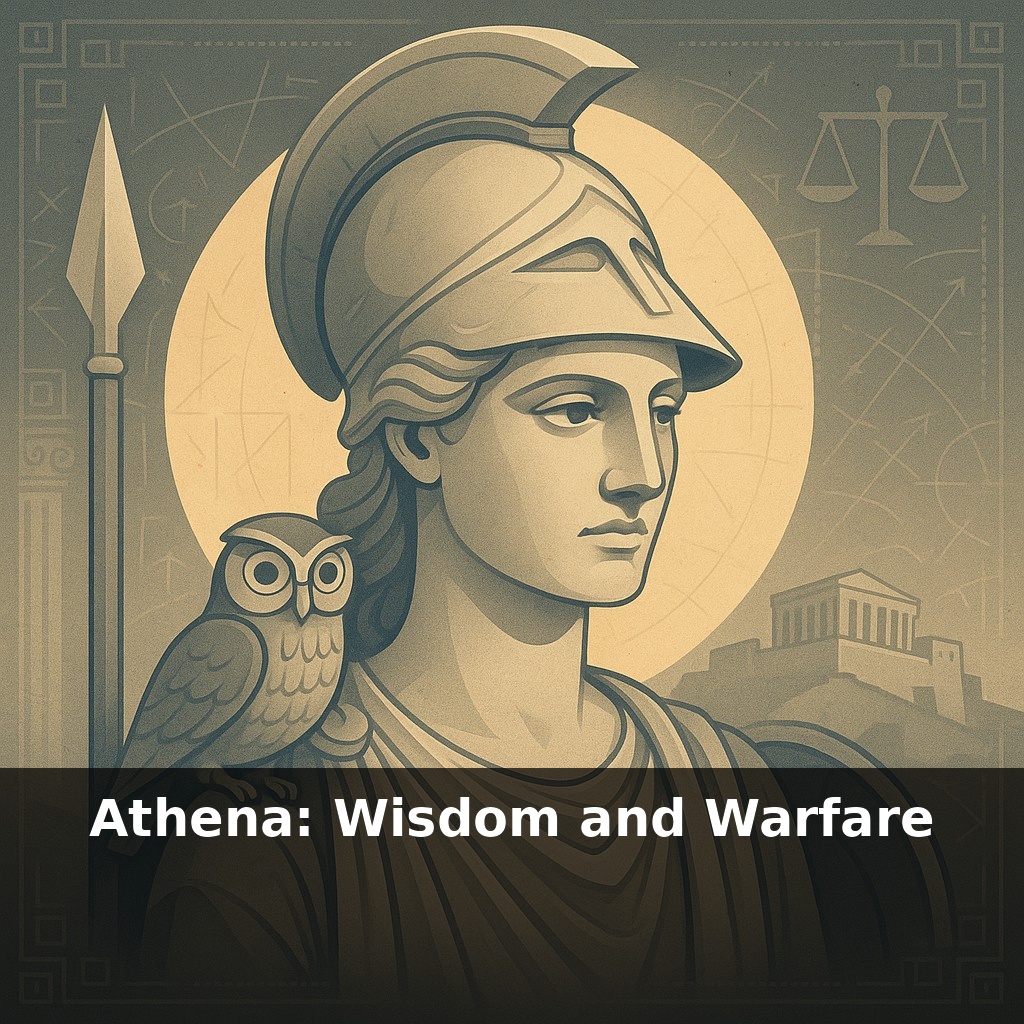
Athena’s world isn’t just battlefields and tribunals; it stretches into workshops, shipyards, and civic halls. She turns up when a city chooses walls or navy, when an inventor weighs safety against spectacle, when a council drafts rules that might outlast them. Her symbols track this range: the owl perches over scribes and scholars, the spear over tacticians, the olive tree over merchants planning long-term trade. In a sense, she oversees “design choices” for a whole society—who gets protection, who bears costs, and how much future security is worth in present sacrifice.
Athena’s edge shows most clearly when others fail. In the Iliad, she doesn’t lead charges; she tweaks outcomes. She yanks Achilles’ hair so he doesn’t kill Agamemnon in a rage. She tricks Ares into taking a spear to the gut by guiding another warrior’s aim. Her victories are often one small, well‑timed intervention that flips the whole board.
That’s why her tools are so specific. The owl isn’t about generic “wisdom”; it sees in dim light, spotting patterns where others see only confusion. Greek vase painters place it beside scribes, shipwrights, and even money‑counters, tying clear perception to record‑keeping and logistics. The aegis is not just protection but psychological armor: a shield so terrifying that enemies reconsider before attacking at all. It’s deterrence as theater—frightening enough to make some battles unnecessary.
Her virginity operates in the same register: not sexual moralizing, but independence from family alliances, heirs, or dynastic agendas. In Athenian politics, that mattered. A goddess with no spouse and no children could be imagined as weighing cases without clan loyalty tilting the scales. When Athena judges Orestes for killing his mother, she breaks a tie in his favor—not because she likes him, but because she decides the city needs a clean break from blood‑feud logic.
Even her “peace” symbol, the olive tree, is quietly demanding. Olives take years to bear fruit and require steady care. Cities that planted them were betting on stability long enough to harvest. Law codes, fortifications, coinage reforms—many were dedicated to her, as if to say: these are our long‑horizon bets. Corinth invoked her for harbor defenses; Rhodes carved her image on coins that funded naval upkeep. She sits wherever a community chooses structure over impulse.
You can see why modern civic seals borrow her so heavily. More than a hundred U.S. towns and agencies surround her with books, gears, engines, and court benches. Each version nudges the same claim: authority here should look more like her than like Ares—alert, disciplined, and slightly skeptical of its own power.
Athena’s logic shows up most clearly when plans collide. In the Odyssey, she doesn’t hand Odysseus a perfect script; she co‑authors his disguises, edits his timing, and lets him adapt the plan in real time. It’s closer to how a good software architect works with a development team than to a general barking orders: she sets constraints, stress‑tests assumptions, and then lets competent people improvise inside a durable frame.
That same pattern shaped institutions. In cities that honored her, councils didn’t just vote on war or peace; they set procedures for how evidence could be heard, how treaties were stored, how future leaders would be bound by past commitments. Inscriptions from Athens and its allies show painstaking clauses about harbor access, emergency grain, shared garrisons—legal “patch notes” updated after each crisis. Athena’s role is less “grant victory” and more “force you to think in versions,” so each failure becomes a prototype for the next, slightly less fragile system.
Modern planners quietly chase the “Athena ratio”: more insight per unit of force. In cyber defense exercises, NATO teams already score not just on repelled attacks, but on how clearly they can explain their choices afterward—wisdom as an audit trail. Urban designers borrow the same logic: a flood barrier that doubles as a park, or a school that’s also a storm shelter. It’s conflict‑aware design, like encrypting a hard drive before trouble comes, so crisis reveals structure, not panic.
Treat Athena less as a myth and more as a checklist: before you launch a project, approve a budget, or walk into a hard conversation, ask what would count as a “clean win” six months from now. Like debugging code before release or marinating a dish overnight, it’s unglamorous preparation that quietly decides which battles you’ll never have to fight.
To go deeper, here are 3 next steps: (1) Read Madeline Miller’s *Circe* or Natalie Haynes’ *Pandora’s Jar* and highlight every scene where Athena appears, then jot quick notes on how her version of “wisdom in war” shows up differently in each story. (2) Pull up a good digital copy of the *Iliad* (like the free Perseus Digital Library edition) and closely re‑read Book 1 and Book 22, underlining every line where Athena intervenes in battle or strategy, then compare that to a modern military case study from the free “Strategy Bridge” online journal. (3) Visit Theoi.com’s Athena page alongside images from the British Museum or Louvre’s online collections of Athena statues, and create a 3-column comparison (symbol, ancient meaning, modern equivalent in your life or work) to translate her helmet, spear, aegis, and owl into concrete decision-making “tools” you’ll test this week.