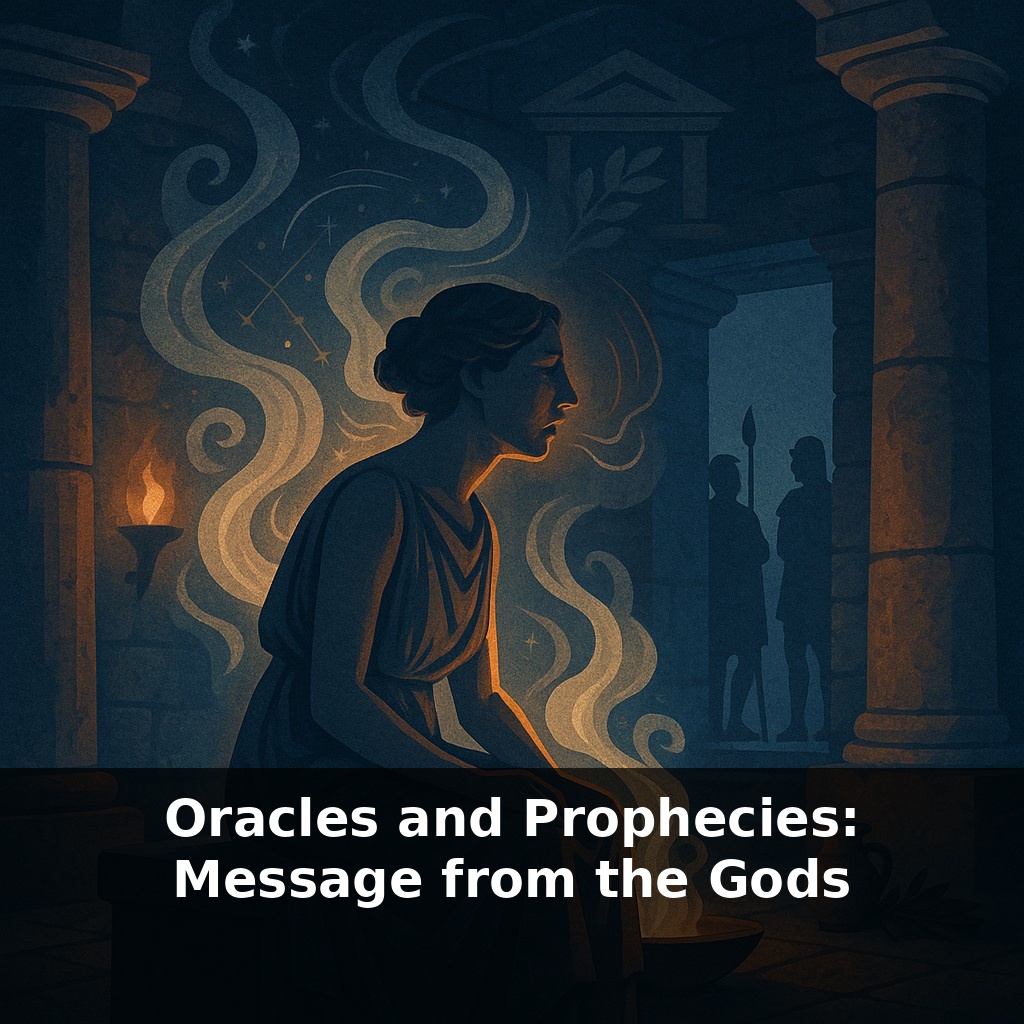
A woman sits in a dark stone temple, breathing strange sweet fumes. Outside, generals and politicians wait, willing to risk thousands of lives on her next sentence. She will speak a few tangled words—and those words might launch a war or found a new city.
By the time our woman in the temple speaks, a whole system has already gone to work around her. Pilgrims have purified themselves in a sacred spring, sacrificed animals to check for favorable omens, and queued according to strict rules of rank and payment. City-states send official delegations; private citizens clutch their own, quieter fears—should I marry, invest, sail, surrender? The temple staff aren’t just handlers; they’re information brokers. They hear rumors from every corner of the Greek world: trade disputes, troop movements, failed harvests. When the god “answers,” that divine voice is shaped by everything they’ve quietly absorbed. It’s less a lightning bolt from the sky and more a storm front forming over time—local winds, distant currents, hidden pressures—finally breaking in a single, cryptic sentence.
By the classical period, Delphi isn’t just a holy place; it’s a calendar event and a travel destination. Delegations time their journeys to hit that single prophetic day, like traders rushing to a seasonal market. Inns fill, temporary stalls appear, and gossip flows faster than the nearby Castalian spring. Inside, the Pythia’s sessions are strictly scheduled; outside, impatient envoys trade favors to move up the list. Other sanctuaries—Dodona with its whispering oaks, Didyma on the coast—compete for prestige, creating a loose network of “godly outlets” where policy, rumor, and theology constantly circulate.
When the Pythia finally speaks, her words don’t drop into a vacuum. A small army of attendants, priests, and record-keepers stands ready to catch, polish, and circulate them. The woman in trance mutters; male priests shape that mutter into hexameter verse, pin it to a client’s question, and, crucially, decide what gets remembered. Some answers stay private, carried home in a single nervous mind. Others are carved into stone and displayed like public press releases.
This is where Delphi turns from local shrine into pan-Hellenic institution. City-states don’t just want guidance; they want proof. A polis that’s just been told its war is “just in the eyes of Apollo” has every incentive to inscribe that verdict on a gleaming stele and set it where every ambassador will see it. The sanctuary fills up with these stone voices: treaties, manumissions of slaves, boundary settlements, colonization charters. Modern historians mine them as one of the most revealing archives of Greek fears, hopes, and spin.
The rhythm of consultation shapes real calendars and campaign seasons. Because the Pythia speaks only on limited days, generals delay invasions, envoys postpone negotiations, and colonists wait for “the right” sailing season that the god confirms. By the 3rd century BCE, demand is so intense that multiple Pythias alternate, yet the fiction of a single divine mouthpiece is maintained. You don’t want the god to sound like a committee.
The content of responses varies wildly. Some are starkly directional—“found your city where the lion drinks from the sea”—giving concrete markers a leader can point to. Others set up conditions: “If you do X, Y will follow.” That framing quietly hands politicians a tool. Fulfill the condition and claim the god’s favor; ignore it and you’ve pre-packaged a scapegoat when things go wrong.
Behind the incense, there’s a hard logic. Sanctuaries that consistently give disastrously bad advice lose clients and dedications; ones whose “predictions” harmonize with later outcomes gain prestige (and building funds). Priests listen, compare stories from different regions, track who’s rising and who’s faltering. When a city on the brink of famine asks whether to risk a grain convoy through pirate waters, the answer reflects not just trance-words but accumulated intelligence: recent raids, shifting alliances, weather patterns from other pilgrims’ tales.
Your challenge this week: pick one big decision from your own life—past, present, or looming—and ask yourself, “If I had to bring this to an oracle, what question would I actually ask?” Not “Will it succeed?” but the precise dilemma beneath it. Then, write two Delphic-style responses: one clear and practical, one artfully ambiguous. Look at both and notice which feels more honest, more usable, and more like something you secretly wanted to hear all along.
Think about how selectively oracles answered. They weren’t a 24/7 helpline; they were more like a rare, high‑stakes meeting with a specialist. That scarcity made every question feel weightier—and every answer easier to spin as destiny instead of one option among many.
In practice, Greek city-states treated oracles as one input in a wider decision process. A general might already favor attacking in spring; a positive response simply hardened that choice into “the god’s will.” A negative sign, on the other hand, could give political cover to delay a risky move without losing face. Leaders didn’t blindly obey; they used oracles to manage risk, blame, and public morale.
You can see a similar pattern in how modern boards use external consultants. The consultants bring synthesized data and reputation; the board brings prior bias and pressure. The resulting “recommendation” often confirms what key players already hoped to do—while giving them a shield if outcomes turn bad. The dance between belief and strategy isn’t uniquely ancient; Delphi just carved it into stone.
Delphi’s stone inscriptions become data points once you zoom out. Patterns emerge: which cities ask about trade, which about civil strife, which stop coming before a war. Future work could treat these as a time‑series of Greek anxiety, feeding them into models that track how stories steer behavior. Like debugging code, you could watch how a single “divine” sentence propagates through policy, rumor, and art—then compare that cascade to how a viral post shapes public mood now.
Even without temples, we still stage our own “Delphis”: algorithms ranking news, trend reports steering budgets, group chats nudging careers. Each becomes a quiet prophecy machine, hinting at what “must” happen next. The real skill isn’t finding a modern oracle; it’s noticing who’s shaping the questions—and whose future those answers truly serve.
Try this experiment: For one day, treat all “random” inputs—overheard snippets of conversation, odd phrases in headlines, song lyrics that grab your attention—as if they were modern oracles speaking directly to you. Before you head out (or go online), silently ask a specific question you genuinely care about, like the ancients consulting Delphi (e.g., “What should I focus on in my work this month?”). As the day unfolds, notice which three messages feel strangely pointed or “too on the nose,” and act on just one of them in a tiny, concrete way before you go to bed. Then, compare how that divinely-inspired action felt—more courageous, risky, or aligned?—versus how you usually make decisions without listening for “prophecies” in your environment.