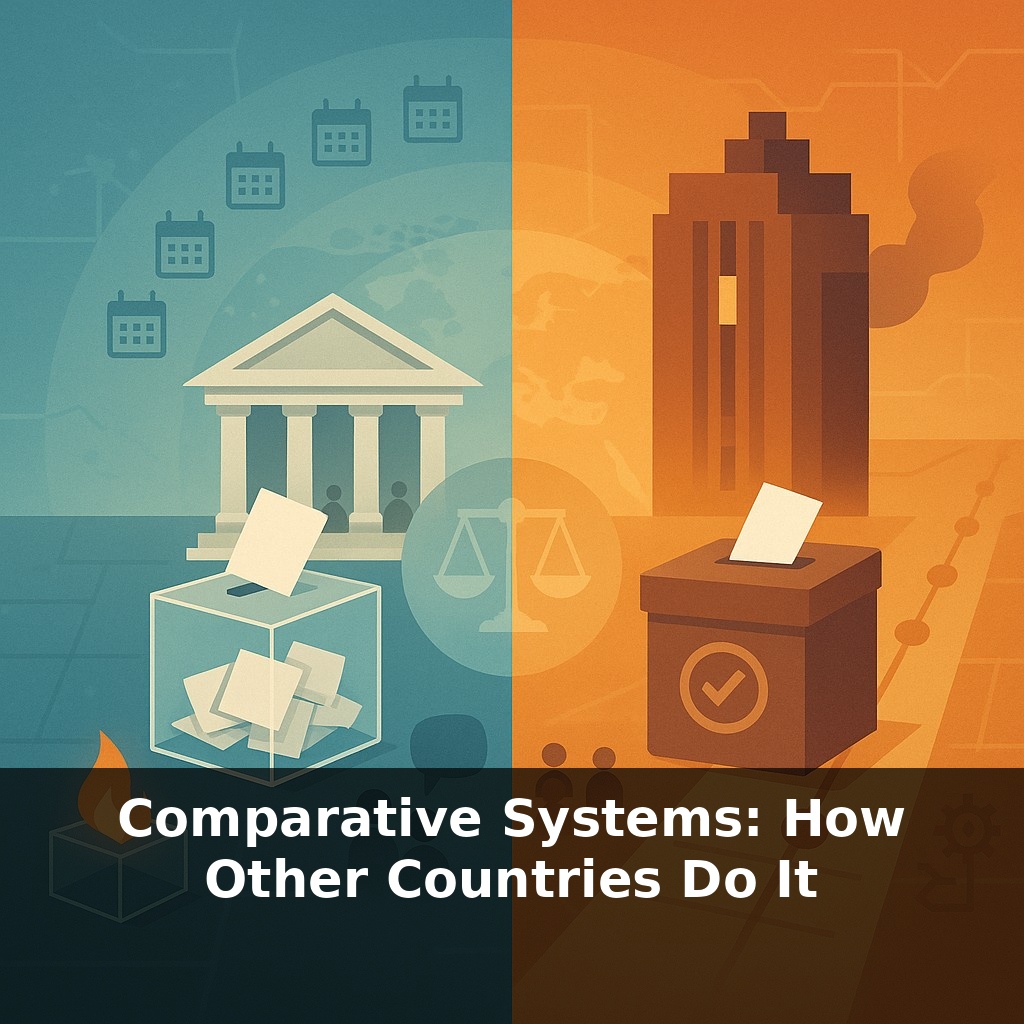
In one country, you can vote several times a year on national laws. In another, the ruling party can plan decades ahead without ever facing an election scare. Both claim they’re “efficient.” The real puzzle is this: how can such different systems all say they serve the people?
Here’s where it gets tricky: two countries can have similar elections and parliaments on paper, yet behave completely differently when things go wrong. One treats a corruption scandal like a kitchen fire—contained quickly, with clear rules about who grabs the extinguisher. Another lets the same spark smolder through layers of loyal appointees, friendly media, and vague laws until the whole house smells of smoke but no one is formally at fault.
So when we compare “how other countries do it,” the question isn’t just who votes or who decides. It’s: what actually happens when power is abused, when policies fail, or when the public stops trusting the story? To answer that, we have to look under the hood at three often invisible ingredients: how rules are enforced, how competent the machinery is, and how much people believe the system is fair.
Some countries try to fix these deeper issues by hard‑wiring safeguards into the basic design. Germany rewrote its post‑war constitution so emergency powers can’t quietly swallow normal politics. Switzerland lets people overturn laws at the ballot box several times a year, not as a protest, but as a routine correction tool. Singapore bets on highly trained, well‑paid officials to keep day‑to‑day decisions sharp. China leans on long, detailed economic plans that local bosses are judged against, like chefs graded on whether every dish leaves the kitchen on time and to spec.
In practice, you can sort modern systems by what they’re trying hardest to avoid.
Some parliamentary democracies are obsessed with avoiding deadlock. Germany, Sweden, and the Netherlands lean into coalition governments, not because they love compromise as a moral virtue, but because they’ve decided fractured societies are less dangerous when major factions are literally in the same cabinet. The trade‑off: slow bargaining, endless committee work, and policies that often look like stitched‑together quilts rather than clean designs. Yet those quilts can be durable, because several parties have reputations tied to keeping the deal alive.
Direct‑democracy hybrids like Switzerland and, in a lighter way, New Zealand, are trying to avoid a different problem: elite drift. They accept that elected politicians will sometimes move faster or further than the public wants. So they build in routine ways for ordinary voters to say, “No, not that,” without burning down the whole government. It doesn’t make politics gentler; it just channels conflict into scheduled, rule‑bound fights.
Technocratic semi‑authoritarian systems, such as Singapore’s, are organized around fear of chaos. Political competition is constrained, speech is managed at the edges, and in return the state promises high‑quality services, safety, and predictable growth. To keep that bargain credible, they pour effort into exams, performance reviews, and clean procurement. The risk isn’t daily dysfunction; it’s that when the top gets something big wrong, there are fewer safe ways to correct course.
Single‑party states like China focus most on avoiding fragmentation and loss of control. Elections don’t decide who rules, but internal party contests, promotions, and disciplinary bodies constantly shuffle the deck. Five‑year plans travel down the hierarchy as marching orders; local leaders are judged on hitting targets, not persuading voters. This can mobilize resources quickly—high‑speed rail, new industries—but it can also reward overstatement and risky bets, because nobody wants to be the cadre who admits a target was unrealistic.
Across all of these, the quiet variables doing most of the work are courts that actually bite, bureaucracies that know their craft, and publics that feel heard enough not to give up or blow up. Different countries assemble those pieces in very different ways, but the components repeat.
A quick way to see these differences is to watch how countries handle very specific, concrete problems.
Take housing. In places like Vienna, the city itself owns and manages large amounts of rental housing. The “rules” live not just in national law, but in long‑term contracts, municipal companies, and budgeting habits that survive changes in party control. In contrast, in the UK or US, central governments lean more on tax breaks and zoning nudges, so mayors and private developers do most of the real deciding. Same social goal—affordable homes—but the levers, and who pulls them, are completely different.
Or think about public health. During COVID‑19, Taiwan used a mix of digital tools, clear communication, and rapid legal tweaks to adjust course week by week, more like a chef constantly tasting and correcting a sauce. France often needed formal decrees and parliamentary debates to shift gears, so changes came in bigger, slower chunks, but with more overt contestation.
Only 600 characters to use, so let’s jump straight into the implications.
Global systems are quietly borrowing from one another. Digital tools let small groups steer big choices: a few thousand people on a platform can reframe a budget or climate plan the way a sharp spice can transform a stew. But the same tech also lets states track, nudge, or exclude at scale. The pressure point to watch isn’t just “democracy vs. autocracy,” but who designs these tools, who audits them, and who can say no.
So the real question becomes: which mix of tools would you actually want where you live? A cautious parliament for long‑term budgeting, a quick citizen veto for big local projects, a data‑savvy agency for crises. Systems aren’t one recipe; they’re closer to a shared kitchen where countries trade spices, test each other’s dishes, and quietly steal whatever works.
Before next week, ask yourself: 1) “If I had to ‘import’ just one feature from another country’s system we heard about—like Germany’s apprenticeship tracks, Singapore’s housing policies, or the Nordic childcare model—what would I pick, and how would it practically change my daily life or community if it existed here?” 2) “Looking at my own city or workplace, where do I already see hints of those better systems (for example, a local training program, a co-op housing project, or a universal pre-K pilot), and what’s one concrete way I could plug in—by attending a meeting, signing up, or talking to someone involved—this week?” 3) “When I catch myself saying ‘that would never work here,’ what specific barrier am I imagining (political, cultural, financial), and what’s one real-world example from the episode that proves at least part of that barrier can be overcome?”