Traders in New York, algorithms in Chicago, and a nervous retiree on her phone all help set the same stock price—down to the cent—at the same moment. If no one “decides” the price, yet everyone moves it, who’s actually in charge of what something is worth?
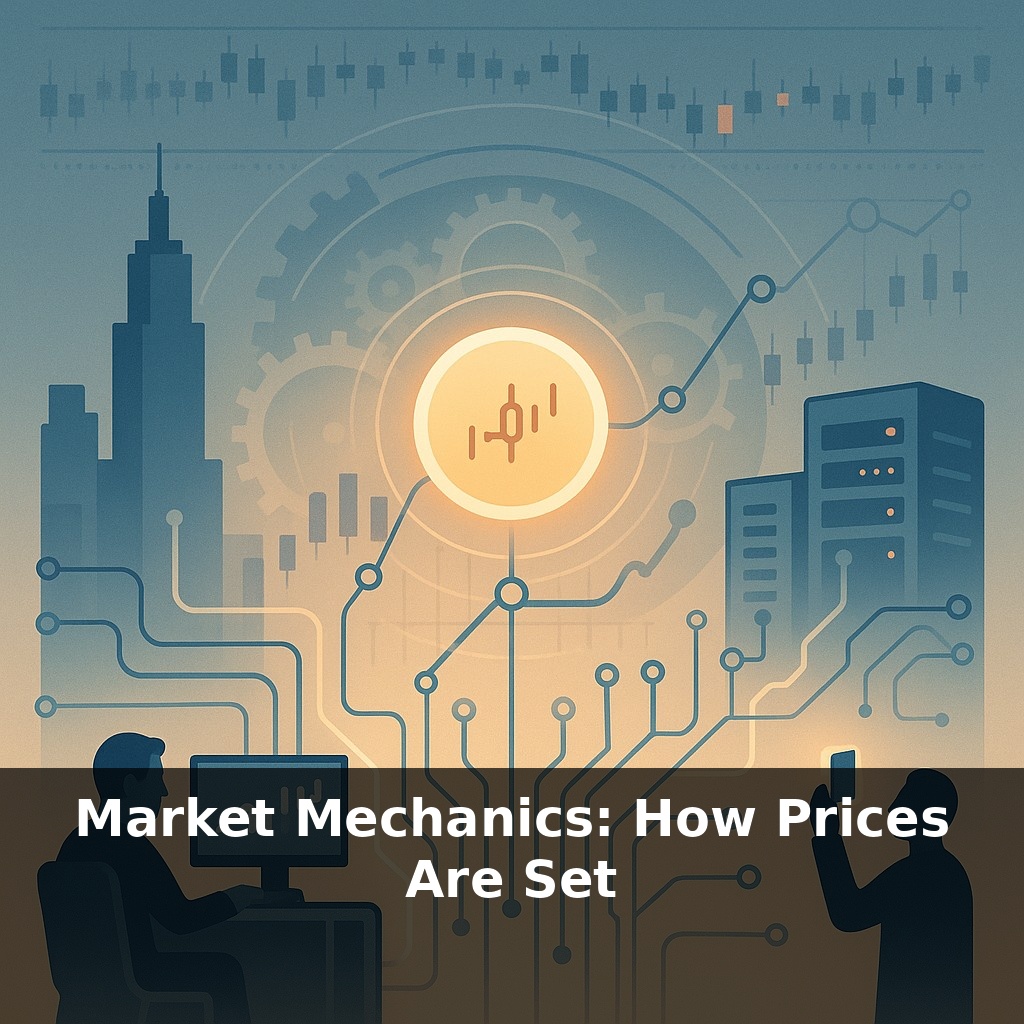
Roughly 80–85% of U.S. stock trades are now fired off by algorithms, not humans clicking “buy” or “sell.” Yet the price you see still looks like a single, simple number—as if the market quietly agreed on it. In reality, that number is the outcome of thousands of tiny negotiations happening every second inside electronic order books, where buy and sell orders line up and collide.
As new information hits—earnings surprises, economic data, a sudden spike in the VIX “fear gauge”—those lines of orders rearrange. Some traders race to pull orders, others rush to add new ones, and market makers step in to keep trading flowing, bound by rules that actually require them to quote prices a minimum share of the day.
In this episode, we’ll peek under that surface number to see how these micro-movements, rules, and algorithms create the prices you rely on.
On days when markets feel calm, that visible price barely twitches. Underneath, though, the pace of change can look more like a busy hospital than a quiet waiting room: triage on urgent news, constant monitoring, and automatic “protocols” that kick in when stress spikes. A shocking earnings miss, a sudden rate‑hike rumor, or a VIX jump above 30 can instantly reshuffle who’s desperate to trade and at what levels. At the same time, venue rules, circuit breakers, and smart order routing decide *where* those trades land—subtly shaping which voices speak loudest in the final price you see.
Most investors only ever see two numbers: the last traded price and maybe today’s high and low. Under the surface, there’s a *ladder* of prices people are quietly willing to trade at—but only if the market comes to them.
At any moment, there’s a *best* price buyers are willing to pay and a *best* price sellers are willing to accept. The gap between those two is the bid‑ask spread. Narrow spread? Lots of competition on both sides. Wide spread? More hesitation, less urgency, or simply fewer participants.
Now layer size on top of price. You might see a stock “at” $50, but that doesn’t tell you whether there are 200 shares available there or 200,000. A big investor who needs to move $50 million worth of stock cares less about today’s midpoint and more about how much *depth* exists at nearby prices before their own order starts pushing the market around.
This is where liquidity quietly dominates short‑term price behavior. When liquidity is plentiful, even large trades barely nudge prices. When it thins out—during a macro shock, a volatility spike, or right before a key data release—small trades can cause outsized jumps. The story stops being “new information changed value” and becomes “there weren’t enough willing counterparties at the old levels.”
Algorithms lean heavily on this structure. Many aren’t predicting the long‑term worth of a company; they’re sniffing out tiny, temporary imbalances. If buyers are slightly more aggressive than sellers across venues, or if one exchange shows a momentary lag, automated strategies will step in, buying in one place, selling in another, and pocketing the difference. In doing so, they help stitch together a single, coherent price across fragmented markets.
In stressed conditions, this stitching can fray. Liquidity providers widen spreads or briefly step back, circuit breakers pause the most extreme moves, and prices can gap rather than glide. Fundamentals still matter, but in those windows, *who needs to trade right now* can matter more than *what the asset is ultimately worth*.
On days when nothing obvious is happening, those silent shifts can still be dramatic. A single fund rebalancing at month‑end might quietly lean on prices across dozens of stocks for an hour, not because anything changed about the businesses, but because a portfolio rule says, “own 3% less of tech, 2% more of healthcare.” Or take the open and close: many pension funds and index trackers aim to transact there, so those few minutes often host a spike in volume and a flurry of short‑term price jostling that never shows up in the day’s headlines.
Think of it a bit like a weather system over a city: most of the time you just register “it’s sunny” or “it’s raining,” while above you, layers of air currents, pressure fronts, and humidity bands are interacting. A passing jet, a patch of warm ground, or a distant storm can all nudge the outcome locally without rewriting the climate. Markets, too, can be steered short‑term by flows and constraints that have little to do with long‑run value—yet still set the prices you trade at.
That hidden ladder of prices is quietly evolving. As more signals feed in—from ESG metrics to real‑time mood scans of social feeds—quotes may start reflecting not just cash flows, but reputation and carbon output. AI models could mix all this the way a chef layers flavors, making prices react to subtler “ingredients.” For long‑term investors, that may mean sharper intraday swings, but also more nuanced clues about what the crowd truly cares about.
So when you glance at a quote, you’re really seeing the surface of a living system that reacts like a stove dial: twist the heat with fresh data, policy shifts, or even social trends, and prices simmer, boil, or cool. Your edge isn’t outguessing every flicker; it’s knowing when to respect the heat, when to ignore the sizzle, and how it all fits your own recipe.
Before next week, ask yourself: Where in my own business or budget do I see prices that clearly reflect supply and demand shifts (like surge pricing, seasonal discounts, or “intro” offers), and what does that reveal about my real priorities as a buyer or seller? Looking at one product or service I use often, what hidden forces the episode mentioned—like market power, information gaps, or psychological pricing—might be shaping the price I accept without questioning it? If I had to renegotiate or reset the price of one thing today (a freelance rate, a subscription, or a product I sell), how would I justify that new price using the market mechanics from the episode instead of just “what feels fair”?