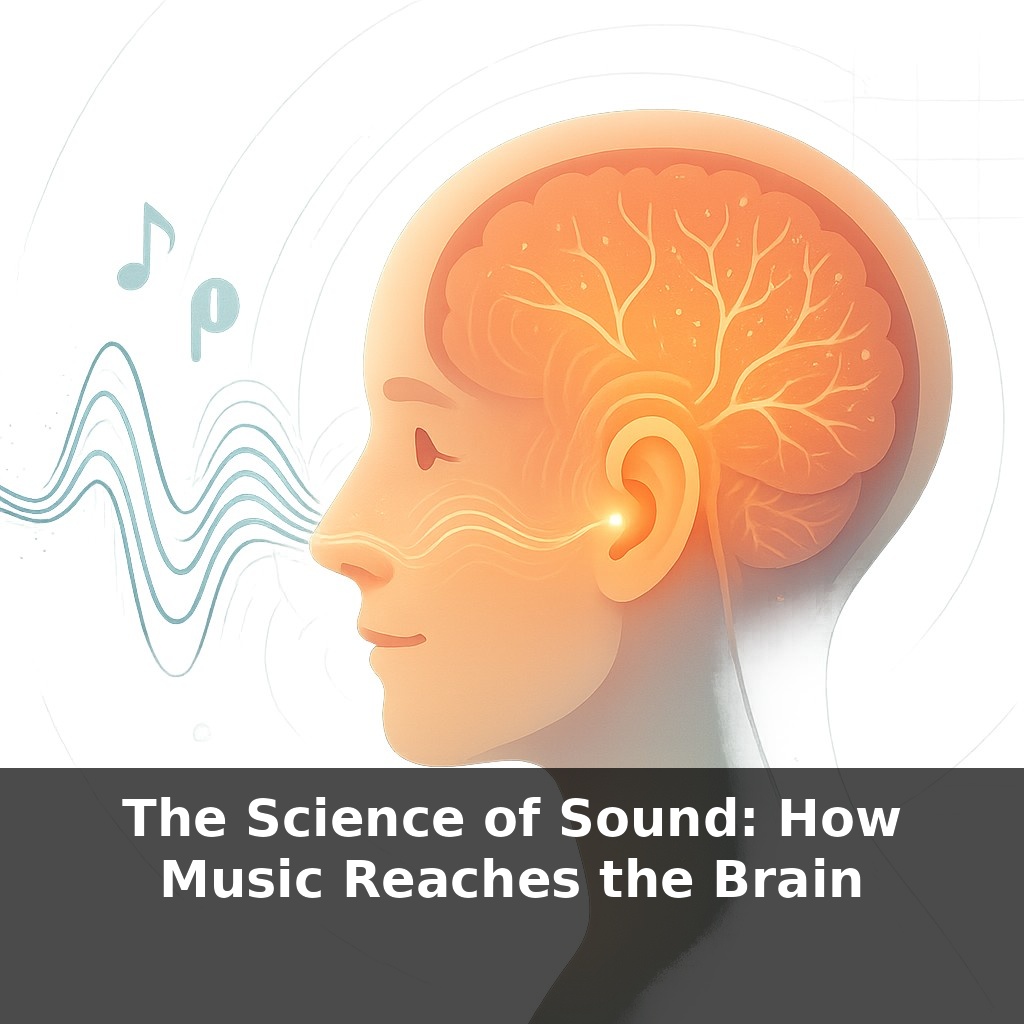
The Science of Sound: How Music Reaches the Brain
📝 Transcript
Your brain can detect the wobble of a sound smaller than an atom of gold, yet it turns that ghost‑tiny motion into tears, goosebumps, or a dance move in your kitchen. In the next few minutes, we’ll step inside that journey from silent vibration to felt emotion.
That sensitivity isn’t just a party trick of biology—it’s the entry ticket for music to hijack your nervous system. By the time a song “arrives” in your awareness, it has already been sliced into frequencies, tagged with timing markers, and cross‑checked against a lifetime of listening. Your auditory system is less like a passive microphone and more like a panel of ruthless music critics, deciding in milliseconds what’s meaningful and what’s noise.
This episode zooms in on that decision‑making. Why do drums feel so physical, while a violin line can feel almost like language? How does your brain separate a singer’s voice from the crowd behind them, or latch onto a bass line in a messy mix? We’ll follow the trail from eardrum to cortex, and then into the circuits that predict, reward, and sometimes overload—showing how “just sound” becomes structure, expectation, and emotion.
Your hearing range may span 20 to 20,000 Hz, but your brain doesn’t treat all those frequencies as equals. Most of the musical action sits in a tighter band—roughly 60 to 5,000 Hz—where speech, melody, and rhythm overlap. Within that window, tiny shifts matter: hair‑cell tips in the cochlea move less than a billionth of a meter to flag a note as “on pitch,” and auditory nerve fibers fire up to 1,000 times a second to preserve timing fine enough to locate a snapping finger in the dark. That raw precision becomes the canvas on which harmony, groove, and emotional “color” are painted.
By the time a song reaches your inner ear, the physics part is mostly over; from here on, it’s information processing. The cochlea doesn’t just “hear a note.” Different sections along its spiral respond best to different frequencies, so a chord from a piano becomes a pattern of activation spread along that curve: low notes near the apex, high notes near the base. That pattern is turned into spikes in thousands of auditory nerve fibers, each tuned to a narrow frequency band and precise timing.
Those spikes don’t travel as a single stream. Parallel pathways pull out different “features” of the music. Some circuits care mostly about pitch regularity—helping you lock onto the key of a song or recognize that a singer has gone slightly sharp. Others specialize in onset and offset, exaggerating the edges of sounds so you hear a snare hit as crisp and separate from the reverb tail behind it. Yet another set emphasizes changes, like a sudden filter sweep in electronic music, so your attention jumps to what’s new.
In the brainstem and midbrain, timing becomes a superpower. Neurons compare left and right ear input on the scale of microseconds, giving you a 3D sketch of where sounds sit in space. That’s how a live recording can feel “wide,” with the crowd, guitar, and hi‑hat occupying distinct locations in your head. These early stations also adapt dynamically: if the background is loud and continuous, they down‑weight it and highlight transient details, which is one reason you can still follow a melody in traffic noise.
When signals hit auditory cortex, the representation shifts from “what frequency, what time” to “what pattern, what category.” Pop hooks that reuse common interval shapes are easier for these neurons to group and store. Rhythmic patterns that align closely with your brain’s preferred tempos—roughly in the range of a relaxed walking pace up to a fast jog—are more likely to entrain motor areas, recruiting foot taps and head nods before you consciously “decide” to move.
Higher still, networks that usually decode speech rhythm and prosody help disentangle vocal phrasing, while regions involved in memory and prediction track the structure of verses, choruses, and drops. The emotional contour of a track—slow build, delayed beat‑drop, abrupt harmonic shift—maps onto circuits that modulate dopamine in the striatum, which is why a perfectly timed modulation or bass entry can feel physically rewarding.
When you get “lost” in a track, what’s happening upstairs looks less like a single light switching on and more like a skyline lighting up district by district. One cluster of areas tracks the groove almost like a metronome with a personality; another quietly compares what you’re hearing to your history with similar songs. This is why a four‑chord pop progression can feel comfortably predictable, while a jazz reharmonization might feel tense until your brain learns its logic.
Think of a playlist like a set of travel itineraries for your neural circuits: a sparse piano ballad takes a scenic local route through memory and imagery networks, whereas a dense EDM drop slams the express lanes between timing, reward, and motor regions. Live concerts add yet another detour—crowd noise and shared movement recruit social brain systems, which can amplify chills even when the song is one you’d ignore on headphones. Over time, repeated “routes” get faster and smoother, which is why your favorite genre feels like coming home and a new one can feel like jet lag.
A future where music reaches your brain without ears isn’t sci‑fi anymore—it’s a roadmap. As implants grow subtler and BCIs skip straight to cortex, “volume” could mean how intensely patterns light up your networks, not how loud speakers are. Your playlists might double as prescriptions: one track list tuned for pain flare‑ups, another for focus, another for sleep, each updated like a stock portfolio as your neural data shifts over days, months, or even moods.
Your challenge this week: treat your listening habits as a personal experiment in “neural tuning.” Pick three everyday moments—waking up, working, and winding down. For each, choose one song that reliably helps you and one that seems to clash with the moment. All week, swap between the “fit” and “clash” tracks and briefly note how your body and focus respond right then: tension, ease, distraction, clarity. By the weekend, you’ll have a rough, real‑world map of how different sound patterns nudge your own brain state.
The next twist: your brain’s sound maps aren’t fixed décor, they’re under renovation every time you replay a favorite track. Like a city adding bike lanes where people already ride, practice and habit carve smoother paths for certain rhythms and harmonies. That means playlists aren’t just mirrors of your mood—they’re quiet tools for reshaping it.
Start with this tiny habit: When you press play on any song today, quietly name one instrument you hear out loud (like “I hear the bass” or “That’s the hi-hat”). Then, take one slow, deep breath while you listen just to that sound for 5 seconds. That’s it—no journals, no timers, just a 5-second “sound zoom-in” to train your brain to notice how music is built. Over time, you’ll start hearing layers in every track without even trying.
From this course

How Music Tricks Your Brain: The Psychology of Sound
7 episodesUnlock all episodes
Full access to 7 episodes and everything on OwlUp.
Subscribe — $1.99/monthLess than a coffee ☕ · Cancel anytime